AI-Driven Merchandise Financial Planning (MFP) Software for Enterprises


UNLOCKING BILLIONS IN VALUE FOR CLIENTS IN 30+ INDUSTRIES
Turn financial targets into executable merchandising decisions
Merchandise Financial Planning is the strategic backbone of retail, defining how sales, margin, inventory, and receipts should evolve over time. Yet in many organizations, MFP remains disconnected from the decisions it is meant to guide. Financial targets are set at aggregate levels, while execution happens elsewhere—leaving planners to reconcile gaps manually and react late when performance deviates.
o9 Merchandise Financial Planning reconnects strategy and execution by embedding financial planning directly into the merchandising ecosystem. Built on a single data model, the solution ensures that financial targets are not abstract goals but active constraints that shape assortment, item planning, and inventory decisions. As the business changes, plans stay synchronized—pre-season and in-season—without relying on offline workarounds.
This shift transforms MFP from a static budgeting exercise into a continuous steering capability. Leaders gain confidence that financial intent is reflected in day-to-day decisions, while planners gain the flexibility to adapt quickly without losing alignment.
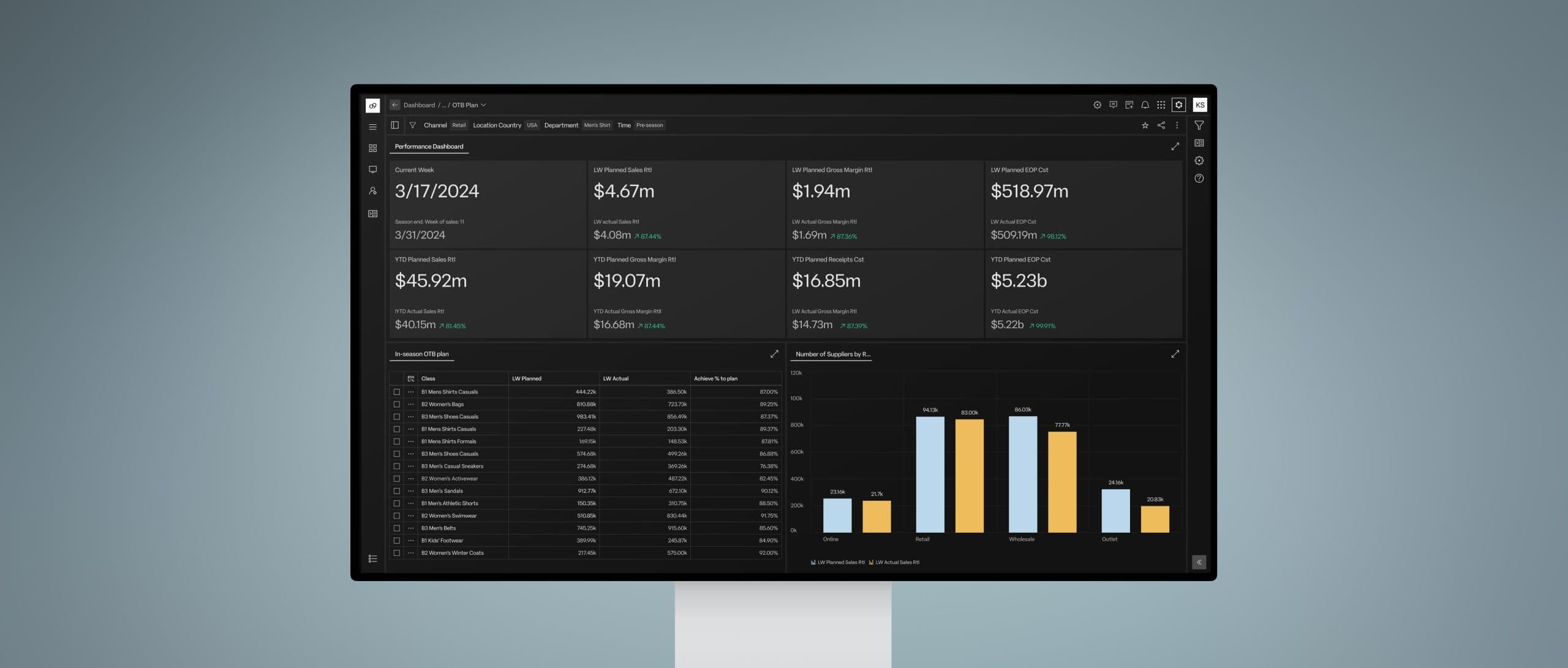

When finance and merchandising drift apart
The core challenge in MFP is not lack of intent, but lack of integration. Finance, merchandising, and supply chain teams often operate with different assumptions, cadences, and KPIs. By the time numbers are consolidated for review, market conditions have already shifted. Conversations focus on reconciling variances instead of deciding how to respond.
Legacy tools reinforce this fragmentation. Rigid planning models struggle to support omnichannel complexity, multiple calendars, or global operations. In-season reforecasting becomes slow and painful, forcing teams to choose between accuracy and speed. As volatility increases, this lag translates directly into margin erosion and excess inventory.
Modern retailers need MFP systems that can move as fast as the business itself—updating targets, recalculating OTB, and revealing trade-offs in near real time.
From static budgets to continuous financial steering
Leading organizations are redefining MFP as a living financial model that evolves with performance. Instead of locking plans at the start of the season, they continuously reforecast based on actuals and emerging signals. This allows teams to protect margin early, redirect investment toward winners, and manage inventory risk proactively.
o9 enables this evolution by linking financial plans directly to operational levers. When sales assumptions change, the impact on inventory, receipts, and margin is visible immediately. This creates a shared understanding across finance and merchandising and enables faster, more confident decisions.
What Makes o9 Different
Industries Supported

































Powered by the o9 Digital Brain
MFP in o9 runs on the same Enterprise Knowledge Graph that powers merchandising and supply planning. This ensures that financial metrics are directly linked to products, channels, and operational decisions rather than managed in isolation. Calendars and currencies are handled natively, supporting global consolidation without manual translation.
The platform’s performance allows teams to re-forecast entire seasons on demand, enabling scenario-based decision-making without long processing times. Workflow and collaboration features ensure accountability and transparency across planning cycles.

Modular by design, enterprise by default
The o9 Merchandise Financial Planning solution is built on a unified financial and operational data model that connects strategic targets directly to merchandising execution. Rather than functioning as a standalone budgeting layer, MFP operates as a continuously updated financial control system that remains synchronized with assortment, item planning, and inventory decisions.
The architecture is designed to break down the traditional separation between finance and merchandising. Financial targets are not static outputs; they actively constrain and guide operational plans. As execution realities change, the financial view updates automatically, enabling leadership teams to manage performance dynamically rather than through periodic reconciliation cycles.
This architecture supports enterprise-scale complexity, including omnichannel operations, multiple planning calendars, global currencies, and varying levels of planning granularity. It ensures that all stakeholders—from executives to planners—operate from a consistent and explainable financial model.
Core Building Blocks
Advanced Building Blocks

A digital operating model for VUCA conditions
APEX is o9’s AI-powered operating model for enterprises navigating volatility, uncertainty, complexity, and ambiguity (VUCA). It enables organizations to plan, execute, and learn as one connected system.

The o9 Digital Brain powers APEX by connecting enterprise data, knowledge, and decisions through a single intelligent model.
Collaborative Demand Planning is one of the building blocks of the Digital Brain. It contributes domain-specific capabilities into the enterprise-wide model that enables APEX from the ground up—linking this solution to decisions across the entire value chain.
→ Learn how the APEX Operating Model works
Where AI drives real decisions
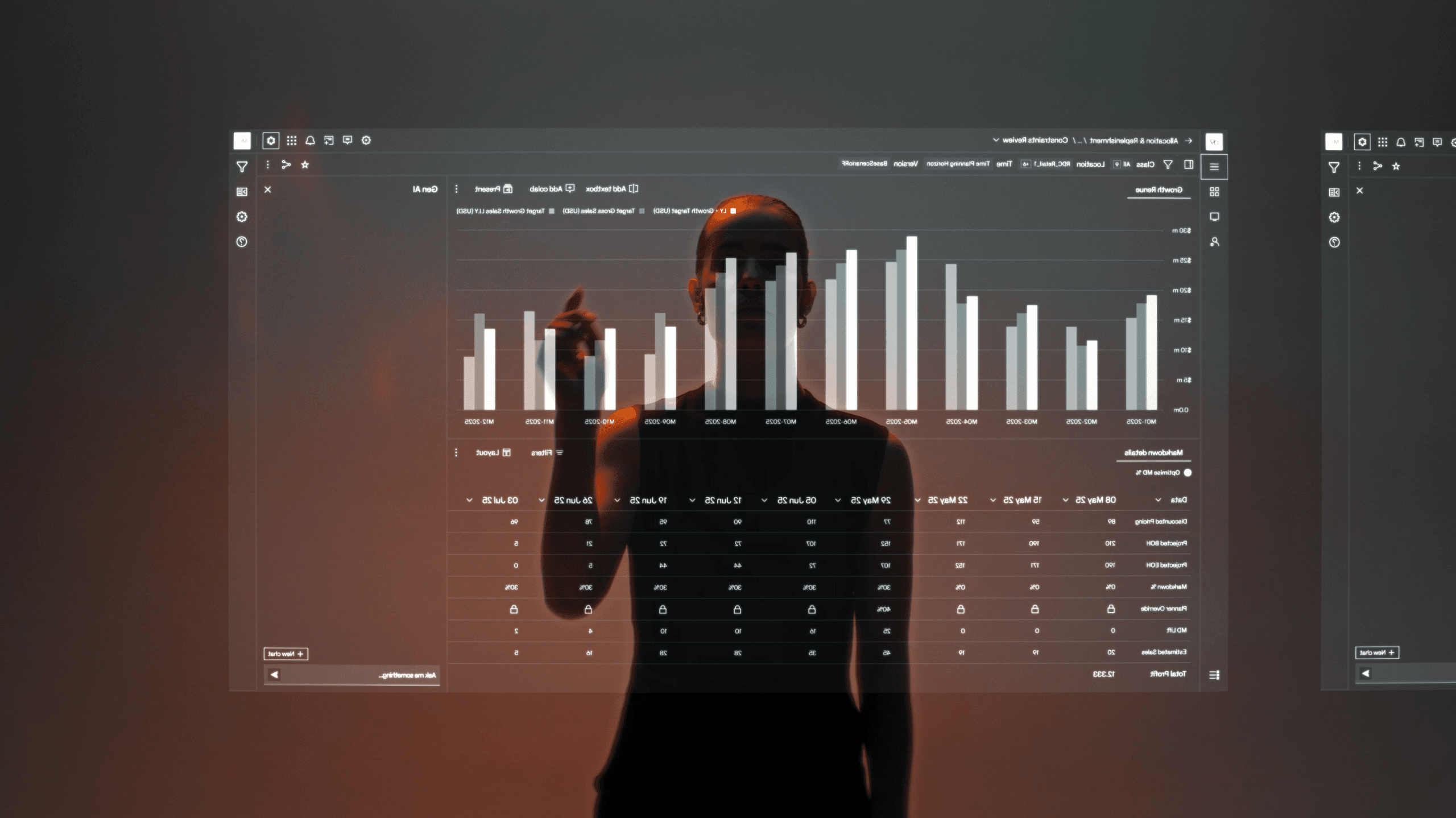
AI enhances Merchandise Financial Planning by transforming financial control from reactive reconciliation into proactive financial steering.
Machine learning models generate intelligent baseline financial plans by analyzing historical performance, trend shifts, and growth drivers, improving accuracy over manual “last year plus” approaches.
Prescriptive analytics evaluate financial trade-offs across pricing, markdown, and receipt scenarios, quantifying impact on margin, inventory, and cash before decisions are committed.
Generative AI enables finance and merchandising leaders to interact with financial plans using natural language, while agentic AI automates variance analysis, scenario comparisons, and early warning alerts for financial risk.
→ Learn more about o9 AI innovations

What our customers say


Related solutions

Digital IBP
At its core, IBP is designed to translate strategic intent into coordinated, financially sound actions across the enterprise. Yet in many organizations, IBP has devolved into a monthly cadence of spreadsheet reconciliation, slide preparation, and functional compromise—producing alignment in theory, but limited impact in practice.
Sales & Operations Planning (S&OP)
Connect strategic planning with day-to-day execution — without breaking alignment or financial control.

Supplier Collaboration
Move from transactional sourcing to continuous, multi-tier orchestration across your supplier network.



Frequently Asked Questions (FAQ)
MFP defines sales, margin, inventory, and receipt targets and ensures they remain aligned with execution decisions.