
/

/

Assortment Planning

Assortment Planning

Localize assortment without losing financial control

Assortment planning sits at the intersection of creativity, customer understanding, and financial discipline. It defines what customers see, choose, and ultimately buy. Yet for many retailers, assortment decisions are still driven by intuition, static templates, and broad assumptions about store similarity. As channels proliferate and customer expectations fragment, the traditional “one-size-fits-all” assortment has become not just inefficient, but actively harmful to performance.

o9 Assortment Planning enables retailers to design assortments that reflect how customers actually shop—by location, channel, and need—while remaining tightly aligned to financial targets and inventory constraints. Built on the o9 Digital Brain, the solution connects assortment strategy directly to Merchandise Financial Planning, space constraints, and downstream execution. This ensures that localization does not come at the expense of margin, inventory productivity, or operational feasibility.

Rather than treating assortment as a static pre-season exercise, o9 supports continuous refinement across seasons and in-season windows. Teams can adapt assortments as demand signals evolve, manage carryover decisions with confidence, and introduce new products with greater precision. The result is a more responsive assortment that improves sell-through, reduces distortion, and strengthens customer loyalty—without increasing complexity for planners.

Business challenges retailers face

Retailers collectively lose hundreds of billions annually due to inventory distortion—overstocks where demand is weak and stock-outs where demand is strong. A major contributor is assortment decisions that fail to reflect regional preferences, store formats, and customer demographics. When assortments are defined too broadly, high-performing stores miss opportunity while low-performing items consume space and working capital.

The challenge is compounded by operational reality. Shelf space is finite. Store formats vary widely. Omnichannel fulfillment blurs the boundary between physical and digital assortments. At the same time, financial targets for sales, margin, and inventory are set at higher levels and often disconnected from the detailed product choices that ultimately drive performance. This disconnect forces planners to compromise late in the process—often through markdowns or forced substitutions.

Assortment planning also becomes harder as product lifecycles shorten. New product introductions carry higher uncertainty, while carryover decisions require careful balance between continuity and freshness. Without a system that connects historical performance, customer behavior, and financial constraints, assortment decisions remain reactive and difficult to scale.

From intuition-led to demand-driven assortment strategy

Leading retailers are redefining assortment planning as a data-informed, financially governed capability rather than an art practiced in isolation. Creativity still matters—but it is supported by analytics that reveal where localization creates value and where standardization protects margin.

o9 enables this shift by embedding assortment decisions within a connected planning framework. Store clustering reflects demand behavior rather than geography alone. Option counts are reconciled with space and financial limits. New products are evaluated using attribute-based intelligence rather than guesswork. This allows teams to localize where it matters most, while maintaining enterprise-wide coherence and control.

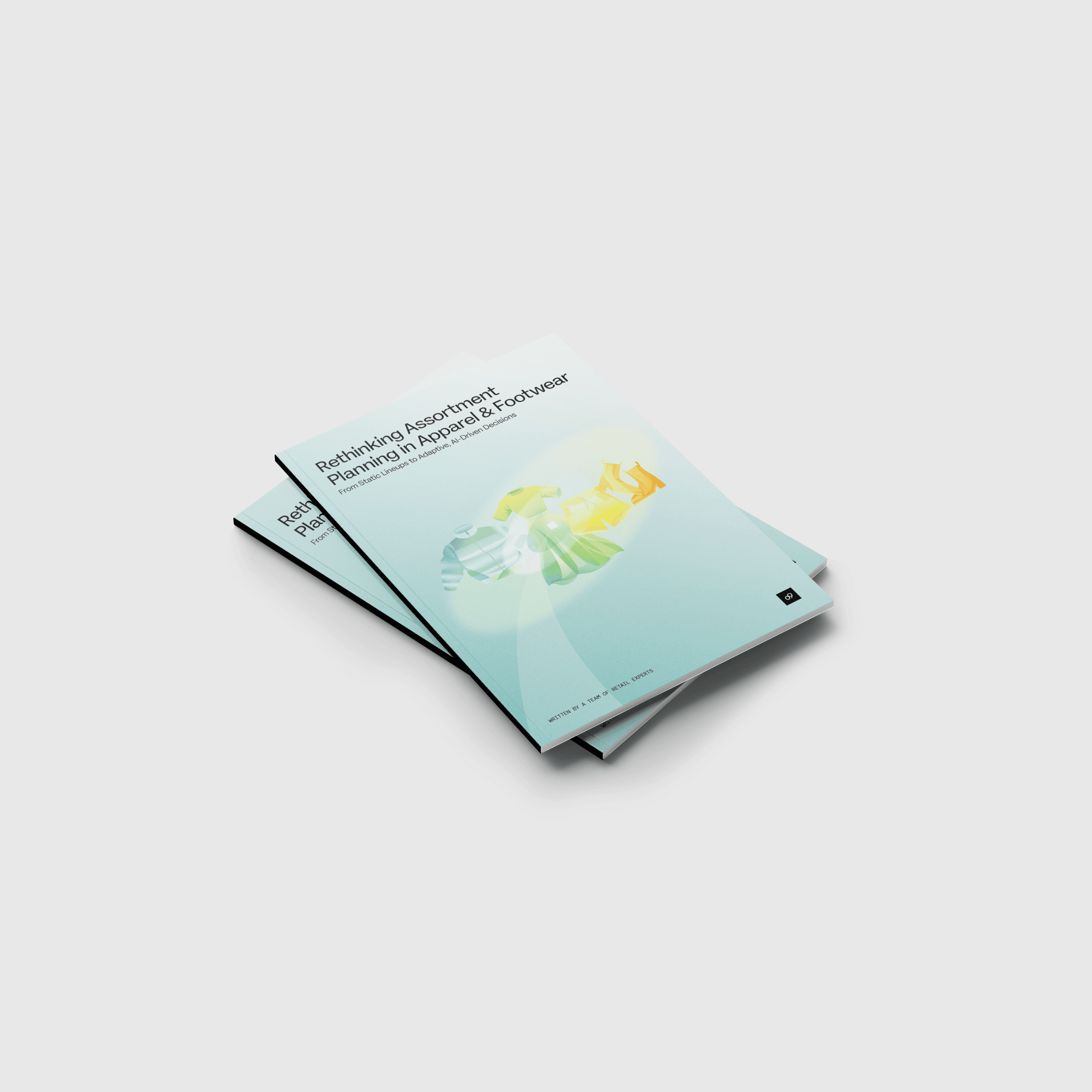
o9 whitepaper assortment planning mockup

Mastering the Art and Science of Assortment Planning

Learn how to leverage next-gen platforms for assortment planning across multiple sales channels and geographies in our free eBook.

KEY DIFFERENTIATORS

What Makes o9 Different

  • Demand-Driven Store Clustering and Localization

    o9 Assortment Planning enables retailers to localize assortments using demand-driven store clustering rather than static geographic or volume-based groupings. Stores are grouped based on performance patterns, customer demographics, climate, and format attributes, ensuring assortments reflect how customers actually shop while remaining scalable to manage.

  • Financially Governed Assortment Decisions

    Assortment decisions are natively connected to Merchandise Financial Planning and Open-to-Buy constraints. As options are added, removed, or carried forward, their impact on sales, margin, and inventory is reflected immediately. This ensures that assortment localization and choice expansion remain aligned with enterprise profitability targets.

  • Visual, System-Driven Assortment Reviews

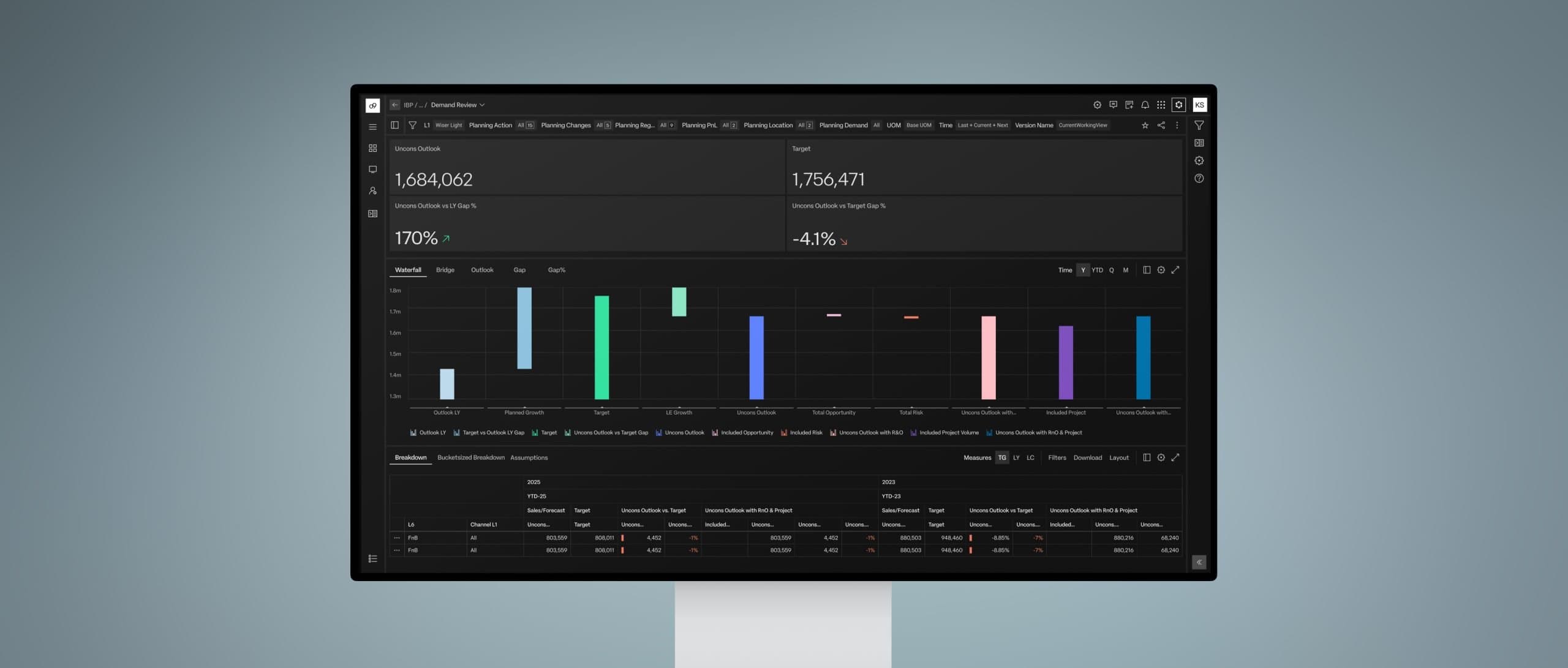
    Assortment reviews are conducted directly within the platform using image-enabled, real-time planning workspaces. Merchants can evaluate product mixes visually, test alternative option strategies, and align on decisions without relying on static spreadsheets or disconnected presentations.

  • Lifecycle-Aware and Space-Constrained Planning

    Assortments are planned with full awareness of product lifecycles and physical space constraints. Multi-season logic supports carryover and overlap across seasons, while space-aware validation ensures option counts are feasible for store formats and fixture capacities—reducing late-stage assortment cuts and execution issues.

Industries

Industries Supported

PLATFORM FOUNDATION

Powered by the o9 Digital Brain

Assortment Planning is built on the o9 Digital Brain and its Enterprise Knowledge Graph, which connects product attributes, customer signals, financial targets, and operational constraints into a single model. This shared foundation eliminates the fragmentation that typically exists between merchandising, finance, and supply chain systems.

The graph-based architecture allows assortments to be analyzed at any level of detail—from enterprise-wide strategies to SKU-store combinations—without rebuilding models or exporting data. As assortment decisions change, their implications for financial plans and inventory flows are visible immediately. This ensures that creative decisions remain grounded in operational and financial reality.

The cloud-native platform is designed to scale across large product catalogs and store networks, enabling planners to work at high granularity without sacrificing performance. Collaboration is built into the experience, allowing teams to comment, align, and resolve trade-offs directly in the plan rather than offline.

The o9 Digital Brain

The digital brain is powered by our patented Enterprise Knowledge Graph (EKG)

SOLUTION ARCHITECTURE

Modular by design, enterprise by default

The o9 Assortment Planning solution is built on a flexible, graph-based data model that integrates financial targets, product attributes, store characteristics, and space constraints into a single planning environment. Rather than treating assortment decisions as an isolated merchandising exercise, the architecture ensures that every ranging decision is continuously evaluated against profitability goals, inventory limits, and execution feasibility.

This architecture allows retailers to design assortments at the level where customer demand actually varies—by store cluster, channel, and lifecycle stage—while maintaining centralized financial governance. Assortment plans are never static snapshots. They are living structures that remain synchronized with Merchandise Financial Planning, Open-to-Buy, and downstream supply chain execution as assumptions change.

At its core, the architecture supports both strategic assortment intent (category roles, breadth vs. depth) and operational execution (option counts, space constraints, lifecycle rules), enabling retailers to localize assortments at scale without introducing fragmentation or manual reconciliation.

Core Building Blocks

  • Store Clustering


    The solution enables planners to group stores into clusters based on a combination of performance metrics—such as sales volume, margin contribution, and sell-through—and structural attributes including store format, size, and location type. This clustering capability allows retailers to manage assortment granularity efficiently, avoiding the extremes of one-size-fits-all assortments or fully individualized store planning.

  • Assortment Strategy & Rationalization

    Assortment strategy tools allow merchants to define category-level intent, including the desired balance between breadth and depth, innovation versus core, and private label versus national brands. Historical performance analysis supports rationalization decisions by identifying which products should be listed, delisted, or carried over into future seasons based on their true contribution to category performance rather than isolated item metrics.

  • Visual Planning & Workspace

    An image-enabled, interactive workspace allows planners to view assortments visually while managing large-scale option creation. Placeholders can be defined in bulk and automatically expanded into style-color combinations aligned with option strategies. This bridges analytical planning with merchant intuition, enabling faster iteration without sacrificing control or consistency.

  • Reconciliation with Financial Targets

    Assortment plans are natively integrated with Merchandise Financial Planning and Open-to-Buy. As options are added or removed, the system continuously reconciles assortment decisions against top-down financial targets and inventory constraints. Variances are surfaced immediately, allowing planners to resolve gaps early rather than late in the season.

Advanced Building Blocks

  • AI-Driven Clustering


    Advanced machine learning algorithms, such as K-Means clustering, enhance store grouping by incorporating external demand drivers including demographics, climate, and lifestyle indicators. This creates dynamic, demand-centric clusters that evolve as customer behavior changes, replacing static geographic or volume-based groupings.

  • Space-Aware Optimization


    Space optimization capabilities validate assortments against physical store constraints such as shelf capacity, fixture limits, and visual merchandising rules. Features like Space Options Reconciliation ensure that planned option counts are executable at the store-cluster level, reducing last-minute assortment cuts and execution failures.

  • Multi-Season Planning

    The architecture supports overlapping product lifecycles across seasons, enabling differentiated start and end rules for carryover items, seasonless basics, and short-life fashion products. This prevents data conflicts and ensures continuity in planning as assortments evolve across time horizons.

  • Auto-Assortment & AI Recommendations

    AI-driven recommendation engines prescribe optimal assortments by matching product attributes to store cluster demand profiles. For new product introductions, the system predicts performance using “like-item” modeling, allowing planners to assess risk and opportunity even when no direct sales history exists.

Take a tour

See how the o9 Digital Brain unifies planning, forecasting, and execution through AI-driven intelligence.

APEX OPERATING MODEL

A digital operating model for VUCA conditions

APEX is o9’s AI-powered operating model for enterprises navigating volatility, uncertainty, complexity, and ambiguity (VUCA). It enables organizations to plan, execute, and learn as one connected system.

The o9 Digital Brain powers APEX by connecting enterprise data, knowledge, and decisions through a single intelligent model.

Collaborative Demand Planning is one of the building blocks of the Digital Brain. It contributes domain-specific capabilities into the enterprise-wide model that enables APEX from the ground up—linking this solution to decisions across the entire value chain.

Learn how the APEX Operating Model works

AI-POWERED INTELLIGENCE

Where AI drives real decisions

AI enhances Assortment Planning by enabling scalable localization without increasing planning complexity.

Machine learning models analyze historical sales, customer behavior, and external signals to identify demand patterns and continuously refine store clusters beyond static geographic or volume-based groupings.

Prescriptive analytics recommend optimal assortments by evaluating product attributes, substitution behavior, and financial contribution, helping merchants decide which items to list, delist, or carry forward.

Generative AI supports natural-language exploration of assortment performance and option strategies, while agentic AI automates cluster updates, assortment recommendations, and lifecycle monitoring across seasons.

Learn more about o9 AI innovations

What our customers say

Canyon Bicycles

"We made the conscious decision with o9 to bring a quicker ROI by integrating with our legacy SAP. [...] When the full ERP transformation happens, we’re ahead of the game."

Paul Tips

Product Owner at Canyon Bicycles

Anheuser-Busch InBev

"What's really succeeding with us is the idea of the connection to the data and a best-in-class UX/UI, so the people that use the business can really make an impact."

David Almeida

Chief Strategy & Technology Officer at Anheuser-Busch InBev

Amway

"With o9 AI/ML-based forecasting in place, we’re already seeing improved forecast accuracy, stronger cross-functional collaboration, and faster, more informed decision-making—all within a centralized platform."

Gaby Gutierrez

VP of Global Supply Chain Planning at Amway

Take a tour

See how the o9 Digital Brain unifies planning, forecasting, and execution through AI-driven intelligence.

Frequently Asked Questions (FAQ)

Assortment planning defines which products are offered in which locations and channels, balancing customer relevance, space constraints, and financial targets.