The APEX Decisioning Model: Agile, Adaptive, Autonomous
The o9 APEX Decisioning Model helps enterprises make better business decisions while continuously improving how those decisions are made. Built for today’s volatile business environment, APEX connects intelligence, people, processes, and AI so organizations can respond faster to change, learn from outcomes, and progressively increase automation.
VUCA creates tens of thousands of situations—and millions of questions
Complexity + volatility overwhelm people-driven processes
As business-model complexity increases (SKUs, channels, regions, supply networks), traditional operating models struggle with:
- Functional silos and loosely coupled processes
- Long decision latencies
- Limited learning from outcomes
The result is underperformance to plan, excess inventory, margin erosion, and missed growth opportunities—even in well-run organizations.
What Is the APEX Decisioning Model?
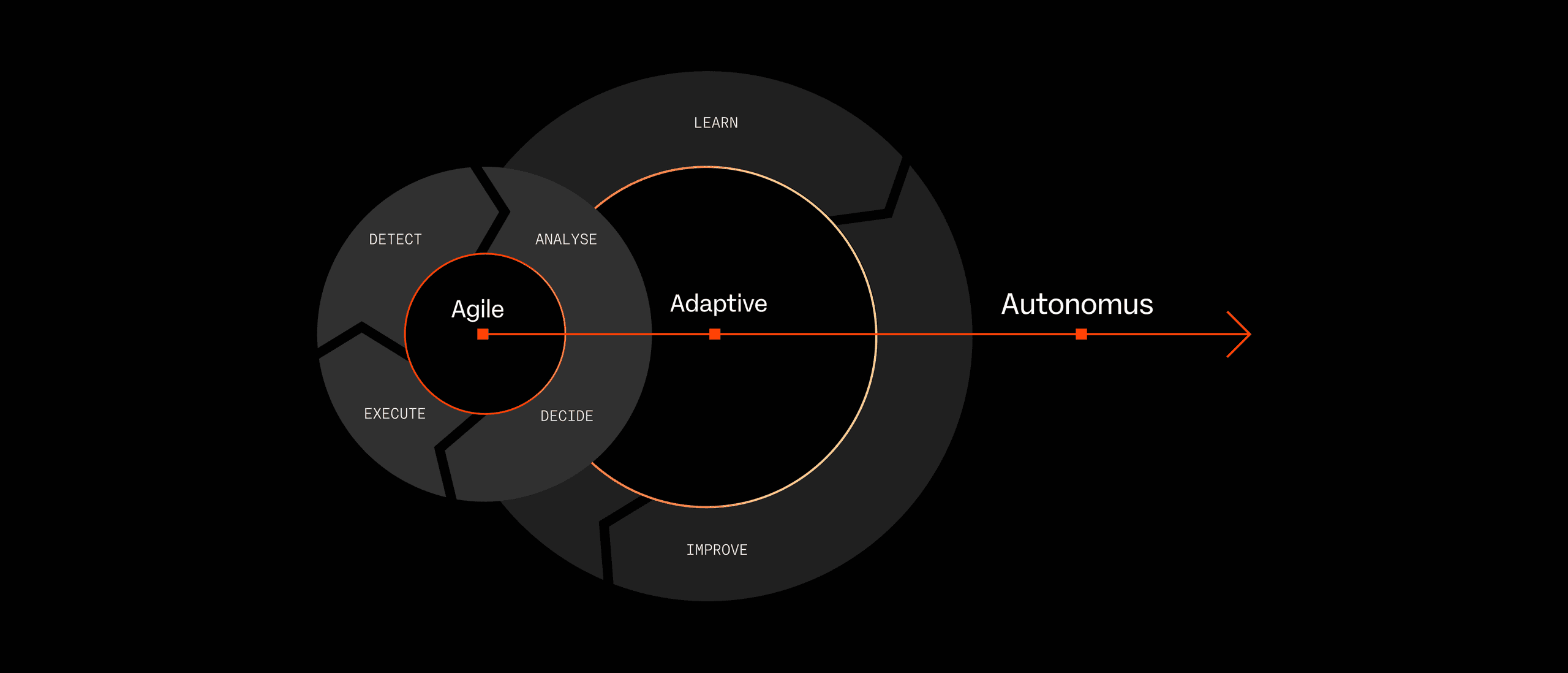
Agile. Adaptive. Autonomous.
APEX brings together three complementary approaches to enterprise decisioning. Agile Decisioning helps organizations make better business decisions. Adaptive Decisioning helps them continuously improve how those decisions are made. Autonomous Decisioning uses AI to progressively take on more of the work across both.
1. Agile Decisioning
Detect → Analyze → Decide → Execute
WHAT IT MEANS
Agile Decisioning helps enterprises make faster, better day-to-day business decisions by detecting changing conditions, analyzing their impact and possible responses, deciding what action to take, and executing that action across the business.
By connecting decisions across commercial, product, supply chain, finance, and other functions, organizations can evaluate trade-offs, coordinate responses, and act while those decisions can still make a difference.
RESULT
Faster, coordinated responses to volatility with fewer handoffs, less lag, and better outcomes.
2. Adaptive Decisioning
Learn → Improve
WHAT IT MEANS
Adaptive Decisioning helps enterprises continuously improve how decisions are made. By learning from previous decisions and their outcomes, organizations can identify what worked, what didn’t, and what needs to change in their processes, policies, data, models, and ways of working.
Capabilities such as Post-Game Analysis help organizations understand why actual results differed from expectations and where business value was lost. These insights can then be used to improve the processes, policies, and models that guide future decisions.
RESULT
Continuous improvement replaces episodic reviews and one‑off transformations.
3. Autonomous
Progressively increase AI-led decisioning
WHAT IT MEANS
Autonomous Decisioning uses AI agents to take on more of the work involved in making business decisions and improving how those decisions are made. Depending on the decision, AI can assist people, recommend actions for approval, or make and execute decisions automatically within defined boundaries.
AI can support both day-to-day business decisions and the continuous improvement of how those decisions are made. Routine, repeatable decisions can become increasingly automated, while more complex or strategic decisions continue to benefit from human judgment and oversight.
o9’s Neuro-Symbolic AI helps ground these capabilities in enterprise knowledge, business rules, and constraints so organizations can increase automation while maintaining control and accountability.
RESULT
Higher decision velocity and productivity without sacrificing trust or accountability.
Delivering Enterprise Value at Scale
- Faster decision cycles across planning and execution horizons
- Improved plan-to-outcome performance across revenue, margin, service, and inventory
- Reduced value leakage driven by cross-functional misalignment and decision latency
- Higher productivity across planners, analysts, and leadership teams
- A more resilient operating model that performs consistently under uncertainty
The result is a more resilient operating model—one that converts strategy into growth, margins, and cash flow with greater predictability, even as uncertainty increases.
Where to start
Organizations can begin their APEX journey by identifying the business decisions that matter most, understanding how those decisions are made today, and determining where better intelligence, connected processes, and AI can improve outcomes.
Common starting points include
- Improving cross-functional alignment between demand, supply, and finance
- Increasing decision speed and scenario confidence in executive reviews
- Learning from recurring plan-to-outcome gaps through Post-Game Analytics
APEX is designed to evolve incrementally. You can start where volatility hurts most and expand your transformation from there.