AI-Driven Allocation & Replenishment Software for Enterprises


UNLOCKING BILLIONS IN VALUE FOR CLIENTS IN 30+ INDUSTRIES
Flow the right inventory to the right place under real-world constraints
Allocation and replenishment decisions determine whether inventory investments translate into on-shelf availability or excess stock. As retailers adopt omnichannel fulfillment and face increasing supply chain volatility, traditional rule-based replenishment approaches struggle to keep up. Inventory must be positioned not just where demand exists, but where it can be fulfilled profitably and on time.
o9 Allocation & Replenishment enables retailers to plan and execute inventory flows using a constraint-aware, network-wide perspective. Built on a digital twin of the supply network, the solution aligns demand, inventory policies, and logistics capacity across multiple planning horizons—long-term, mid-term, and daily execution.
This approach transforms replenishment from reactive order generation into proactive flow orchestration, improving service levels while controlling working capital.
When rules meet real-world constraints
Traditional replenishment systems assume infinite capacity. In reality, labor, transport, storage, and lead times all impose hard limits on what can be executed. When these constraints are ignored, plans break down downstream—resulting in split shipments, missed promotions, and service failures.
Omnichannel fulfillment further complicates allocation decisions. Stores now serve customers directly, act as fulfillment nodes, and compete for limited inventory. Without visibility into demand supportability, retailers struggle to prioritize inventory effectively.
From rule-based replenishment to flow orchestration
Leading retailers are adopting flow-based planning approaches that align inventory movement with capacity and cost. Instead of asking “what should be replenished,” they ask “what can be fulfilled, when, and at what cost.”
o9 enables this shift by integrating demand sensing, inventory optimization, and constrained flow planning within a single execution framework.
What Makes o9 Different
Industries Supported































Powered by the o9 Digital Brain
Allocation & Replenishment operates on a digital twin of the supply network modeled within the o9 Digital Brain. This enables real-time propagation of disruptions and capacity changes across plans.

Modular by design, enterprise by default
The o9 Size & Pack Optimization solution is built on a high-performance, attribute-driven data model that translates localized demand into executable size and pack directives. Rather than treating sizing as a static input, the architecture continuously refines size intelligence based on real sales behavior and execution outcomes.
Core Building Blocks
Advanced Building Blocks

A digital operating model for VUCA conditions
APEX is o9’s AI-powered operating model for enterprises navigating volatility, uncertainty, complexity, and ambiguity (VUCA). It enables organizations to plan, execute, and learn as one connected system.

The o9 Digital Brain powers APEX by connecting enterprise data, knowledge, and decisions through a single intelligent model.
Collaborative Demand Planning is one of the building blocks of the Digital Brain. It contributes domain-specific capabilities into the enterprise-wide model that enables APEX from the ground up—linking this solution to decisions across the entire value chain.
→ Learn how the APEX Operating Model works
Where AI drives real decisions
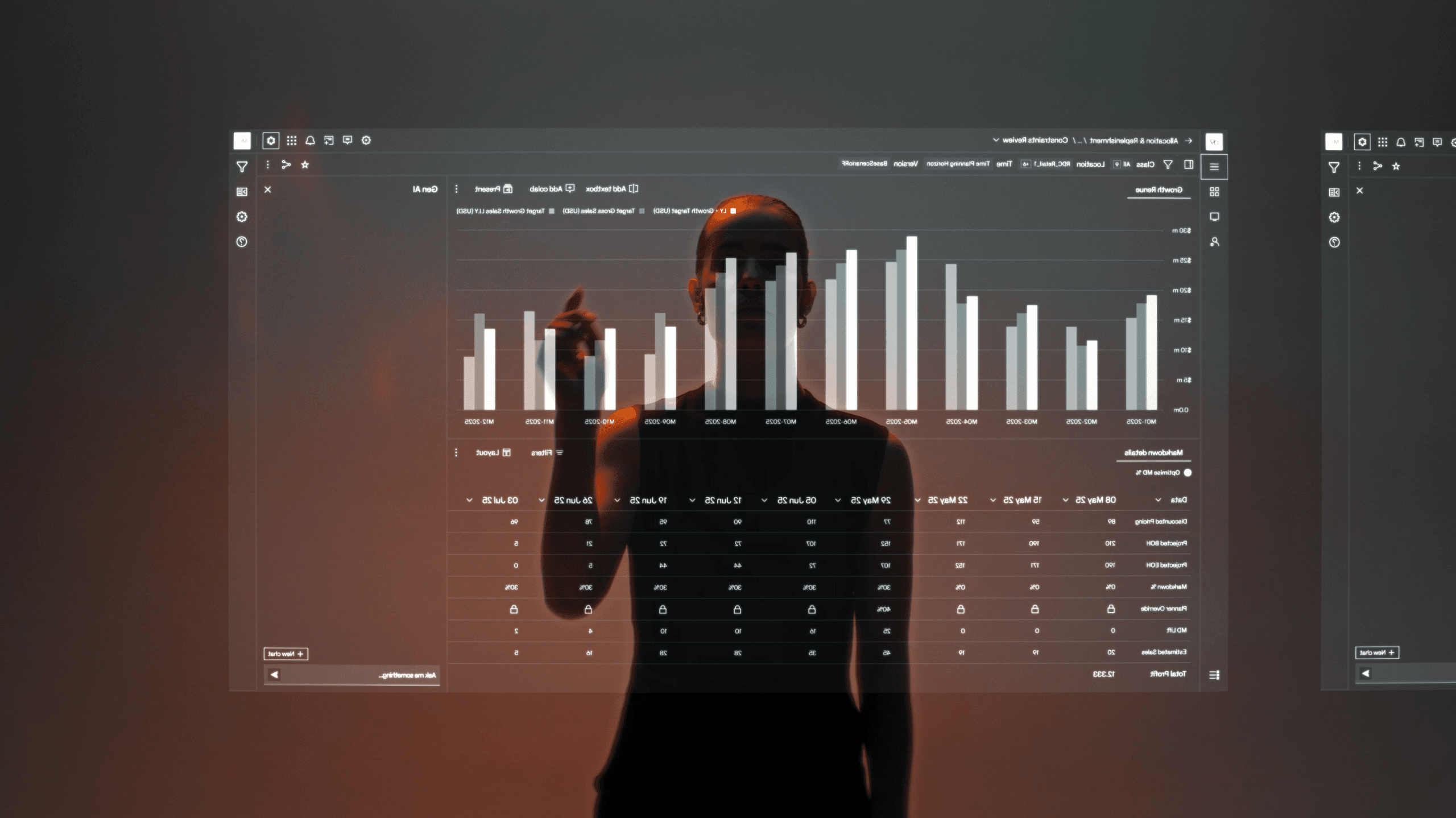
AI enhances Allocation & Replenishment by shifting inventory flow decisions from rule-based execution to constraint-aware optimization.
Machine learning models improve short-term demand sensing using POS trends, promotions, weather, and local events.
Prescriptive analytics recommend allocation and replenishment actions while quantifying service and cost trade-offs.
Generative AI enables natural-language exploration of flow decisions, while agentic AI monitors execution risks and recommends corrective actions.
→ Learn more about o9 AI innovations

What our customers say


Related solutions

Digital IBP
At its core, IBP is designed to translate strategic intent into coordinated, financially sound actions across the enterprise. Yet in many organizations, IBP has devolved into a monthly cadence of spreadsheet reconciliation, slide preparation, and functional compromise—producing alignment in theory, but limited impact in practice.
Sales & Operations Planning (S&OP)
Connect strategic planning with day-to-day execution — without breaking alignment or financial control.

Supplier Collaboration
Move from transactional sourcing to continuous, multi-tier orchestration across your supplier network.



Frequently Asked Questions (FAQ)
Replenishment planning ensures timely restocking by using demand forecasts and inventory data to prevent stockouts, reduce excess, and optimize inventory flow.