14 read min
Two forces are reshaping how global enterprises operate: the new normal of VUCA—heightened volatility, uncertainty, complexity, and ambiguity—and the mandate now landing on every executive’s desk to unlock business value with AI.
In this environment, siloed planning and decision-making amplify value leakage. When demand swings, supply is disrupted, input costs fluctuate, and conditions shift faster than the organization can detect, analyze, and respond as one, every gap between functions can turn into a forecast miss, inventory build-up, missed service levels, lost growth, and margin erosion.
At the same time, plugging those value leaks requires transformation across enterprise operating models: organization, processes, system capabilities, ways of working, and adoption. Everyone inside a large enterprise can see value leaking, but fixing it often means long timelines, difficult alignment, change-management risk, and uncertainty around what the future AI-enabled operating model should actually look like.
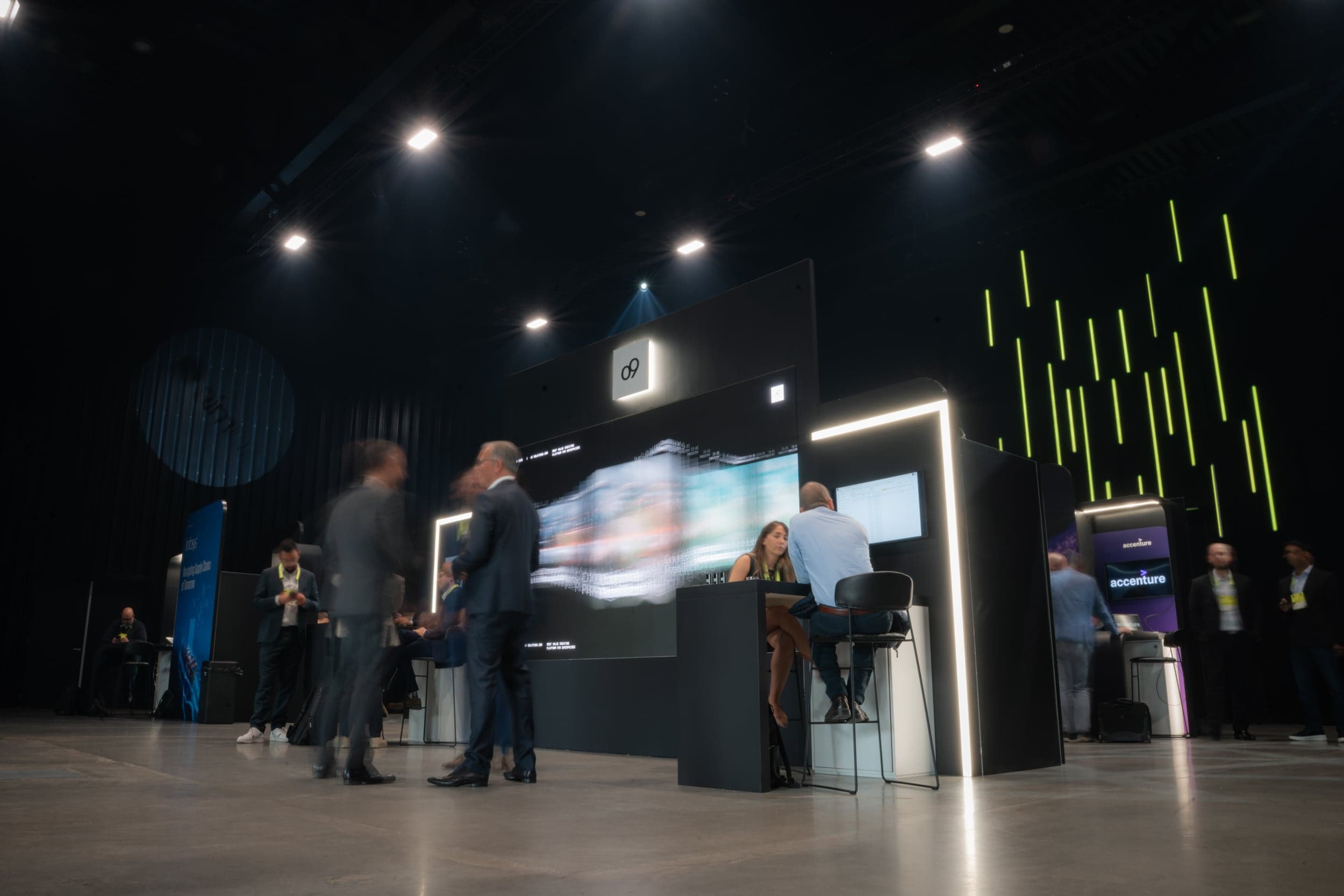
On June 4 in Amsterdam, at aim10x Europe, o9’s premier executive event for the EMEA region, o9 previewed its next leap-forward innovation designed to address these challenges: APEX, an Agile, Adaptive, Autonomous Planning and Execution system designed to focus every enterprise function, process, and decision on optimizing enterprise value.
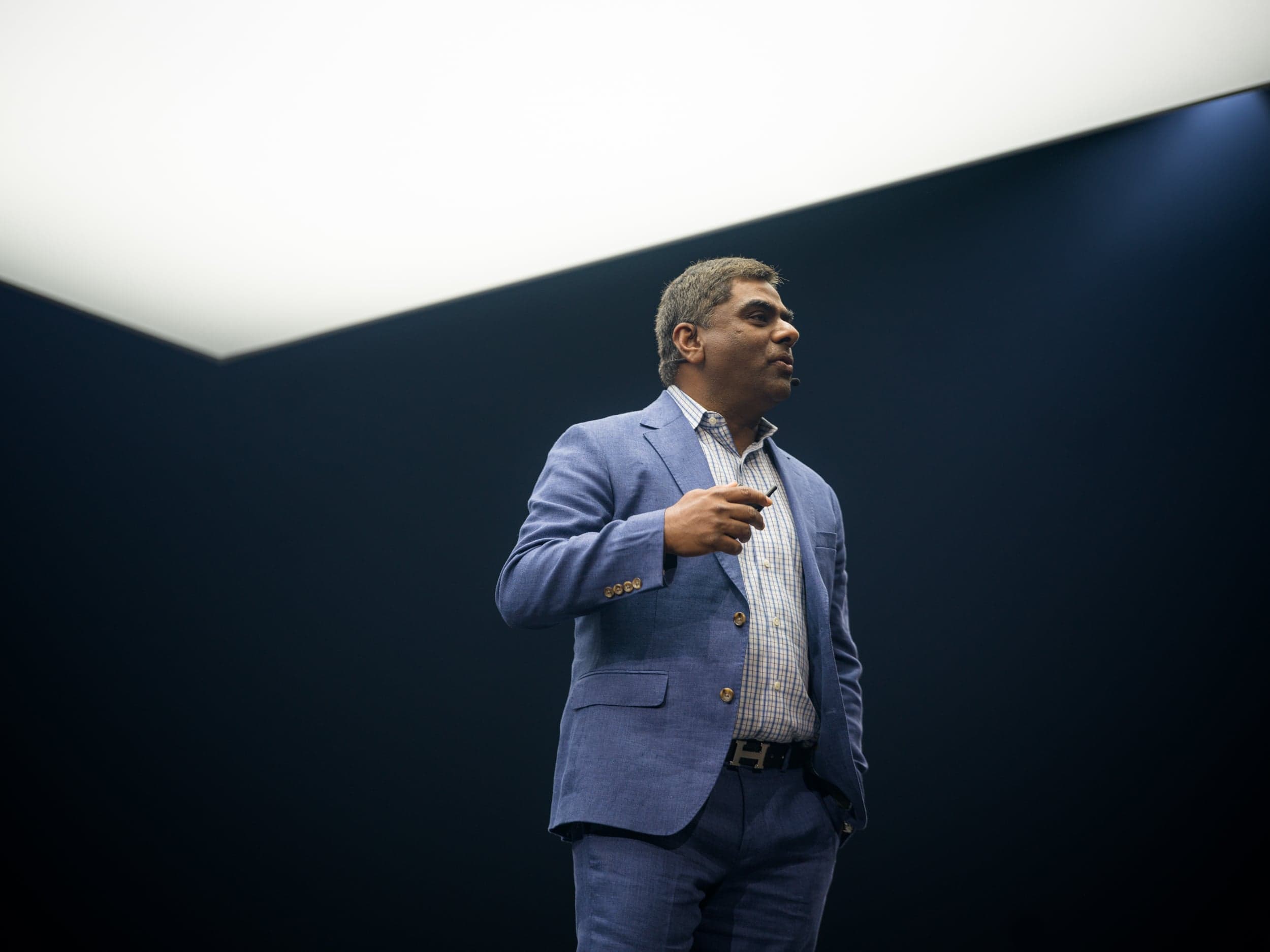
Across three connected opening keynote sessions, o9 executives, led by Chakri Gottemukkala, Co-Founder, CEO, and Chairman, previewed APEX as a 10x innovation in enterprise operating models. The model is designed to help enterprises become more agile, more adaptive, and progressively more autonomous in how they plan, execute, learn, improve, and make decisions.
This innovation is made possible by what o9 calls neuro-symbolic AI, previewed by Dr. Ashwin Rao, o9’s Executive Vice President, Next-Gen AI and Technology, in his keynote.
Dr. Rao explained how neuro-symbolic AI combines the latest advances in neural AI—the AI behind LLMs—with symbolic AI, the AI behind o9’s original Enterprise Digital Brain. This combination is key to APEX’s ability to solve enterprise decision-making problems and the associated change-management challenges at scale.
The keynote sessions were followed by demonstrations from o9 product managers of agentic AI-powered capabilities, including APEX Post-Game Performance Analyzers and Business Simulators, that are designed to make the journey from the current state to a North Star operating model faster and easier.
The Original 10x Innovation: The Enterprise Digital Brain to Drive Silo-Free Planning and Execution
Chakri traced APEX back to the problem o9 was founded to solve: enterprise value leakage caused by slow, siloed, fragmented decision-making in environments of rising volatility and complexity.
As companies grew in scale and complexity, decision-making within operating models naturally became increasingly distributed across functional domains such as supply chain, sales and marketing, product, finance, HR, and IT, as well as across long-range, tactical, operational, and execution-horizon planning and decisioning.
But rising volatility created situations—daily variances to plan across the value chain, new demand signals, supply risks, and market opportunities—that called for faster, smarter, cross-functional, one-team decision-making. There was increasing evidence that functionally oriented operating models, which had evolved to manage scale, did not have the one-team agility required to manage the new normal of volatility and complexity. Significant value was leaking.
To imagine what an enterprise without those silos could look like, Chakri outlined a story used at o9’s founding to inspire its Digital Brain invention: the story of Mr. Lay, whose early packaged potato chip business eventually became Lay’s potato chips.
When Mr. Lay started his packaged potato chip business, he was effectively a one-person management team. His family helped make and package the chips at home. He convinced a retail store owner he knew to give him shelf space. Then he drove his truck to replenish stores, checked stock levels, talked directly with consumers, watched what was selling, and used that information to decide what to buy, make, ship, price, and change.
Because the operation was small, every decision was naturally connected. Mr. Lay could see what consumers liked, translate that feedback into product changes, estimate demand, buy potatoes accordingly, guide production, manage freshness, adjust prices, and work with retailers to keep product moving and cash flowing.
Most importantly, he was constantly learning in real time by analyzing plan-versus-execution variations: what happened versus what he expected, and why. In a nutshell, Mr. Lay operated a one-person, silo-free, one-team, one-plan management system with three powers working together: end-to-end value chain visibility, connected plans and optimized decisions with fast execution, and real-time learning and continuous improvement.
Helping a large enterprise get as close as possible to Mr. Lay’s silo-free decision-making system is the challenge o9 was founded to solve, and what led to o9’s original 10x innovation: the Digital Brain, powered by its patented Enterprise Knowledge Graph technology.
This platform, rooted in symbolic AI, has enabled global enterprises to make major strides in silo-free, agile planning and decision-making. Companies using the Digital Brain have become better at detecting risks and opportunities earlier, forecasting market demand, connecting commercial, supply chain, product, and finance forecasts, plans, and decisions, evaluating trade-offs faster, and aligning teams around a shared, integrated plan.
Those strides have translated into significant value. Across industries and geographies, o9 customers have reported hundreds of millions of dollars in incremental EBITDA, inventory savings, cash-flow improvements, service-level gains, and productivity benefits. A growing group of customers has crossed into billion-dollar cumulative value creation.

APEX: Agile, Adaptive, Autonomous Planning and Execution; o9’s Next 10x Innovation
Even as enterprises have gained better visibility, improved planning, and more connected decisions, the speed and effectiveness of transforming the operating model itself remain a major challenge.
That is the next problem APEX is designed to solve: not only helping enterprises plan and execute better, but helping them learn, improve, and change faster in a fast-changing world. Transformation is not a one-time activity. It must become continuous.
“APEX stands for Agile, Adaptive, Autonomous Planning and Execution,” Chakri said.
APEX builds on the Digital Brain foundation, but its purpose is broader than improving visibility or connecting end-to-end plans. APEX is designed to embed continuous learning, continuous improvement, and progressive automation into the operating model itself, so enterprises can keep improving without waiting for the next crisis or the next multi-year transformation program.
Chakri explained that APEX is more than a technology upgrade or a new AI model. It is an operating model innovation powered by deep knowledge of enterprise decision-making: how organization structures, processes, data, knowledge, measurement, and incentives need to come together to optimize enterprise value.
Its purpose is to help enterprises evolve from current-state traditional operating models toward a higher APEX state: more agile, more adaptive, and progressively more autonomous with agentic AI.

1. The first pillar is Agile. Where the Digital Brain created the connected planning foundation, APEX extends that foundation by reducing latency across the enterprise: detecting risks and opportunities earlier, moving analysis and decision-making closer to the edges, escalating trade-offs faster, and helping the enterprise respond as one team with greater speed, consistency, and predictability.
2. The second pillar is Adaptive. Adaptive is designed to solve one of the hardest problems traditional enterprises face: the change journey. It helps enterprises move from their current state to a higher state of agility by making change faster, easier, more continuous, and more reliable.
Adaptive capabilities of the APEX model, such as Post-Game Analyzers, help teams learn where and, most importantly, why value is leaking: why execution is deviating from plan at granular levels across the value chain. That learning can then be converted into targeted improvements in skills, data, processes, policies, decision rights, adoption, and system capabilities.
The result is a continuous improvement loop that makes change part of the operating model itself, rather than a one-time transformation program. This is the key mantra of Adaptive: avoid expensive, time-consuming, high-risk transformation cycles by building the capability to sense, learn, and improve at speed.
3. The third pillar is Autonomous. Autonomy does not mean removing human judgment. It means neuro-symbolic AI agents increasingly automate routine planning, execution, learning, and improvement workflows within clear business guardrails, while humans remain focused on strategy, policy, oversight, exception management, and enterprise-value trade-offs.
Autonomy materializes progressively as the enterprise’s data, knowledge, process, and decision foundations become richer.

The core promise of APEX is that transformation becomes continuous. Change becomes easier. Value delivery becomes more reliable. And the enterprise moves closer to Mr. Lay’s North Star not through periodic reinvention, but through a learning operating model that improves every quarter, every cycle, and across more decisions.
Instead of VUCA being a driver of value leakage, Chakri said, APEX turns managing volatility and complexity into a differentiator: an Enterprise Value Optimizer. It is the operating model innovation every enterprise needs for the AI age.

Why Language Models Alone Can't Answer "Why"
If answering "why" is the key to continuous learning, the next question is what kind of AI can actually do it. Dr. Ashwin Rao, Executive Vice President, Next-Gen AI and Technology at o9 Solutions, picked up exactly there, explaining why the convergence of neural and symbolic AI is essential to building truly agile, adaptive, and autonomous enterprises.
Ashwin's perspective is shaped by an unusually broad career. He spent years on Wall Street, where the cost of an unreliable model is measured in real money. He later led AI at Target Corporation and now serves as an adjunct professor of applied mathematics at Stanford, where he continues to conduct AI research.
That combination of trading-floor accountability, retail pragmatism, and mathematical rigor ran through his presentation. While acknowledging the transformative impact of large language models, he gave a clear explanation for why language alone is not enough.
"Language is not complete cognition," he said. "LLMs are powerful, but we need AI that goes well beyond the AI of language. That's the AI of mathematics, structure, and domain knowledge."
That gap explains why so many enterprise AI agents disappoint. The deeper issue is reliability. LLMs work by approximation, and approximation is a virtue for scale but a liability for planning. "You have to be exact, you have to respect the rules and constraints, you have to respect the decision rights people have in an enterprise." A language model, however capable, is the wrong tool for that job.

Neuro-Symbolic AI: The Machinery That Lets an Enterprise Learn
The complement is symbolic AI, the discipline o9 has been building for fifteen years. It encodes the enterprise knowledge graph, the mathematical logic, and the decision models for inventory, pricing, and the rest. Its decisive advantage over a neural network is that it can show its work: "It's traceable, it's auditable, and it can explain things to you in very clear business terms as to why it made the decision." Neither half is sufficient alone. "What's the strength of the neural on the left is the weakness of the symbolic on the right, and vice versa," he said. "That combination of symbolic AI and neural AI is called neuro-symbolic."
Ashwin then connected the architecture directly back to Chakri's "why," and to Mr. Lay's continuous learning. The enterprise knowledge graph doesn't just store the business: a decision context graph records who decided what, when, and on which facts and assumptions, while a learning layer links those decisions to the outcomes they produced, steadily codifying what works into the rules that govern the company.
That is the machinery that lets an enterprise learn continuously, the way Mr. Lay once did instinctively, without needing a crisis to trigger the lesson. But an architecture described from a stage is still a promise. The natural next question is whether neuro-symbolic AI can actually answer "why" on a real business problem, with the traceability Ashwin had just described. That is exactly what the o9 team turned to next.

Post-Game Analysis in Action: Diagnosing $60M in Excess Inventory
The demonstration was post-game analysis, the technology that puts the theory on screen, and it began from the gap everything so far had been building toward. Every planning system on the market can show that inventory is up. Yet none can explain why. That was the gap Peter Taylor, SVP of Solutions Consulting at o9 Solutions, opened with. Planning systems forecast the future well but rarely tie decisions back to outcomes, and today's post-game analysis, in the form of dashboards and consulting decks, stops short of getting to the root cause. "It's about treating the smoke of an inventory problem," Peter said, "but doesn't get to treating where there are fires in the organization." The result is politics and inaction: too complex to diagnose, and too contested to fix.
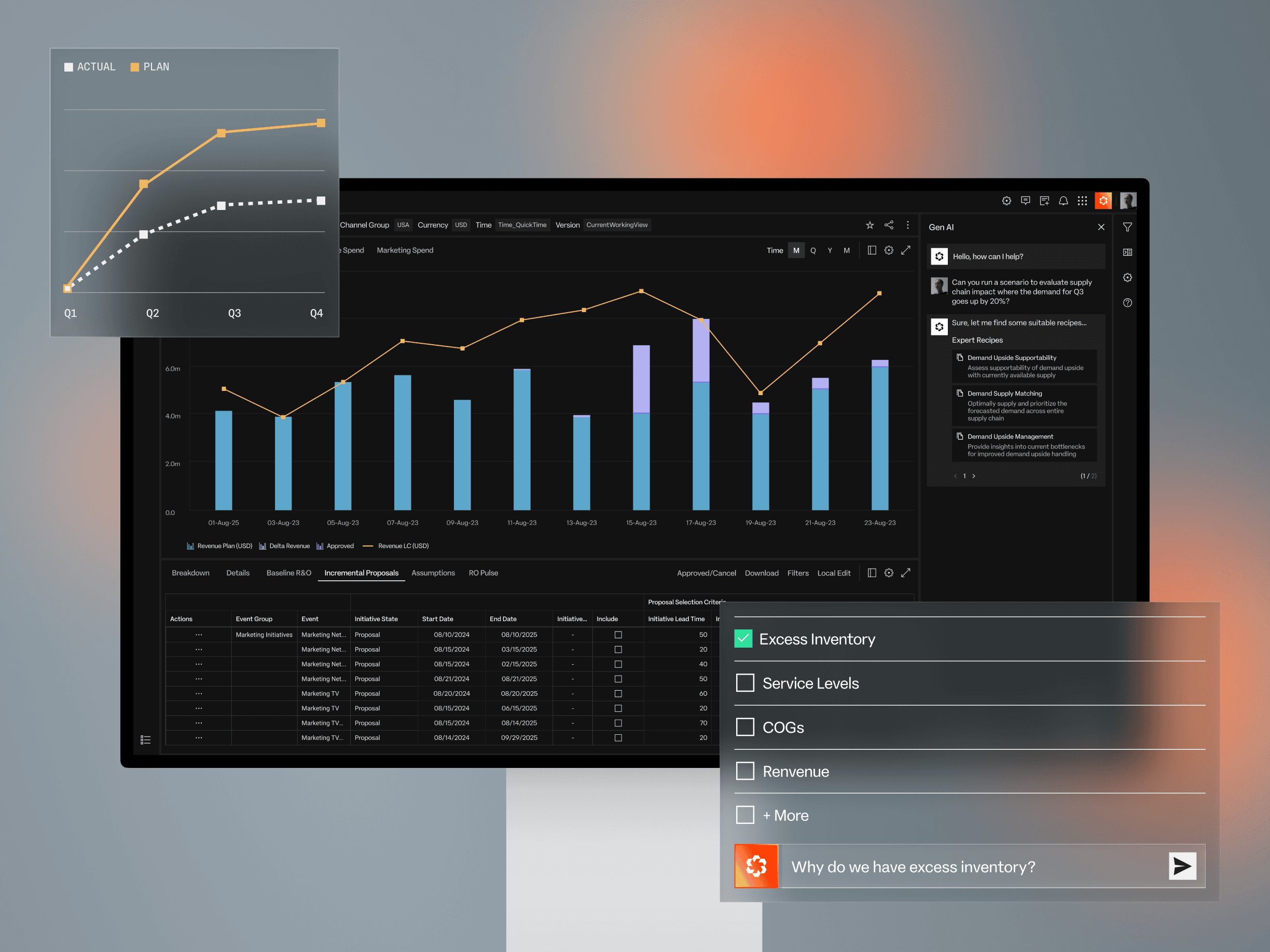
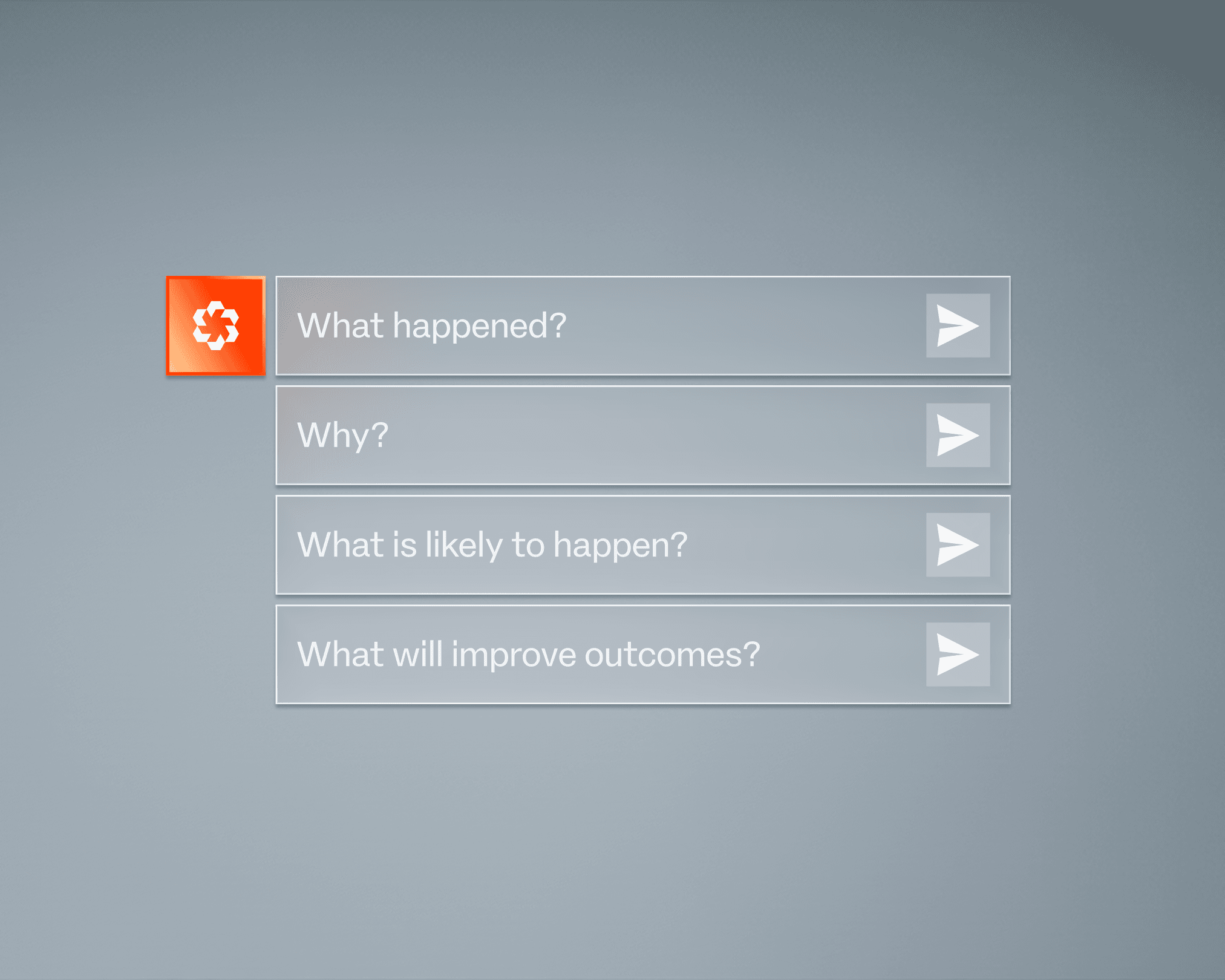
Working through a real excess-inventory analysis for a beverages customer, Peter showed an agent generating an executive narrative on four questions: what happened, where it happened, why it happened, and what to do. Visibility alone has value; he cited $100 million in inventory savings simply from connecting inventory data across divisions and ERPs that no single view had reached before. But visibility is a one-time gain, the execution-silo half of the problem. The key innovation is the why. The system mines the decision trail, including the system forecast, the planner's override, the production order, and the next override, to answer a precise question: when inventory piled up at this node, which decisions and policies caused it? A poor forecast at the DC, or a production lot size set upstream at the plant a month ago? The agent then sizes the prize, in this case $60 million in recoverable excess inventory, split across demand planning, production, and procurement, with fixes ranging from immediate policy changes to longer transformation work.

Inside the Demo: How the Agent Maps Data and Stays Auditable
Nitin Goyal, EVP of Product Management at o9 Solutions, then showed how the analysis is assembled, and how it embodies exactly the neuro-symbolic split Ashwin described: the neural front end sitting on the symbolic foundation beneath it. A user uploads raw files and the agent does the mapping work that normally consumes months, linking raw data to o9's data model without manual preparation. It profiles the data, overlays external drivers, and benchmarks forecast quality against industry norms, in this case flagging a gap between the customer's 30% error rate and a 22% industry benchmark, before recommending three concrete levers, starting with removing biased overrides. Every step is inspectable. "You can see the traces," Nitin said, "so you have the confidence that it is actually using the information and not hallucinating." The auditability Ashwin had promised from symbolic AI was visible on screen.
The demo collapsed into a single session of minutes what typically takes months of analysis. But the deeper point was not speed. It was that the "why" question Chakri opened with, the one enterprises have never been able to answer reliably, now had an answer that was traceable, explainable, and ready to act on. The team pointed the audience to a live site, pga.o9solutions.com, to run the analysis on their own data.

From Periodic Crisis to Daily Habit: The Enterprise That Never Stops Learning
The three opening sessions of aim10x Europe reinforced a simple but critical idea: transformation cannot remain a periodic, multi-year effort triggered by disruption or crisis. In a world now defined by constant volatility, uncertainty, complexity, and ambiguity, transformation must become a continuous enterprise capability.
By helping organizations identify value leakage, learn faster, and improve continuously, the APEX model is designed to make agility, adaptation, and progressive autonomy part of the operating model itself—not the outcome of the next transformation initiative.
aim10x Europe was the preview.
aim10x Americas, on September 23 in Chicago, Chakri said, is where that vision begins to take shape.
About the authors

The Editorial Team, o9
A multidisciplinary collective of editors, strategists, technologists, and former executives with experience across Fortune 500 companies and top consulting firms. Grounded in o9’s mission to help enterprises make faster, better decisions through the power of AI-driven planning and execution software, the team shares clear, practical insights on digital transformation, supply chain, and enterprise planning to support business leaders in navigating complexity and driving change.