Overview
Multi-Echelon Inventory Optimization (MEIO)
Balance service, cost, and risk across the entire supply network — not just at individual warehouses.
Multi-Echelon Inventory Optimization (MEIO) on the o9 Digital Brain enables organizations to set, deploy, and continuously adjust inventory targets across the end-to-end network. By accounting for demand variability, supply risk, in-transit inventory, and shelf-life constraints, MEIO helps companies protect service levels while reducing working capital and obsolescence — even in volatile environments.
Achieving the right inventory balance has become significantly more complex.
Fluctuating customer demand, supplier disruptions, longer lead times, and transportation volatility make it difficult to rely on traditional, location-by-location inventory planning.
Delays and fragmented data across planning, procurement, and execution often lead to excess inventory in some nodes and shortages in others. Organizations are forced to react rapidly — expediting orders, reallocating stock manually, or accepting obsolescence — all of which increase cost and erode margins.
At the same time, the shift from just-in-time to just-in-case inventory strategies has intensified balance sheet pressure. Supply chain leaders must now hold more inventory to protect service, while ensuring that inventory remains productive rather than stranded or aging.
From Local Optimization to Network-Wide Decisions
Traditional inventory planning focuses on individual warehouses or stocking points. MEIO shifts the perspective to the entire network.
By optimizing inventory decisions across multiple echelons — suppliers, in-transit stock, distribution centers, and downstream nodes — organizations can place inventory where it delivers the greatest service impact at the lowest total cost.

How to Take Control of Supply Chain Complexity
Effective supply planning has become indispensable for organizations seeking to navigate complexities, ensure resilience, and maintain competitive advantage.
What this solution enables
Optimal Inventory Targets and Network Rebalancing
MEIO calculates optimal inventory targets across the supply network, balancing service objectives against holding and expediting costs.
Rather than defaulting to expedite, the solution identifies opportunities to rebalance inventory across distribution nodes, leveraging excess stock elsewhere in the network. This reduces unnecessary transportation costs while improving responsiveness to demand changes.Postponement and Service-Level Optimization
Inventory does not always need to be committed early. o9 supports postponement strategies that delay final allocation until demand signals are clearer. Service levels are optimized by explicitly weighing the penalty of missed deliveries against the cost of holding, expediting, or reallocating inventory.
This ensures that inventory decisions are economically rational, not driven by local firefighting.
What Makes o9 Different
End-to-End Inventory Visibility
MEIO on o9 optimizes inventory based on complete network visibility — not just what is on hand in a warehouse.
Planners can consider in-transit inventory and Tier 1 and Tier 2 supplier availability when confirming orders or releasing production. This enables earlier action, shorter cycle times, and better use of inventory already in motion.Shelf-Life and Aging-Aware Optimization
Inventory availability alone is not enough — inventory must also be viable.
o9 uniquely integrates shelf-life, freshness, and aging risk into inventory optimization and order confirmation. This is especially critical in industries such as food & beverage, life sciences, and consumer products, where obsolescence directly impacts profitability and sustainability.Scenario Planning for Inventory Risk
MEIO enables planners to simulate scenarios such as demand surges, supplier delays, or transportation disruptions.
The impact on inventory levels, service performance, and cost is visible immediately, allowing organizations to proactively adjust policies rather than reacting after service failures occur.
Industries Supported


Powered by the o9 Digital Brain
MEIO runs on the o9 Digital Brain, which connects inventory decisions with production scheduling, master planning, and execution.
The platform provides real-time visibility into inventory positions across the network and supports multi-tier collaboration with suppliers and downstream partners. Inventory targets are not static numbers, but living parameters that inform production, procurement, and allocation decisions.

The o9 Digital Brain
The digital brain is powered by our patented Enterprise Knowledge Graph (EKG)
Modular by design, enterprise by default
MEIO optimizes inventory across the entire supply network, balancing service levels, risk, and working capital at a system level rather than node by node.
Core
Multi-Echelon Network Model
Calculates optimal inventory targets across suppliers, DCs, and customers simultaneously to prevent localized overstocking and shortages.
Service Level Optimization Engine
Balances holding cost, service penalties, and expedite costs to determine economically optimal inventory policies.
Postponement Logic
Supports holding inventory upstream and deploying it only when actual demand signals materialize.
Advanced Building Blocks
Stochastic Risk Modeling
AI accounts for demand variability and supply uncertainty when setting safety stock and cycle stock levels.Shelf-Life & Freshness Constraints
Integrates aging and FEFO logic into inventory decisions for perishable and regulated products.
Risk Sensing & Mitigation Workflow
Correlates third-party risk signals to inventory positions and recommends proactive adjustments or rebalancing actions.
Pre-built industry templates provide packaged logic and workflows that reduce time to value while remaining fully customizable.

Take a tour
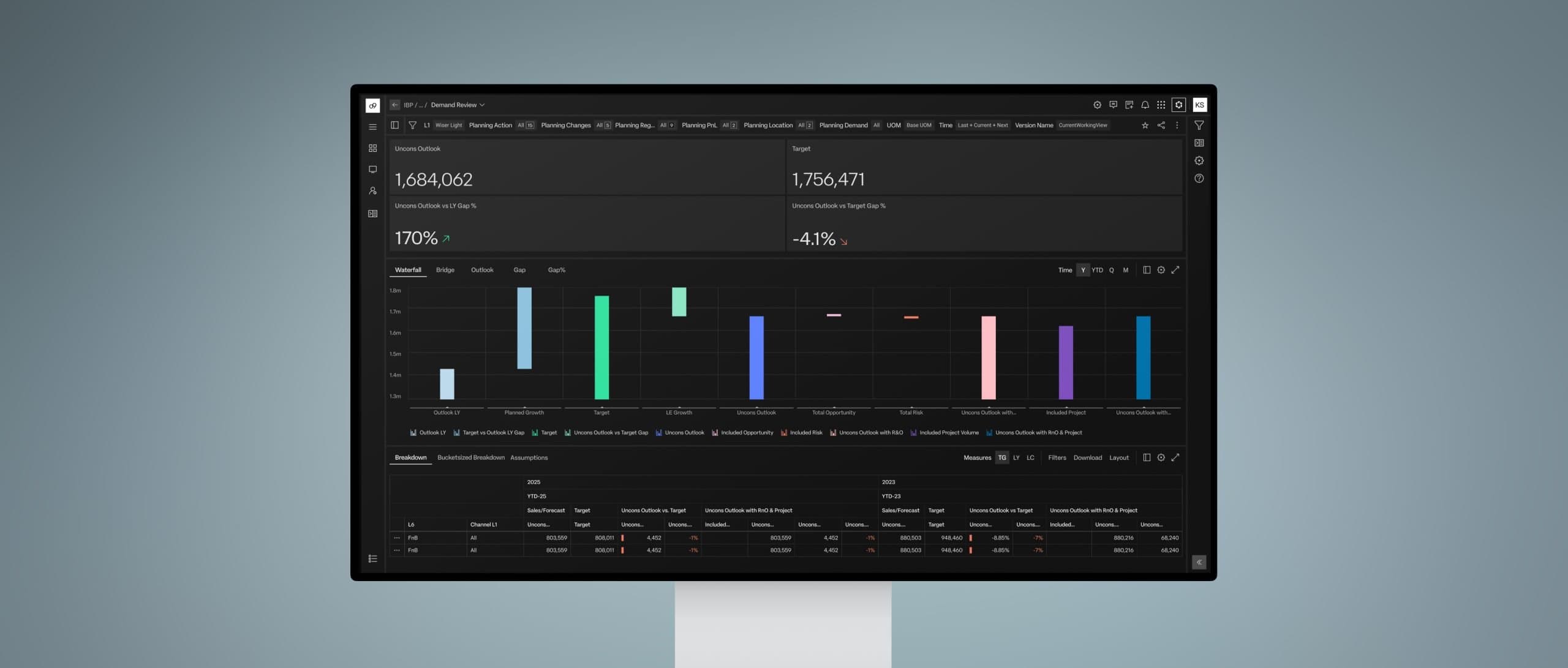
See how the o9 Digital Brain unifies planning, forecasting, and execution through AI-driven intelligence.
A digital operating model for VUCA conditions
APEX is o9’s AI-powered operating model for enterprises navigating volatility, uncertainty, complexity, and ambiguity (VUCA). It enables organizations to plan, execute, and learn as one connected system.

The o9 Digital Brain powers APEX by connecting enterprise data, knowledge, and decisions through a single intelligent model.
Collaborative Demand Planning is one of the building blocks of the Digital Brain. It contributes domain-specific capabilities into the enterprise-wide model that enables APEX from the ground up—linking this solution to decisions across the entire value chain.
→ Learn how the APEX Operating Model works
Where AI drives real decisions

Artificial intelligence enables MEIO to account for uncertainty and risk.
Stochastic modeling uses AI and machine learning to capture variability in demand and supply when calculating safety stock and cycle stock. This leads to more resilient inventory policies that reflect real-world volatility rather than average conditions.
Risk sensing continuously monitors signals such as supplier delays or demand volatility and recommends inventory adjustments to protect service levels. This shifts inventory management from reactive firefighting to proactive optimization.
→ Learn more about o9 AI innovations
Results in real-world complexity
Global Food & Beverage Company
This organization relied on manual inventory planning and struggled to manage complex allocation rules, leading to losses, inefficiencies, and service penalties.
By implementing automated allocation scenarios that accounted for inventory aging risk and multi-echelon deployment, the company optimized stock placement across distribution centers.
7%
reduction in inventory holdings
3-5%
improving OTIF
Avon

Take a tour
See how the o9 Digital Brain unifies planning, forecasting, and execution through AI-driven intelligence.
Related solutions
Supply Chain Master Planning

Collaborative Demand Planning
Collaborative Demand Planning on the o9 Digital Brain enables cross-functional teams to co-create, reconcile, and commit to a single, transparent demand plan, powered by shared assumptions, real-time collaboration, and AI-driven automation.
Supply Chain Control Tower
Frequently Asked Questions (FAQ)
Multi-echelon inventory optimization determines optimal inventory levels across multiple stages of the supply chain, considering demand variability, lead times, and service targets at the network level.