AI-Driven Collaborative Demand Planning Software for Enterprises
Align Sales, Marketing, Finance, and Supply Chain around one trusted demand signal — without sacrificing speed or accountability.


UNLOCKING BILLIONS IN VALUE FOR CLIENTS IN 30+ INDUSTRIES
Collaborative Demand Planning on the o9 Digital Brain enables cross-functional teams to co-create, reconcile, and commit to a single, transparent demand plan, powered by shared assumptions, real-time collaboration, and AI-driven automation.

The problem traditional planning can’t solve anymore
In most organizations, demand planning is still a coordination exercise rather than a decision-making advantage. Sales, Marketing, Finance, and Supply Chain often operate with different tools, timelines, and incentives. Forecast inputs are collected late, assumptions are unclear, and accountability is diffuse. The result is not just inefficiency — it is missed revenue, excess inventory, and avoidable service risk.
As markets become more volatile, this fragmentation becomes increasingly costly. Demand signals change faster than traditional monthly or quarterly planning cycles can absorb. Teams spend more time reconciling numbers than acting on them, and critical decisions are made using outdated or incomplete information.
Market Trend: The One-Number Forecast
Leading organizations are responding by shifting toward a One-Number Forecast. Instead of maintaining separate demand views for Sales, Finance, and Supply Chain, they align around a shared demand baseline that supports all downstream decisions.
This does not mean forcing every function into the same level of detail. Sales may plan at the account or customer level, Finance at a revenue or budget level, and Supply Chain at SKU-location. Collaborative demand planning ensures these perspectives remain connected, reconciled, and explainable — so the organization moves forward with confidence rather than compromise.
o9 enables this shift by:
What this solution enables
What Makes o9 Different
Industries Supported

































Powered by the o9 Digital Brain
Collaborative Demand Planning runs on the o9 Digital Brain, powered by the Enterprise Knowledge Graph (EKG).
The EKG acts as a digital backbone, connecting data, processes, and decisions across the organization. It breaks down silos by modeling relationships between products, customers, markets, and financials, enabling a shared understanding of demand.
Built on open standards such as Apache Hadoop and Spark, the platform integrates seamlessly with existing enterprise architectures and supports both structured data and unstructured tribal knowledge.

Modular by design, enterprise by default
o9 accelerates implementation through configurable building blocks that can be tailored to unique business requirements.
Core Building Blocks
Advanced Building Blocks
Pre-built industry templates provide packaged logic and workflows that reduce time to value while remaining fully customizable.

A digital operating model for VUCA conditions
APEX is o9’s AI-powered operating model for enterprises navigating volatility, uncertainty, complexity, and ambiguity (VUCA). It enables organizations to plan, execute, and learn as one connected system.

The o9 Digital Brain powers APEX by connecting enterprise data, knowledge, and decisions through a single intelligent model.
Collaborative Demand Planning is one of the building blocks of the Digital Brain. It contributes domain-specific capabilities into the enterprise-wide model that enables APEX from the ground up—linking this solution to decisions across the entire value chain.
→ Learn how the APEX Operating Model works
Where AI drives real decisions
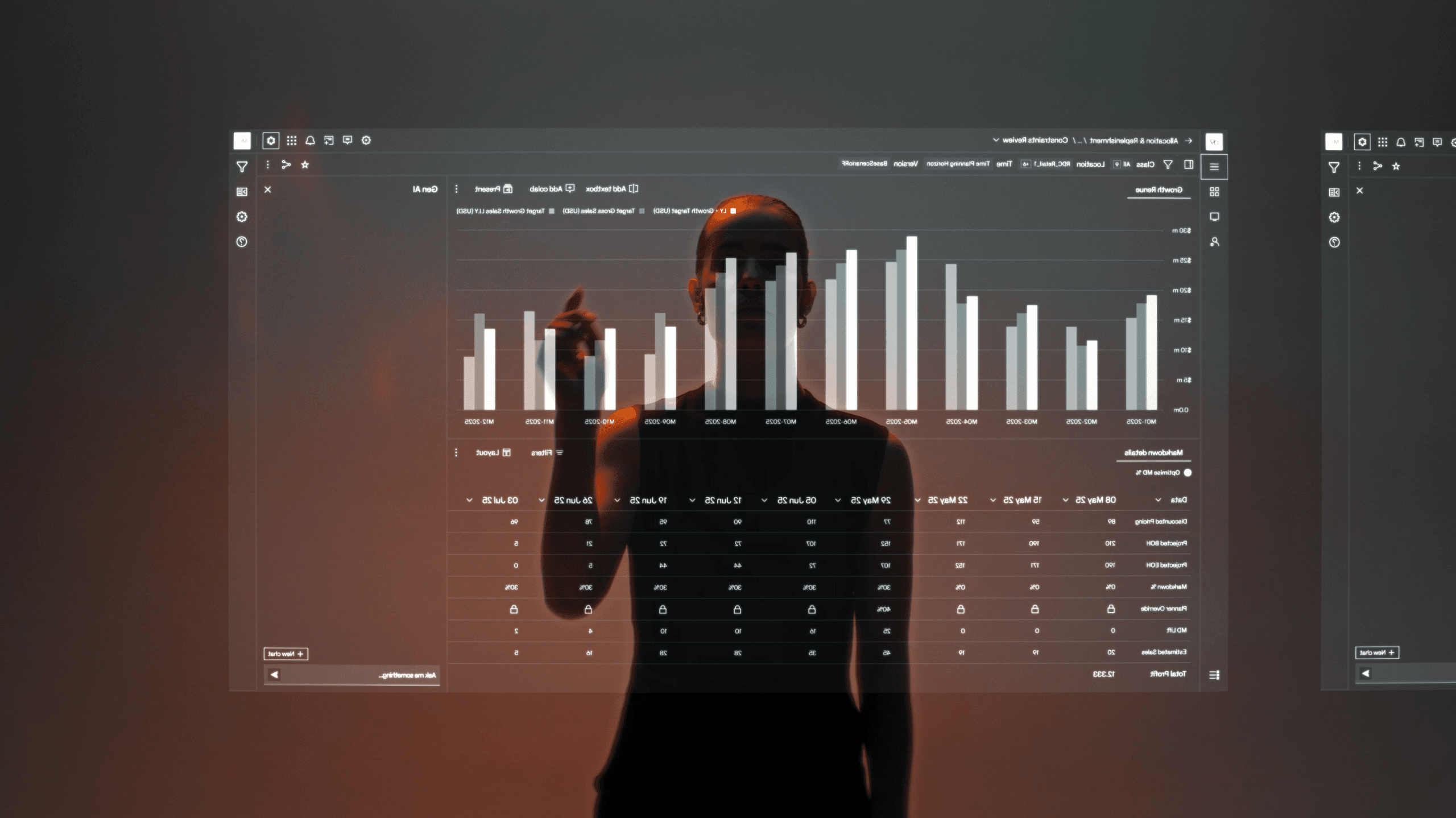
Artificial intelligence enhances collaboration by reducing friction and improving decision quality.
Generative AI enables natural-language interactions with the plan, allowing users to adjust assumptions or scenarios conversationally while automatically documenting context and rationale.
Natural Language Processing (NLP) captures planner comments and notes, embedding tribal knowledge directly into the planning process instead of losing it in emails or meetings.
Agentic AI uses digital agents to perform analysis, generate reports, and monitor signals in parallel, freeing planners to focus on high-value work.
→ Learn more about o9 AI innovations

Results in real-world complexity
ABinBev

By leveraging o9’s integrated planning platform, AB InBev replaced legacy systems such as SAP APO with a single, cloud-native solution, streamlining demand forecasting, supply planning, and inventory management.
The transformation enabled a 60% reduction in out-of-stocks, a 53% decrease in inventory losses, and a four-year high in service levels. Additionally, planners experienced a 30% time savings, while touchless planning adoption reached 70-90% across key markets.
60%
Reduction in Stock-Outs
53%
Decrease in Inventory Losses
90%
Touchless Planning Adoption
Kraft Heinz

7,000 SKUs across multiple regions, Kraft Heinz partnered with o9 Solutions in North America and Europe to implement an advanced ML forecasting platform, collaborative demand planning solution, and a sales planning module.
This initiative resulted in an 11% increase in Monthly Forecast Accuracy, a 14% increase in Weekly Forecast Accuracy, a 20% reduction in safety stock levels, and a 32% reduction in time spent on forecasting.
10%
Increase in Forecast Accuracy
25%
Decrease in Excess Inventory
32%
Reduction in Time Spent on Forecasting
What our customers say


Related solutions

Digital IBP
At its core, IBP is designed to translate strategic intent into coordinated, financially sound actions across the enterprise. Yet in many organizations, IBP has devolved into a monthly cadence of spreadsheet reconciliation, slide preparation, and functional compromise—producing alignment in theory, but limited impact in practice.
Sales & Operations Planning (S&OP)
Connect strategic planning with day-to-day execution — without breaking alignment or financial control.

Supplier Collaboration
Move from transactional sourcing to continuous, multi-tier orchestration across your supplier network.



Frequently Asked Questions (FAQ)
Demand planning is an integral part of any business's supply chain management process, and its importance extends across multiple dimensions, impacting everything from operational efficiency to customer satisfaction and long-term profitability. A well-executed demand planning process ensures that businesses can anticipate customer needs and align resources effectively.