Decision Latency Is the New Cost Center: Why the o9 Digital Brain Is Redefining Enterprise Performance
authors

Ashwin Rao
EVP of AI at o9 & Adjunct Professor at Stanford
7 read min
Global enterprises make tens of thousands of decisions every day, some operational, some commercial, some deeply strategic. Even so, the biggest competitive advantage rarely comes from making the perfect decision. It comes from making the right decision fast enough to matter.
In a time where market conditions can shift within hours, the real threat is no longer poor decision quality. It is the widening gap between when a risk or opportunity emerges and when the enterprise responds. That delay is decision latency, and it is quickly becoming the most important KPI that organizations must learn to measure and manage.
Volatility has lifted the lid on the limits of traditional decision-making models built for scale, not speed. Functions, hierarchies, and sequential planning processes were designed to coordinate an expanding enterprise, but they now struggle to keep pace with a marketplace defined by disruption, not stability.
The enterprises that will lead the next decade are those that can compress the time between sensing and action, shrinking decision latency across every horizon of planning and execution. This is exactly the transformation powered by o9’s Digital Brain.
The Hidden Cost of Slow Decisions
Today’s operating environment is filled with familiar symptoms that all trace back to decision latency. Risks often surface too late because visibility is fragmented across systems and functions. Forecasts drift out of alignment as sales, supply chain, and finance interpret different signals on different timelines.
Planning cycles remain slow, weighed down by manual touches that inject bias and distort information as numbers move across hierarchies. Scenario planning is still treated as an exceptional exercise, something performed in crisis moments, not a daily habit. And when plans fail to keep up, teams resort to firefighting, manually intervening in execution processes that should be automated and synchronized.
Each of these symptoms creates measurable value leakage. Enterprises absorb higher expediting and reactive costs. Inventories rise even as service levels fall. NPIs slow down, commercial initiatives underdeliver, and operational teams lose productivity in the noise of exception management.
For a $10 billion company, this leakage can erode $50–150 million in earnings every year, an amount that compounds over time. The core issue is not a lack of smart people or advanced tools. It is a structural inability to move information and decisions at the speed required.
Reframing the Enterprise: From Functions to Decisions
The Digital Brain was invented more than a decade ago based on a simple but transformative idea: an enterprise should not be viewed as a collection of functions. It should be viewed as a network of interconnected decisions. These include commercial decisions that shape demand; supply chain decisions that meet that demand; financial decisions that guide budgets and targets; and P&L decisions that govern profitability. Every one of these decisions influences the others.
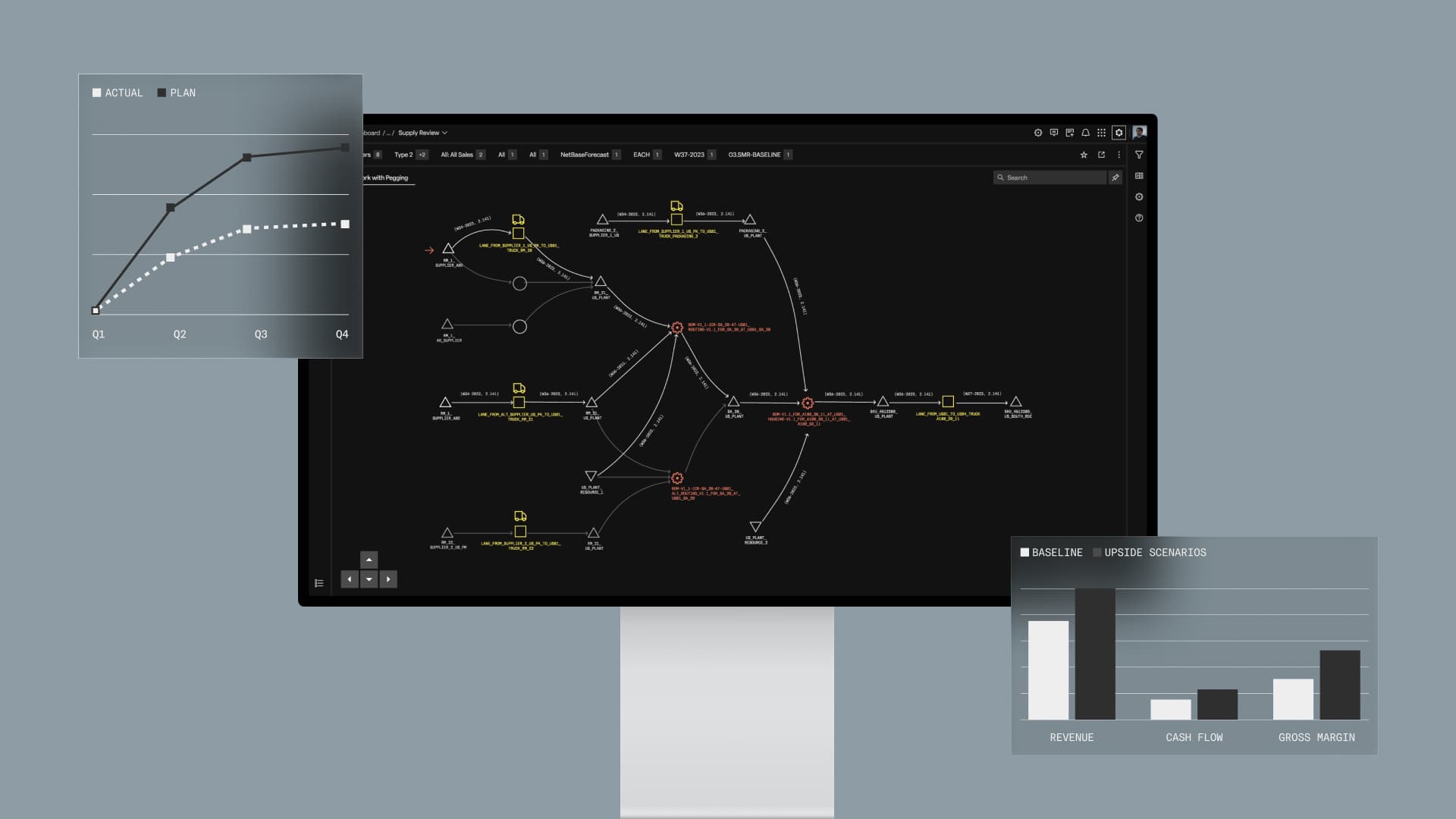
Instead of relying on people and processes as the connective tissue between decisions, the Digital Brain digitizes the entire decision network. This is made possible by the Enterprise Knowledge Graph (EKG), a model that captures not only structured data from systems, but also the tribal knowledge, rules, constraints, and real-world complexity that typically sit in spreadsheets or in the minds of experts.
With the EKG orchestrating the interdependencies, the Digital Brain can continuously recompute billions of micro-decisions, synchronize them across horizons, and execute them with minimal latency. This represents a shift from fragmented, manual decision-making to boundaryless, touchless, synchronized intelligence.
“The Enterprise Knowledge Graph gives an enterprise tremendous agility in evaluating situations, analyzing possibilities, and understanding reasons, with enormous speed. With AI agents, we can perform the above with a simple conversational interface.”
Dr. Ashwin Rao
Executive Vice President, AI Strategy and R&D
Decision Latency: The KPI Revealing True Agility
Traditional KPIs like forecast accuracy, inventory turns, and service levels remain important, but they tell us what already happened. They offer little insight into whether teams acted fast enough to prevent issues or capture opportunities. Decision latency, on the other hand, exposes the operational heartbeat of the enterprise: How quickly did a signal move? How fast did planning teams converge? How rapidly did downstream plans realign? How consistently could the execution layer respond?
Enterprises that reduce decision latency naturally solve problems faster, but, importantly, they also experience a structural uplift in performance. They spot risks earlier, adapt plans more frequently, and coordinate responses with greater precision. Commercial and supply chain teams work from the same reality instead of parallel assumptions. Strategic decisions reach execution systems in hours rather than weeks. Over time, the organization develops momentum: fewer surprises, fewer firefighting cycles, and more capacity focused on growth rather than recovery.
This explains why o9 customers across beverage, high tech, retail, telecom, and industrial sectors are generating hundreds of millions to over a billion dollars in cumulative value. The differentiator is not just the intelligence of the decisions, but the speed and scale at which they are delivered.
How the Digital Brain Reduces Decision Latency
Touchless forecasting and synchronized planning
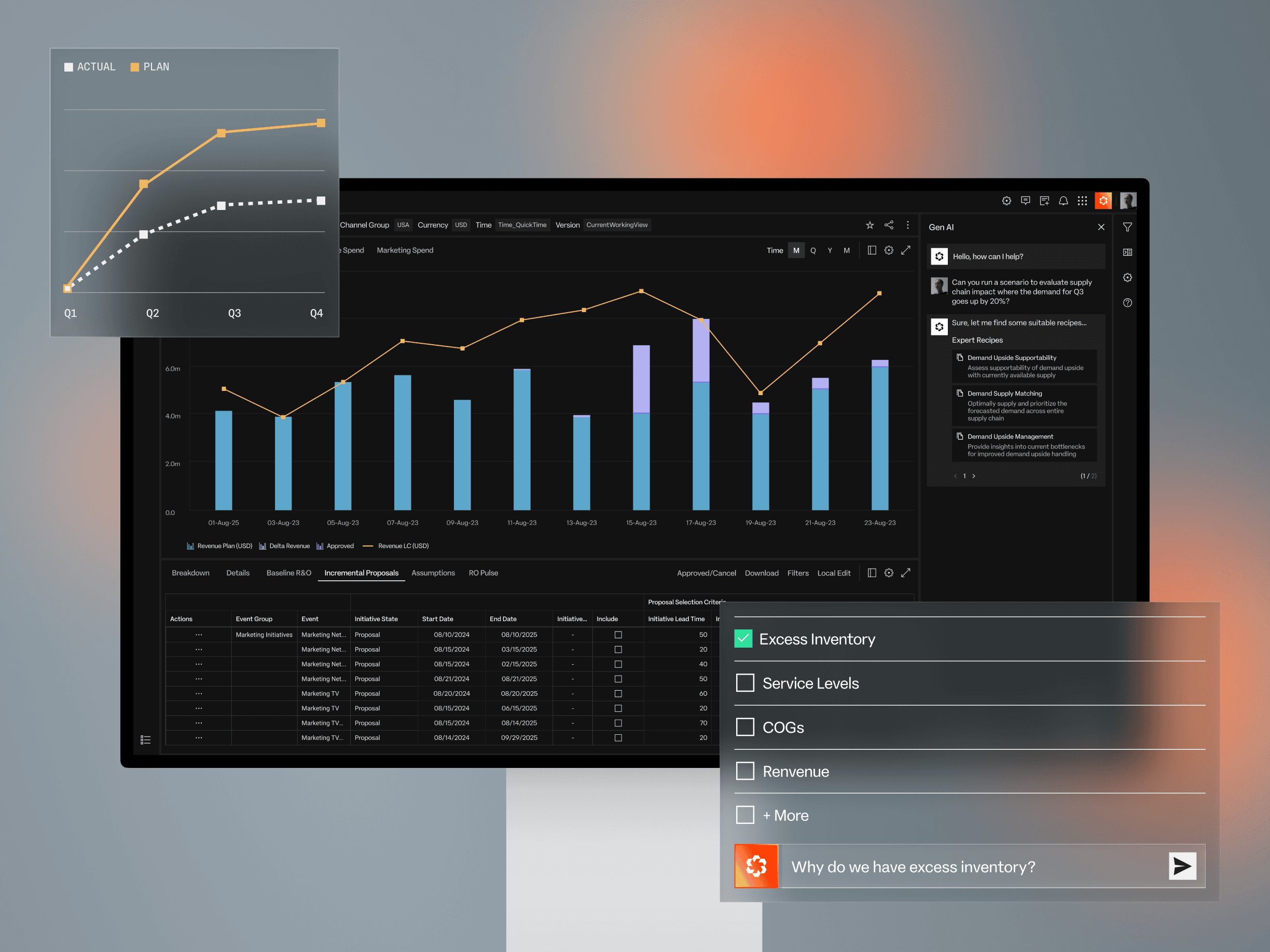
The Digital Brain elevates planning by enabling touchless forecasting at unprecedented accuracy levels. Many enterprises now operate with more than 90 percent automated forecast generation, removing variability introduced by manual judgment. When conditions shift, scenario planning that once required multi-week alignment can be executed in a single day.
Commercial, supply chain, and finance teams evaluate multiple versions of the future together, using consistent data and assumptions, so they can converge quickly on the best path forward. Once plans are updated, the changes propagate instantly across functions, eliminating the delays and opacity that used to accompany cross-functional alignment.
Automated execution that reacts in real time
Speed matters even more in the execution horizon, where organizations handle customer orders, supply disruptions, and short-term market volatility. The Digital Brain enables these processes to operate with near-zero manual intervention by embedding intelligent algorithms that automatically allocate inventory, adjust replenishment, recommend assortments, or determine order promises.
These algorithms are shaped by segmentation logic that accounts for product margins, service priorities, risk profiles, and operational constraints. Over time, the system improves by learning from the decisions where humans intervene, continuously refining its policies. The outcome is an execution layer that remains aligned with strategy even when volatility increases.
Self-learning models accelerating continuous improvement
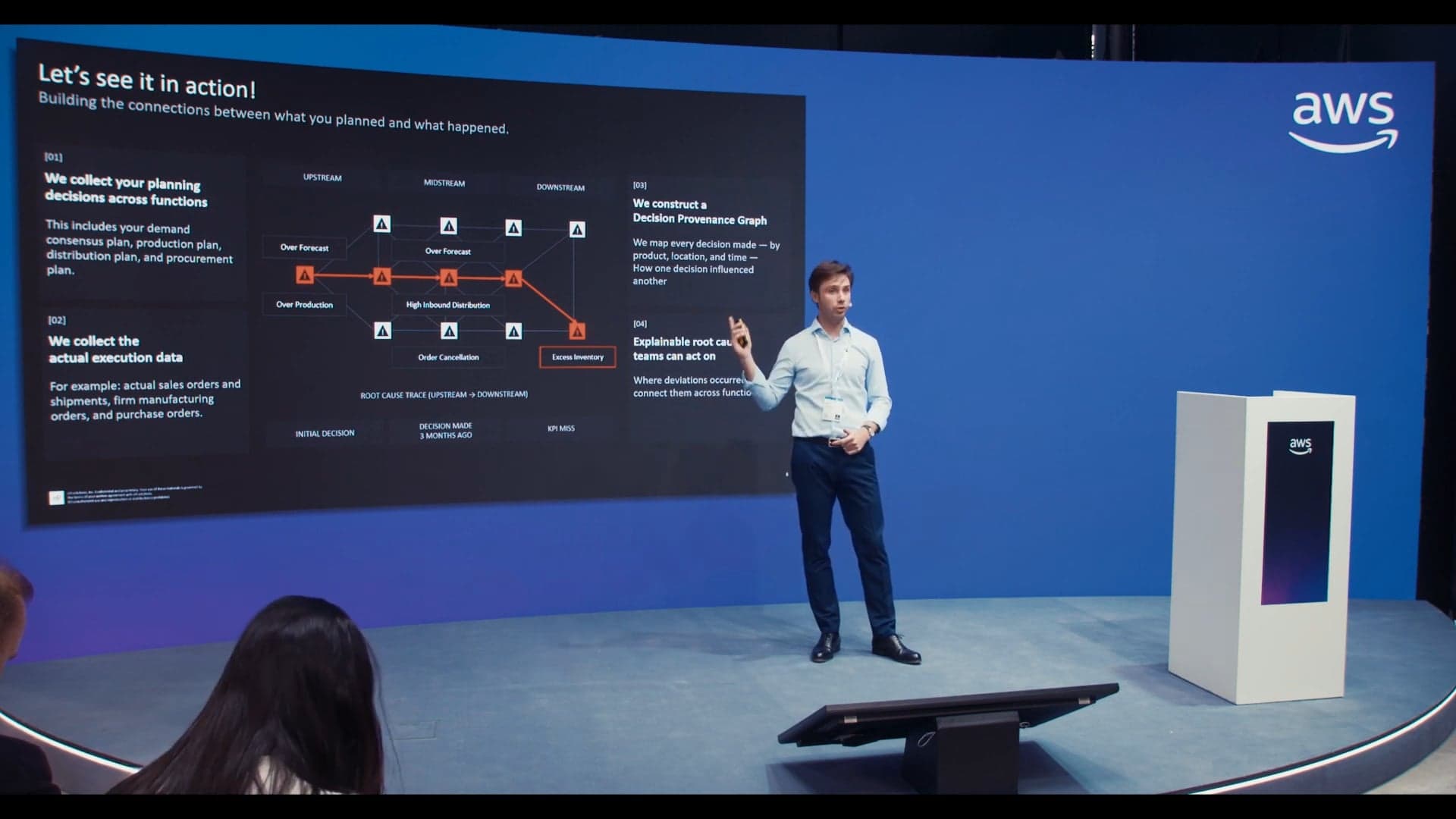
Understanding why execution deviates from plan has historically been one of the most time-consuming tasks for planning and commercial teams. Self-learning models integrated into the Digital Brain trace deviations back to the decisions that caused them. They analyze planning cycles, execution activities, and outcomes across time to uncover the specific sources of excess inventory, lost sales, or margin erosion.
By revealing the root causes, the system replaces crisis-driven transformations with continuous improvement. Organizations move from reactive course correction to proactive performance management, strengthening decision accuracy and reducing latency along the way.
AI agents expanding the impact of skilled roles
As enterprises build richer knowledge models, AI agents become essential partners in decision-making. These digital assistants can analyze past performance, model future conditions, and propose integrated commercial and supply chain actions, all in minutes. They reduce the analytical burden on planners and managers, allowing skilled individuals to manage broader scopes: more products, more customers, more suppliers, and more scenarios.
The distance between strategy and execution shrinks as AI agents prepare insights, simulate outcomes, and even generate alignment materials automatically. The result is a workforce focused on high-value thinking rather than manual data gathering.
Self-service innovation at the speed of strategy
One of the most important ways to reduce decision latency is to ensure the enterprise can evolve its capabilities as fast as its strategy evolves. The Digital Brain supports this through a self-service innovation model. Business-led teams, supported by low-code and no-code tools, can modify processes, automate policies, and introduce new decision workflows without waiting for lengthy transformation programs.
This model mirrors how digital-native companies operate, where continuous improvement is part of the organizational DNA. Enterprises that adopt this approach become more adaptive, more resilient, and far better positioned to respond to emerging opportunities.
“o9’s Agentic AI is distinctive because it is built on a decade-long symbolic foundation that captures how enterprises plan, decide, govern, and learn, then pairs that rigor with modern LLM capability to deliver neuro-symbolic agents that executives can trust in the real world.”
Dr. Ashwin Rao
Executive Vice President, AI Strategy and R&D
The shift toward APEX: Agile, Adaptive Planning & eXecution
The combination of next-generation AI, the Enterprise Knowledge Graph, and advanced digital decisioning capabilities culminates in o9’s APEX model. APEX represents a new performance standard where planning and execution operate with intelligence, synchronization, and touchless automation. It is both agile (capable of responding rapidly to market signals) and adaptive, continuously learning and improving.
In this model, planning gains deeper visibility and faster response cycles. Execution becomes more automated and more aligned with enterprise strategy. AI agents extend human capability. Learning models drive continuous improvement. And the organization as a whole becomes more capable of moving at market speed rather than legacy speed.
A Call to Leaders
Enterprises that begin measuring and reducing decision latency will gain an immediate performance edge. They will sense disruptions earlier, coordinate responses faster, and turn volatility into advantage rather than risk. And as the Digital Brain becomes the foundation of their operating model, decision-making will shift from a source of friction to a driver of growth, resilience, and efficiency.
Decision latency is no longer an invisible cost. It is a measurable KPI, a strategic differentiator, and a pathway to the next frontier of enterprise performance. The organizations that recognize this and transform their decision-making models today will define the standard for the decade ahead.
About the authors
Ashwin Rao
EVP of AI at o9 & Adjunct Professor at Stanford
Ashwin Rao is EVP-AI at o9 Solutions with the responsibility for o9's AI Strategy & Architecture as well as leading o9's R&D team. Ashwin is also an Adjunct Professor in Applied Mathematics at Stanford University, focusing his research and teaching in the field of Reinforcement Learning (RL), and has written a book on RL with applications in Finance, Supply-Chain and Dynamic Pricing. Previously, Ashwin was the Chief AI Officer at QXO, VP of AI at Target Corporation, Managing Director of Market Modeling at Morgan Stanley, and VP of Quant Trading Strategies at Goldman Sachs. Ashwin has a Ph.D. in Theoretical Computer Science from University of Southern California and a B.Tech in Computer Science from IIT-Bombay. Ashwin resides in Palo Alto, CA.