AI-Driven Long Range Planning (LRP) Software for Enterprises


UNLOCKING BILLIONS IN VALUE FOR CLIENTS IN 30+ INDUSTRIES
Build strategic plans for your organization over a longer time horizon. Forward-looking, data-backed insights so your plan is prepared for anything. Translate long-term strategy into an executable, resilient operating model.
Long Range Planning on the o9 Digital Brain enables organizations to evaluate strategic decisions over a multi-year horizon while remaining grounded in operational and financial reality. Rather than treating strategy as a qualitative exercise, LRP creates a data-driven bridge between ambition and feasibility. LRP takes a current business plan and executes on future decisions for the next 3-5 years.
Organizations use LRP to assess growth initiatives, capacity investments, network design, and sustainability commitments — understanding trade-offs and risks before committing capital.
Business challenges organizations face
Long-term strategies often fail not because the vision is wrong, but because the path to execution is unclear or unrealistic. Strategic targets are set without sufficient understanding of capacity constraints, supplier limitations, capital requirements, or network complexity. As a result, organizations find themselves reacting later with expedited investments, compromised service, or missed commitments.
This challenge is compounded by volatility. Macroeconomic shifts, geopolitical uncertainty, commodity price fluctuations, and regulatory change can quickly invalidate assumptions made years in advance. When long-range plans are built in spreadsheets and revisited infrequently, they become brittle — providing false confidence rather than guidance.
Modern Long Range Planning addresses these challenges by embedding operational and financial constraints directly into strategic evaluation. It allows organizations to stress-test ambition, quantify risk, and understand what it will truly take to deliver on long-term goals.
From Aspirational Strategy to Executable Roadmaps
Leading organizations are moving away from static, once-a-year strategic plans toward continuously evaluated strategic roadmaps. Instead of locking assumptions for multiple years, they revisit scenarios as conditions change — without starting from scratch.
In this model, LRP becomes the bridge between strategy and execution. Strategic choices flow into mid-term planning and annual targets, while feedback from execution informs long-term assumptions. This ensures that strategy remains connected to reality and evolves as the business evolves.
What this solution enables
What Makes o9 Different
Industries Supported
































Powered by the o9 Digital Brain
Sales & Operations Planning runs on the o9 Digital Brain, powered by the Enterprise Knowledge Graph (EKG). The EKG models relationships across products, customers, locations, resources, and financial structures, creating a digital twin of the planning environment.
This architecture enables fluid aggregation and disaggregation, allowing executives to plan at an enterprise level while planners validate feasibility at detailed levels — all within the same model.
Modular by design, enterprise by default
o9 accelerates S&OP deployment through modular building blocks that establish core data models, workflows, and governance. These include demand planning, supply and capacity planning, inventory modeling, and financial reconciliation, all operating on a shared foundation.
Organizations can adopt these capabilities incrementally while maintaining alignment with broader IBP objectives.
Core Building Blocks
These foundational components establish shared data, network visibility, and collaborative workflows across the supplier ecosystem.
Advanced Building Blocks
These components apply AI and automation to turn collaboration into proactive orchestration and resilience.

A digital operating model for VUCA conditions
APEX is o9’s AI-powered operating model for enterprises navigating volatility, uncertainty, complexity, and ambiguity (VUCA). It enables organizations to plan, execute, and learn as one connected system.

The o9 Digital Brain powers APEX by connecting enterprise data, knowledge, and decisions through a single intelligent model.
Collaborative Demand Planning is one of the building blocks of the Digital Brain. It contributes domain-specific capabilities into the enterprise-wide model that enables APEX from the ground up—linking this solution to decisions across the entire value chain.
→ Learn how the APEX Operating Model works
Where AI drives real decisions
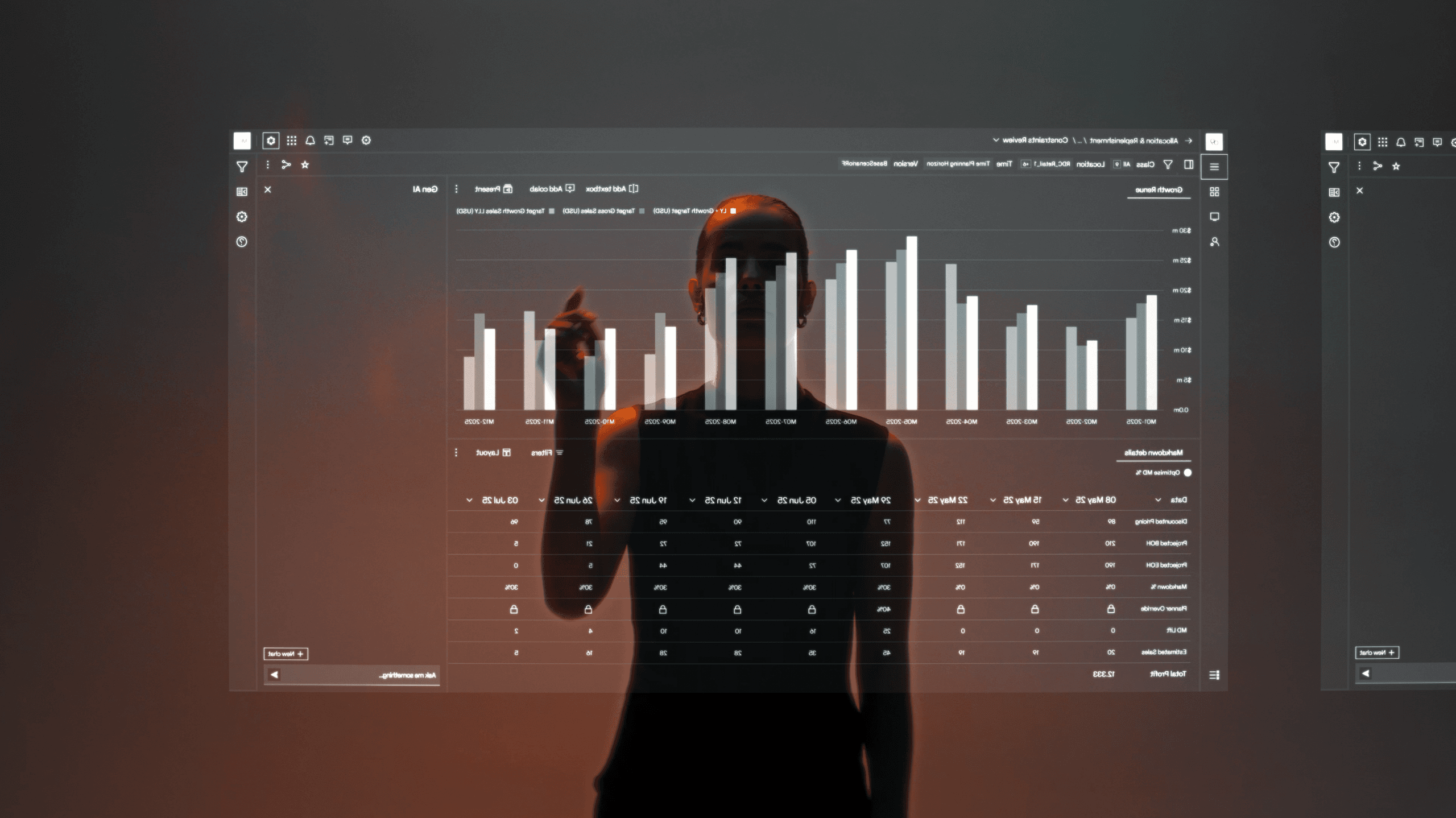
Artificial intelligence enhances LRP by expanding the range and quality of scenarios organizations can evaluate.
Machine learning models incorporate external market signals, macroeconomic indicators, and historical trends to inform long-term demand assumptions.
Probabilistic forecasting generates demand ranges rather than single-point estimates, allowing leaders to understand uncertainty and risk.
AI-driven analysis highlights the key drivers and constraints shaping long-term outcomes, focusing attention where it matters most.
Generative AI enables natural-language exploration of strategic scenarios, allowing executives to ask questions, compare options, and document rationale directly within the planning environment.
→ Learn more about o9 AI innovations
Results in real-world complexity
What our customers say
“So with IBP, what we are achieving now is one single source of truth. Everyone aligns behind one number, with the ultimate accountability for IBP being the general manager. So you take the power out of the functions and give it to the general manager to run the business as they see fit, which is unbelievable.”
Dr. Athina Kanioura
Chief Strategy and Transformation Officer
Related solutions

Long Range Planning (LRP)
Build strategic plans for your organization over a longer time horizon. Forward-looking, data-backed insights so your plan is prepared for anything. Translate long-term strategy into an executable, resilient operating model.

Collaborative Demand Planning
Collaborative Demand Planning on the o9 Digital Brain enables cross-functional teams to co-create, reconcile, and commit to a single, transparent demand plan, powered by shared assumptions, real-time collaboration, and AI-driven automation.

Multi-Echelon Inventory Optimization (MEIO)

Frequently Asked Questions (FAQ)
Long Range Planning embeds operational and financial constraints directly into strategic evaluation, ensuring long-term plans are executable.