8 read min
One of the core challenges facing Integrated Business Planning (IBP) today is that it struggles to support decision-making that optimally benefits the entire Profit and Loss (P&L) statement. This issue arises from a combination of conflicting incentives among various functions and, more fundamentally, the incomplete integration of data and decision-making processes across functions such as Sales, Marketing, Procurement, and Finance. As a result, when companies attempt to make decisions that span multiple functions or evaluate trade-offs, they often lack accurate assessments of the integrated impacts.
Currently, it is nearly impossible to understand the estimated operational costs of a Commercial activity within existing IBP solutions. The absence of full integration means that disparate data from various sources must be manually compiled in tools like Excel to generate these estimates. Unfortunately, these estimates are frequently inaccurate, and there is a lack of a centralized repository for analyzing these estimates and assumptions post-implementation. Consequently, the linchpin for a successful IBP capability lies in robust Data Management and Integration, addressing the foundational need for seamless coordination and accuracy in decision-making processes.
Ensuring Data Integration Across Functions (Including Shared Algorithms)
A robust IBP solution excels in handling intricate commercial decisions, such as determining investments in promotions, above-the-line (ATL) media spending, and New Product Introductions (NPI). It efficiently translates these decisions into key operational data, ensuring an optimal P&L impact. Moreover, for companies venturing into algorithmic approaches, consistency is key. It is imperative that the same algorithms power both Commercial decision-making (specifically Revenue Growth Management) and demand predictions across the Commercial, Supply Chain, and Finance teams. Achieving this alignment ensures a seamless and cohesive approach to decision-making. This is working extremely well for one of the world’s leading food & beverage companies:
Algorithms must be transparent to end users, allowing them to understand their logic regardless of their functional role.
Enhancing Agility: Leveraging Platform Flexibility and Extensibility for Seamless Integration of New Data Sources with Graph Technology
To optimize decisions on Price Pack Architecture or similar aspects, companies require not just internal data but also external sources like IRI or Nielsen. With evolving market routes and increasing data availability, however, the landscape of data sources for ingestion constantly expands or changes. Therefore, a technology with inherent flexibility is crucial. Graph technology - like o9's Enterprise Knowledge Graph (EKG) - enables companies to construct a model and easily modify its structure. These models are adaptable, allowing for seamless incorporation of new demand drivers, channels, or any other datasets. o9's EKG technology also facilitates effortless adjustments to the core characteristics of the business and relevant Key Performance Indicators (KPIs). For instance, Consumer Packaged Goods (CPG) companies can transition from linear to circular business models and align the key KPIs accordingly.
Adopting an open architecture is crucial for ensuring adaptability and scalability in your platform. In the case of o9 customers, this translates to the ability to utilize a core common data model while incorporating specific customer extensions. Unlike legacy solutions, the o9 platform allows for unlimited objects, hierarchies, and attributes, providing unparalleled flexibility and customization.
Consequential Decision-Making in IBP Meetings Requires Cross-Functional Simulations
To enable consequential decision-making in IBP meetings, not only do you need a platform that integrates data from different functions, but it also needs to be able to run powerful simulations (scenario plans) to equip decision-makers with accurate and actionable insights.
Ideally, the Data, analytics, and impact information necessary to make decisions should be known and shared upfront. Leaders can therefore analyze (in full) the possible scenarios to consider, and the monetary/nonmonetary impacts. However, new and innovative ideas can emerge at any time, underscoring the need to execute cross-functional decisions seamlessly during IBP meetings. Granting all functions access to these cross-functional simulations plays a crucial role in mitigating bias in decision-making, as all stakeholders can objectively review the data within a trusted platform. This stands in contrast to the uncertainty surrounding the source data when dealing with hastily assembled Excel-based scenarios. Besides their inherent inaccuracy, scenario plans created in Excel erode trust and are more susceptible to data or scenario manipulation.
The inclusion of on-platform IBP meetings as promoted by o9 also helps to build this trust. Risks and opportunities source data can be shared in the o9 platform as well as the underlying assumptions.
The Imperative of a Truly Cross-Chasm IBP Platform
Companies often attempt to establish a connection between Sales and Demand Planning solutions in the IBP process - and then consider the job done. However, linking just two or three functions falls short; a genuine IBP platform must extend its connectivity from Marketing and Revenue Growth teams to Production and Procurement plans, or at least aspire to do so. While an IBP platform may initially focus on connecting Sales and Demand Planning, its evolution should encompass all functions involved in making commercial or operational decisions.
o9 stands out in steering the directional P&L of businesses due to its unparalleled cross-functional and cross-chasm nature. Unlike other Planning software providers, o9 can delve further into Revenue Growth Management capabilities, analyze how commercial initiatives impact the business, and seamlessly propagate these insights to Production and Procurement plans - and vice versa.
Beyond P&L Data: Integrating Sustainability and Resiliency Metrics
Historically, IBP focused on optimizing a triangle of three elements - Service, Cost, and Cash - to optimize the P&L. In recent years, this paradigm has evolved from a virtuous triangle to a virtuous circle, incorporating two additional crucial elements: sustainability and resiliency. As the importance of integrating resiliency metrics into IBP decision-making grows, it becomes imperative for a company's IBP platform to seamlessly connect with Supplier Collaboration tools and incorporate data from key suppliers.
IBP platforms and scenario planning capabilities must also have the capacity to incorporate essential sustainability metrics. A prime example is the inclusion of carbon emissions data. Additionally, metrics such as single-use plastic tracking throughout the supply chain are vital, especially for industries like Food and Beverage. The ability to encompass these broader considerations is fundamental for a comprehensive and forward-looking IBP strategy.
Knowledge Assistants: the Next Frontier in Data Integration
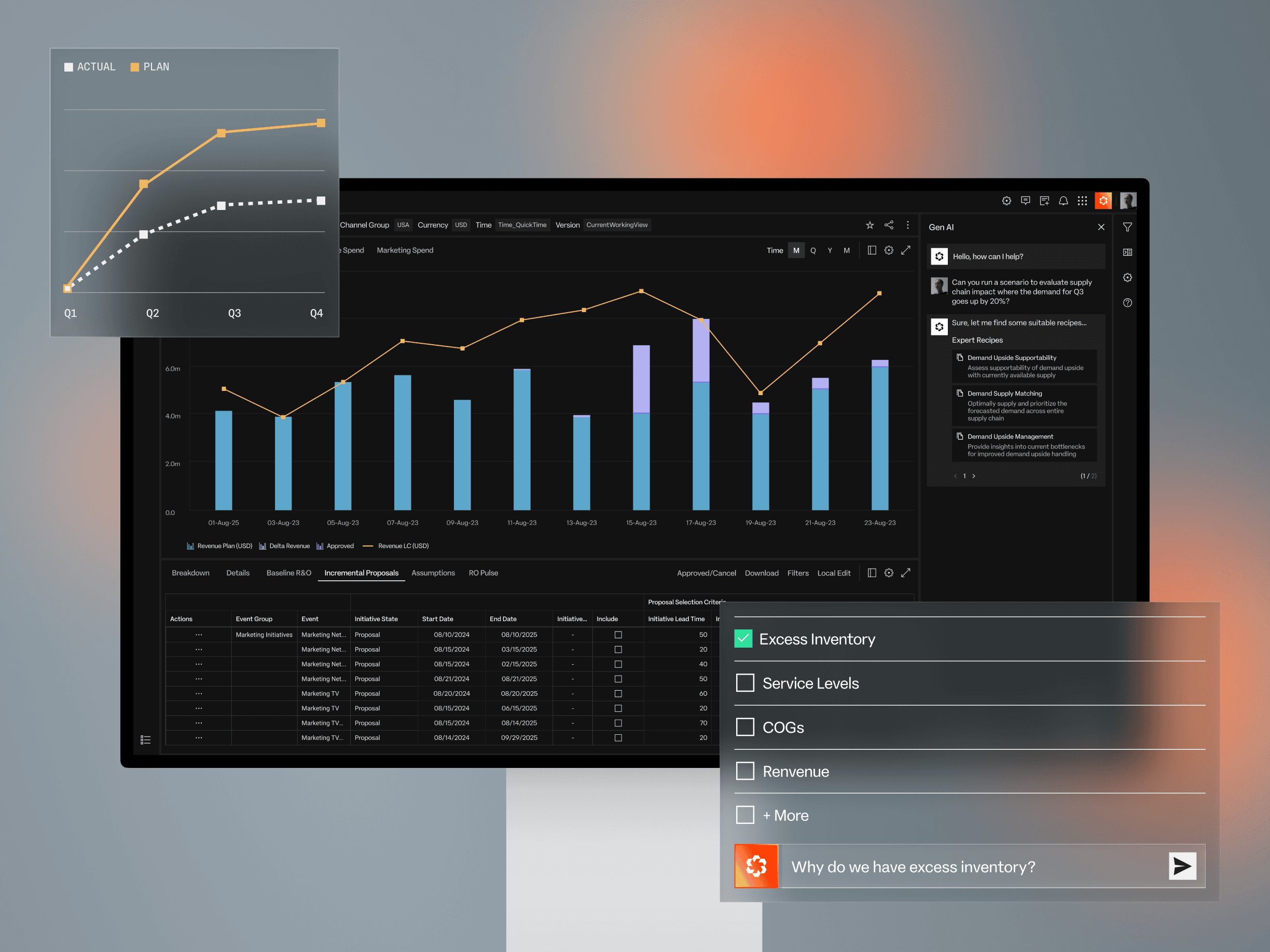
With the growing trend of end-to-end data integration, IBP analytics can now offer tailored recommendations for specific initiatives to bridge gaps and achieve desired revenue and profitability targets. Looking ahead, the future of addressing IBP business questions is anticipated to involve Chat GPT-style knowledge assistants. However, the effectiveness of these assistants hinges on having the right datasets and robust data integration within the Large Language Model (LLM) that underpins them.
As things progress, these knowledge assistants are poised to bring institutionalized organizational knowledge to users' fingertips. They are expected to learn from past decisions made across the organization, contributing to a more informed and adaptive approach to IBP processes. The synergy between advanced analytics, data integration, and knowledge assistants marks a transformative shift in how businesses navigate and optimize their planning strategies.
The success of a cross-functional IBP process lies in its ability to identify and seize opportunities that maximize shareholder value while efficiently utilizing company resources. Achieving optimization in this process is a complex task that heavily relies on the integration of data from all functions contributing to the P&L - a task easier said than done. Companies that excel in transformative IBP are those that successfully integrate data from all relevant functions. This shared data not only facilitates optimization but also plays a critical role in fostering trust and collaboration between functions. In essence, the ability to seamlessly integrate and leverage data becomes a cornerstone for effective and collaborative decision-making in the IBP process.

About the authors

Zarrin Lilani
Supply Chain Expert
Zarrin is a Supply Chain Leader and technology strategist who has built out Supply Chains and their supporting tech systems at organizations both large and small. Zarrin is passionate about building resilient and carbon-neutral Supply chains with a particular focus on sustainable food systems.