8 read min
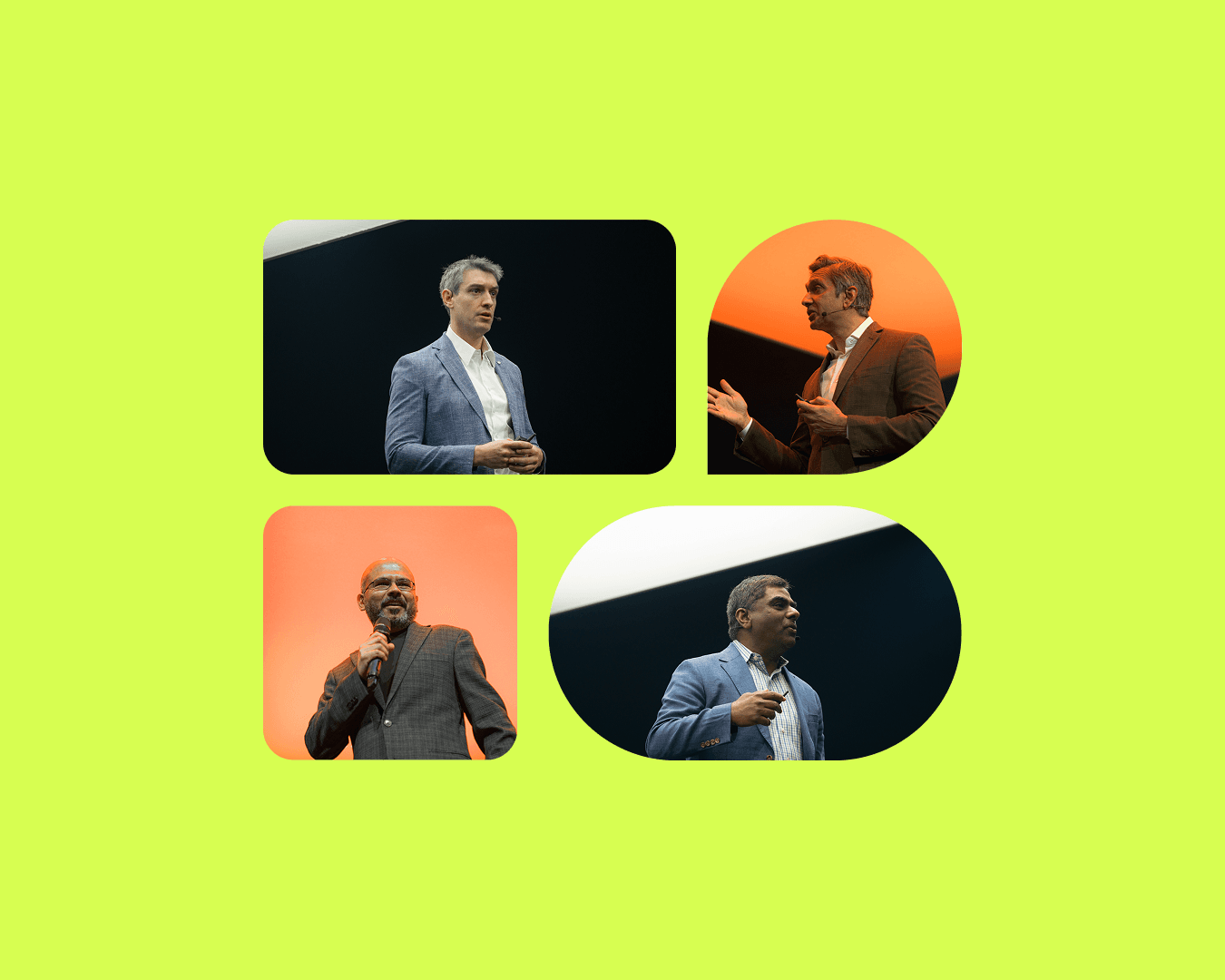
After two days of insightful and engaging keynote and panel sessions at aim10x global 2022, Innovators Connect took the discussion to the next level. Each session allowed participants to learn from and interact with senior leaders as they discussed critical topics from supply chain to sustainability. To watch the five sessions in their entirety, please visit aim10x global’s website to view the recordings on-demand.
The Future of Talent
Hiring and keeping top talent has always been a high priority for organizations. But what worked in the past may not work in the future. The Future of Talent session opened with Rohit Sathe explaining how the convergence of increasing disruptions, technology advances, and evolving employee preferences has necessitated a new approach to attracting, retaining, and upskilling talent.
While Rohit highlighted the importance of upskilling people for a technology-enabled future, keeping talented people is equally critical from Brandon Curry’s perspective.
While he clarified that competitively compensating top talent is also critical for retention, he cited a recent study at MIT in which participants had to choose between higher compensation or a lateral development move. The researchers found that those employees who chose the growth opportunity were 2.5 times more likely to stay with their employers.
The discussion shifted from retaining employees to upskilling them, both from an employer and employee perspective. On the employer side, according to Brandon, providing a combination of training and growth opportunities is vital for upskilling and retaining people. Rohit listed “finding the right manager” as a critical action for employees looking to upskill themselves. “Finding the right manager can do wonders for your career [because they] will give you the opportunities to learn, the opportunities to earn, the platform, the exposure, the visibility, and the mentorship required to build out your career,” he added.
Supply Chain Resilience
Angela Qu and her team had to act quickly when the pandemic struck. Their planes were grounded, and revenue had come to a screeching halt. During this period of intense uncertainty, Angela and her team developed a crisis checklist—a list of sixteen strategies for leaders to follow during times of crisis.
She led the discussion by exploring the four most important strategies on the list. The number-one strategy was to have open and honest communication with suppliers. “It wasn’t just us having this problem,” said Angela. “Our suppliers were having a huge problem as well.” Transparent communication about Lufthansa’s grounded planes and stalled revenue allowed her and her team to assuage the worries of their supplier network and calm any doubts about insolvency. The second most important strategy was maintaining the team’s integrity and ethical standards despite increasing pressures. With planes grounded, Lufthansa decided to continue paying suppliers even when some airlines in a similar position did not. The third strategy was to create transparency in the supplier portfolio, segmenting critical versus non-critical parts. The fourth was to keep corporate responsibility in mind by supporting suppliers in weaker positions.
Angela’s crisis checklist also included strategies for protecting the well-being of people during a crisis. “Put people first,” “Keep a clear line of communication open,” and “Stay connected and keep yourself available to your team” were at the top of her list. Whether Angela was protecting the business, the well-being of its people, or the suppliers, the importance of practicing compassion was a common thread. She concluded the session by defining compassion as “understanding the other person—or the other organization’s experience—and being willing to support them.”
Advanced S&OP and Integrated Business Planning
Chris Tyas had seen it all. Then the pandemic struck. “In the last two years, we’ve seen more change in supply chain than most of us saw in the last twenty years,” said Chris. Drawing on his forty-plus years of experience in the consumer goods industry, he detailed why the changing supply chain landscape has led to S&OP and integrated business planning becoming more critical than ever. Such a changing landscape “has led to a need to plan, replan, and plan again,” he added. Many organizations have increased the frequency of their S&OP cycles from monthly to weekly to even daily.
Increasing volatility and complexity means enterprises need a fundamentally new planning capability. This capability must enable them to make data-driven decisions at the speed and scale required. To improve the quality and speed of planning, “having data is critical,” said Chris. But having data is not enough. “The insights that the data produces are actually supreme.” Insights that, in order to be discovered, require “proper tools, analysis, and real talent.”
He continued by highlighting the importance of aligned and integrated decision-making. “We have to have concurrent decision-making. We cannot have consecutive decision-making,” he stated. “Integrated business planning across the functions of finance, supply chain, sales, and marketing has become absolutely paramount.” But integration must go further than the organization itself. Collaboration with partners, stakeholders, and even regulators is also essential. He closed the session by emphasizing the need to attract, hire, and retain talented people, expose them to leading-edge technology and processes, and support education and training to bring out the best in them.
S&OE and Control Tower
In times of crisis, the quality and speed of execution is critical. Philippe Lambotte started off the session by listing his top five principles to improve execution and better manage disruptions. The first principle is having a clear crisis escalation process—all the way to the CEO.
Such an escalation flow allows enterprises to have “an ongoing process to digest all of those permanent ongoing problems.” He then emphasized that this escalation process must be “multi-functional” and work “across the entire business.”
The session then shifted to the topic of real-time visibility and the importance of having “outside-in” sensing capabilities to better manage disruptions and understand demand. Said Philippe, “the whole demand world is changing. Are you just comparing a market share of products that are very similar to yours, and are you missing the point that there’s an entire other demand channel that has been created that you’re not even seeing?” Philippe then stressed the importance of being able to model different scenarios. “Modeling is about being much more proactive,” he said. “Do I go one way or another? At what point do I trigger air freight? Do I produce in Mexico versus Taiwan? All of those were things that needed to be done in crisis times. But now they have to be done on a permanent basis.”
Fred Baumann closed out the session by providing a high-level overview of the Control Tower solution. He explained how it enables real-time supply chain visibility, demand sensing, ‘what if’ scenario modeling, and better execution. He walked participants through the five key capabilities of a Control Tower: sensing unplanned events like disruptions or new demand, calculating their impact, prescribing optimal resolutions, enabling process orchestration for better execution, and learning from the outcomes to improve future protocols. He then shared a series of use cases, explained how they align with S&OE objectives, and emphasized the importance of a prioritized, agile, and iterative approach to implementation.
The Sustainability Forum
Awareness is not enough—this was a central theme that emerged from the very beginning of Darina Elencheva’s session on sustainability. While some organizations have shifted focus from generating awareness to achieving their sustainability goals, Darina explained it’s more important for organizations to focus on the “why” rather than solely the “what” of sustainability. Shared Darina, “[Sustainability] is not just about ticking boxes and meeting KPIs. Organizations must also work to align on a common purpose and vision. Only by having this collective mindset can we bring progress and go forward.”
Darina continued by listing organizations’ biggest pain points in delivering against their sustainability targets. Though data reporting and standardization for sustainability has become a popular topic, the gathering and standardization of the data is a massive challenge. “Very few companies are prepared to do this,” said Darina. In discussing what organizations can do to overcome these pain points, she recommended creating easy-to-use and easy-to-understand practices, guidelines, and solutions for sustainability. However, this must also be supported with tools. In Darina’s mind, integrating the many tools used for sustainability metrics and reporting is a tall task: “There are so many tools and we need a way to consolidate them.”
Darina emphasized that there is no quick fix for sustainability, “There is no one-size solution that fits all. Why? Well, it’s because every company is different. It has a different culture and a different setting. It has a different scope. And it has different expectations from its customers and its employees.” She closed out the discussion with a message for all who undertake sustainability and digital transformation initiatives: “Whatever we do, we need to make sure that we make it relevant for the environment we move and work within. And we need to write our own story.”

Want more insights from the event?
Read our recap blogs from day one, day two, and day three of aim10x global 2022.
Get the recordings on-demand.
Visit the aim10x global website to watch all of the session recordings on-demand.
Have a question?
Do you have a question, feedback, or a request related to the event? Get in touch with us at [email protected].
About the authors

Cameron Tyler Chang
Senior Copywriter and Editor, CSCP
Cameron is a senior copywriter and editor at o9 who is passionate about making business and technology human through the power of the written word. With an advanced degree in communications and an APICS CSCP certificate, he leverages a unique combination of writing skills and domain-specific knowledge to make o9’s business writing leap off the page. His non-supply-chain-related work has been featured in HuffPost and The Washington Post.