8 read min
Amsterdam, NL – AI is no longer just a buzzword in strategy decks. It’s becoming a real force in how businesses operate. What once felt like a distant bet is now a top priority in boardrooms across industries. For instance, Gartner predicts that by 2026, more than 80% of enterprises will have tested or implemented GenAI tools, a considerable leap from under 5% in 2023. At the same time, McKinsey reports that nearly 70% of executives expect AI to materially reshape their operating models within three years.
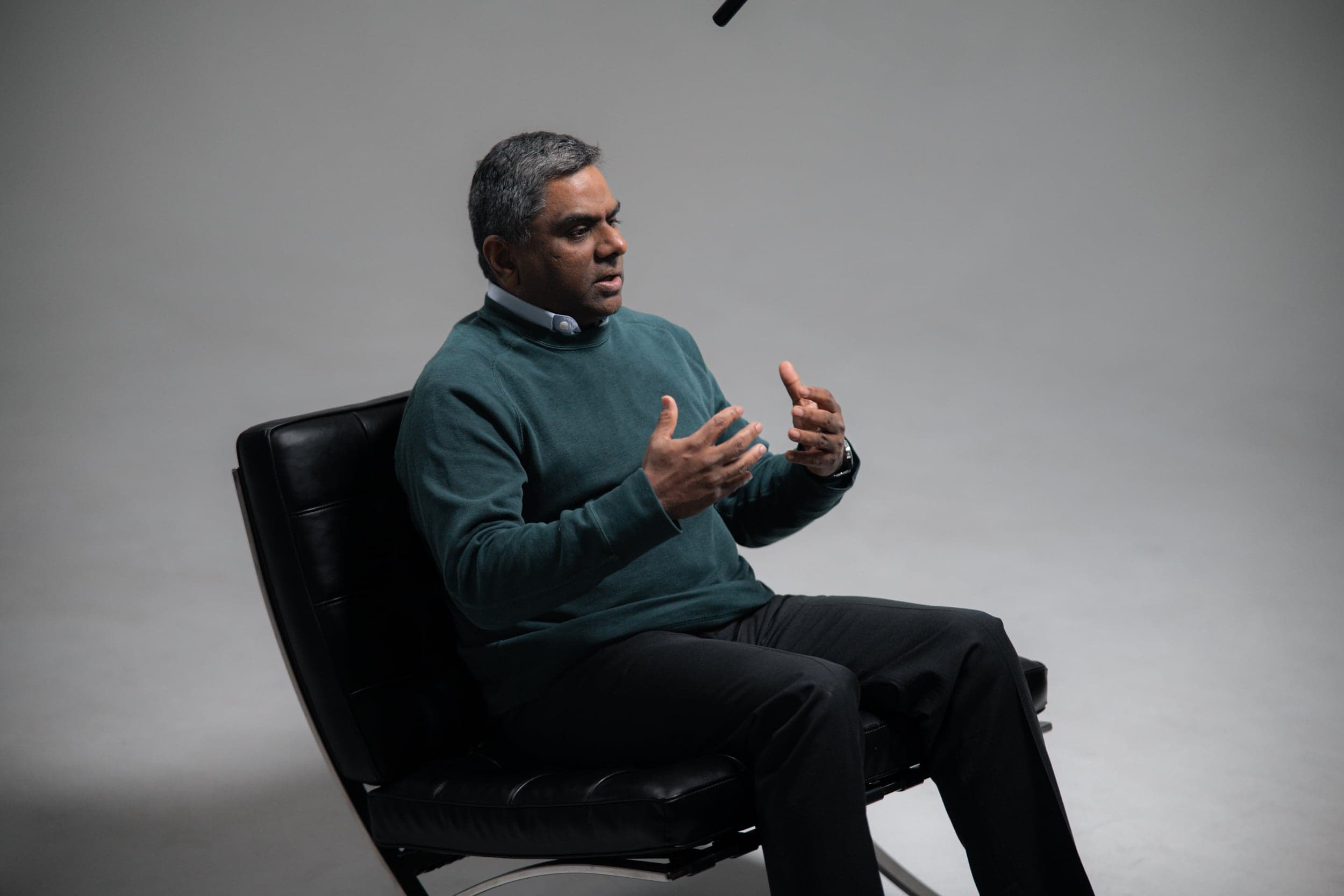
Still, one burning question remains for many leaders: how do you move beyond pilots and proof-of-concepts to deliver real, scalable value? In his opening keynote at aim10x Europe, o9 Co-Founder and CEO Chakri Gottemukkala didn’t stick to slides; he showed the audience what’s possible. Through live demos, he showcased several of o9’s latest AI innovations in action, making it clear that this technology isn’t just theoretical anymore. It’s tangible, it’s evolving fast, and it’s moving straight into the heart of how businesses plan and make decisions.
Rethinking Enterprise Planning: From Complexity to Execution
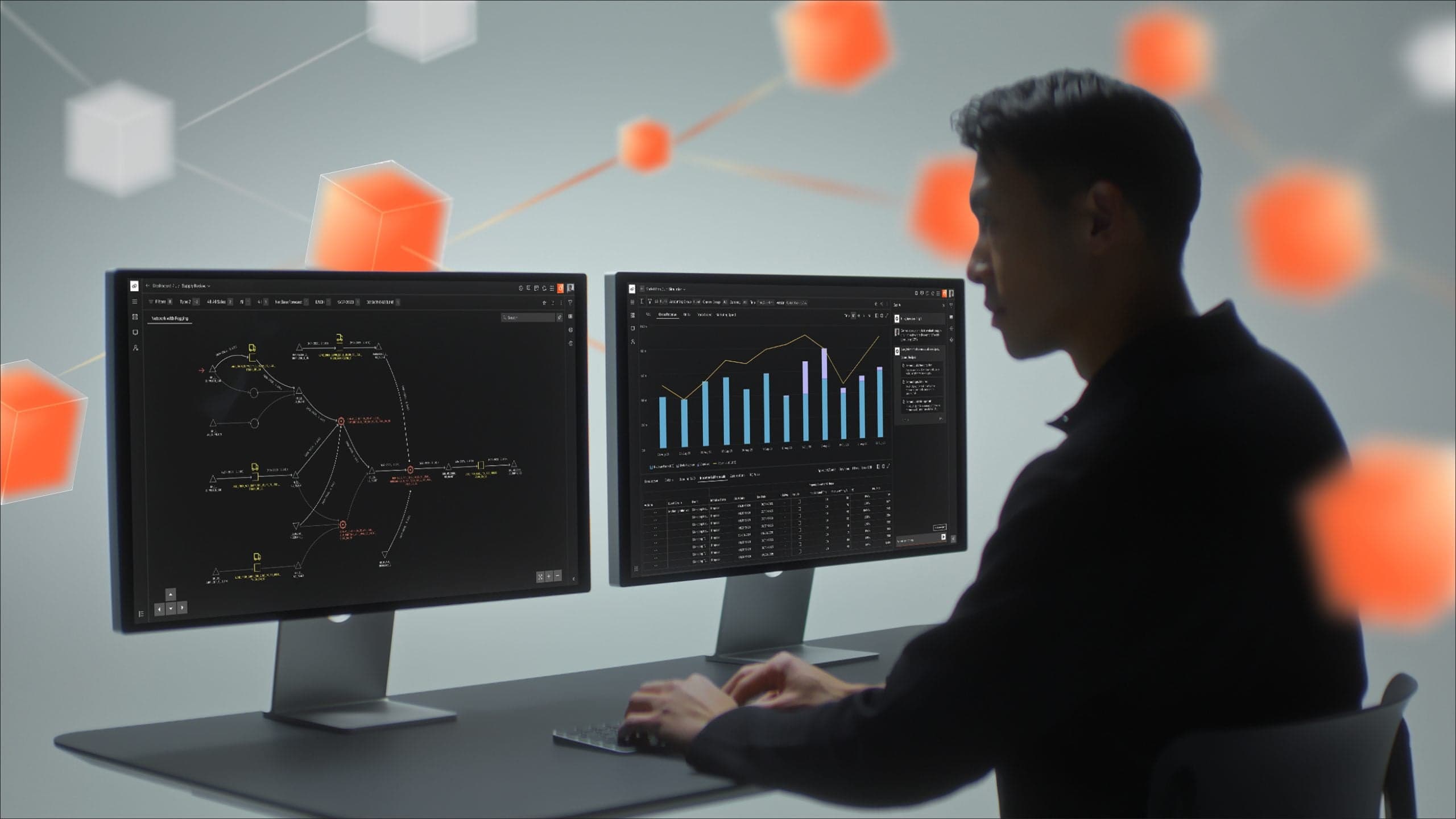
Chakri opened by challenging the traditional view of companies as hierarchies of roles and functions. Instead, he urged the audience to see the enterprise as a network of decisions that must continuously respond to shifting market dynamics. These decisions, spanning sales, marketing, supply chain planning, and procurement, interact closely. A shift in price planning and optimization impacts customer demand, which affects warehouse and production capacity needs and ultimately shapes procurement requirements. As Chakri put it, enterprises operate as tightly linked systems of decision-making.
This interdependence drives enormous complexity. Global businesses managing hundreds of thousands of SKUs must coordinate billions of decisions daily. But the issue, he noted, isn’t just scale, it’s fragmentation. As companies grew, they distributed decision-making across siloed departments, each with its own systems and goals. “Sales is focused on revenue growth. Supply chain is focused on cost and inventory. Value leaks in between,” he said.
This challenge led o9’s founders to rethink the architecture of enterprise planning. The result was the o9 Digital Brain, powered by the Enterprise Knowledge Graph, or EKG, which captures the relationships, constraints, and trade-offs required for cross-functional decision-making. “No technology existed that could model the complexity of both commercial and supply chain decisions,” Chakri explained. “That was the innovation behind the knowledge graph.”
Today, companies across more than 30 industries rely on the Digital Brain to drive measurable value. At Anheuser-Busch InBev, for example, the CFO approved a billion-dollar stock buyback, citing supply chain performance improvements enabled by o9. In ABI’s advanced markets, teams now run 90 percent of planning processes without manual intervention.
“But the touchless mindset is not just about productivity,” he added. “It’s a driver of change. Every time someone touches a plan, are they adding value or destroying it?”
The Role of AI: Increasing Intelligence, Automation, and Span of Control
Building on this foundation, o9’s latest leap forward is powered by Agentic AI. Chakri described this next frontier as one where AI doesn’t just support planning, it transforms it. Specifically, he outlined three dimensions of AI impact: intelligence, automation, and what he called “span of control.” In other words, the ability for a single user to influence a broader set of decisions.
To illustrate this, he described how some companies operate with planning teams exceeding 1,000 people. Now, executives are asking whether they can reduce that number dramatically by automating repetitive tasks and focusing human capital on strategy.
This shift is already underway. o9 has piloted AI agents that surface insights, evaluate scenarios, and recommend actions autonomously. One such agent can mine transcripts and unstructured data to detect recent market shifts or competitive threats. “It connects to the knowledge graph. It understands categories, customers, SKUs, and can surface previously invisible opportunities,” he explained.
As a result, planners can now simulate what-if scenarios, assess demand supportability, and evaluate financial trade-offs, all using natural language. This fundamentally changes how teams access and act on information.
“Enterprises are going to generate far fewer reports,” he said. “Because now, the information just comes to you.”
Closing the Loop: An Agentic AI-Driven Decision-Replay System
To show where Agentic AI is headed next, Chakri introduced one of the most compelling applications: post-game analysis. Despite investments in forecasting and planning, most enterprises still lack a feedback loop to close the execution gap. Plans often diverge from reality. Inventory builds. Orders cancel. Forecasts miss. Yet teams rarely understand why.
“Enterprises have visibility into the what,” he said. “But they do not have visibility into the why.”
To solve this, o9 has developed a Decision Replay System, modeled after post-game analysis in sports. The platform records every planning decision, compares it to outcomes, and uses multi-layer causal analysis to explain what went wrong and how to fix it.
Self-learning models now detect whether inaccurate forecasts, overproduction, or flawed safety stock policies caused excess inventory. The system spans multiple planning cycles, ranks the most impactful deviations, and recommends specific corrective actions.
This is where Agentic AI becomes transformative. It autonomously learns from execution and feeds intelligence back into the planning loop. It doesn’t just improve decisions, it evolves them.
A Live Demo of the Decision-Replay Capability
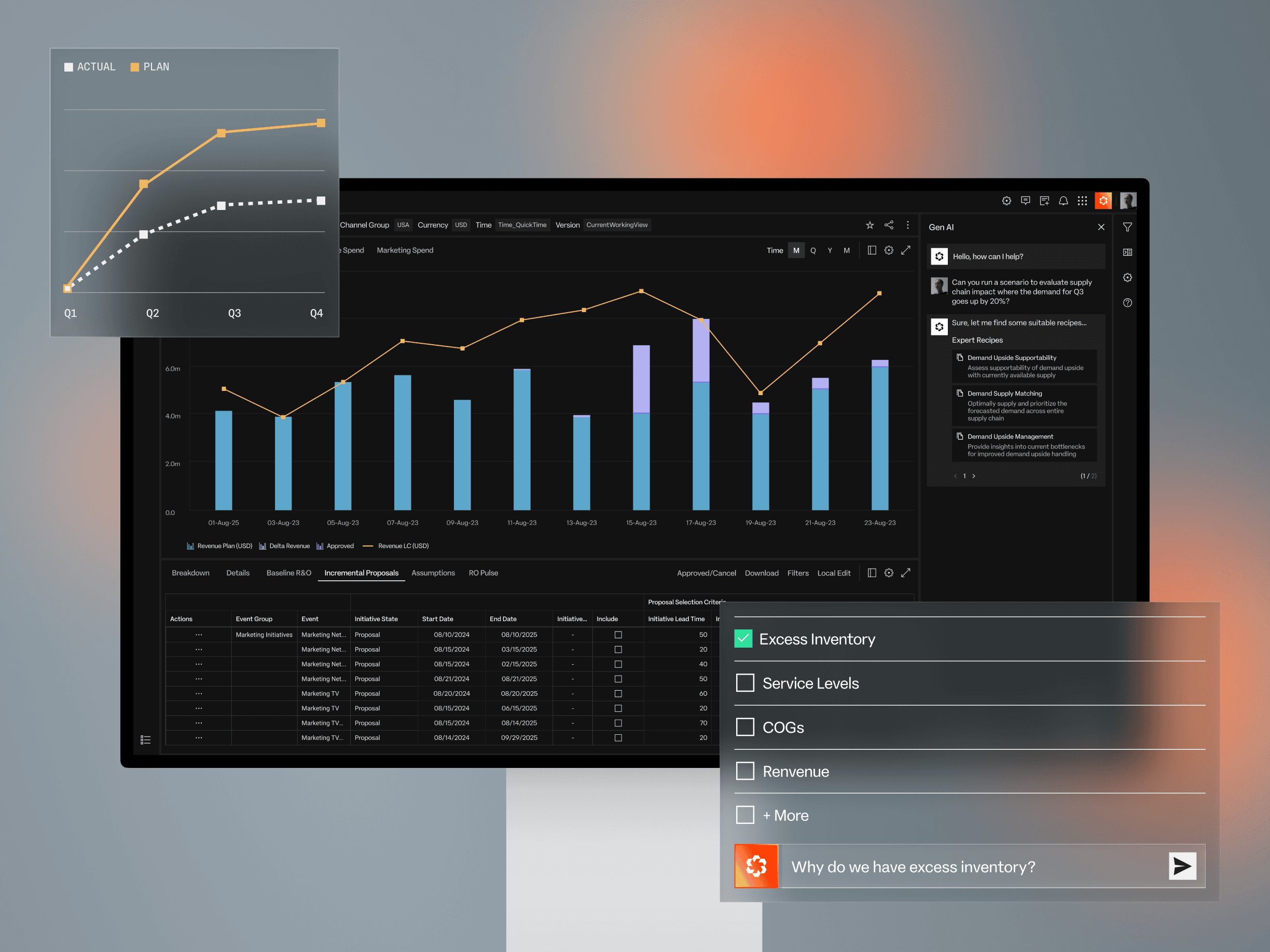
With o9’s Chief Product Officer, Umesh Arasu, operating the laptop, Chakri presented a live demo of the AI-driven Decision-Replay capability. In this example, a CFO observes a sudden $300M spike in excess inventory alongside declining service levels and seeks answers. Traditionally, uncovering the root cause would require weeks of cross-functional investigation. This time, however, an AI agent embedded in the o9 platform responded in real time.
Step 1: Quantify the problem
The agent accessed o9’s Enterprise Knowledge Graph to assess the scope of excess inventory and isolate high-risk SKUs. Applying an 80/20 lens, it prioritized the subset of product groups responsible for the most value leakage. As a result, leadership could focus on the areas with the greatest impact.
Step 2: Diagnose the root causes
Next, the system used multi-cycle decision records and self-learning models to identify a range of contributing factors:
- Forecast overrides that diverged from system recommendations
- Strategic bulk purchases made under outdated pricing assumptions
- Safety stock policies misaligned with current demand patterns
- Plant-level overproduction driven by misaligned performance incentives
- Customer order cancellations exceeding normal thresholds
Together, these issues revealed breakdowns across multiple layers of the planning and execution process.
Step 3: Recommend corrective actions
Then, the system synthesized its findings into an executive-ready summary, outlining targeted interventions and action owners, from revising inventory targets to analyzing competitor pricing. Importantly, these recommendations were not abstract; they were context-aware, SKU-specific, and based on empirical data.
Step 4: Institutionalize the learning loop
Finally, by codifying both decision intent and execution impact, the platform enabled enterprises to embed continuous improvement into their operating model. In doing so, it helped close the loop between planning and outcomes, turning isolated decisions into a system of learning and adaptation.
This capability represents a shift in how enterprises approach planning and performance management. Rather than relying on episodic transformations, organizations can now leverage AI to drive continuous, self-correcting improvement, with transparency, speed, and accountability.
The implications are significant for leadership teams. Value erosion due to unexamined decisions—long accepted as a cost of complexity—can now be identified, quantified, and mitigated. More importantly, this learning loop enables enterprises to evolve from static planners to adaptive systems.
“It is the biggest driver of change,” he said. “Once you shine a light on why things are going wrong, improvement becomes mandatory. That is the real secret to change management.”
Building at the Speed of Strategy
Chakri closed by returning to the strategic imperative. In today’s world, companies must launch new products, enter new channels, and shift supply chains with increasing speed. Yet, organizational agility is often constrained by inflexible systems and limited technical capacity.
“Executives don’t have the time to wait for ERP upgrades,” he said. “What do they do? They throw more people at the problem. But that creates inefficiency and slows everything down.”
To overcome this, o9 is investing in AI agents that not only automate decisions but help users evolve the platform itself. These agents can update configuration, create new workflows, and enable continuous innovation.
“We want our customers to build capabilities at the speed of strategy,” he concluded. “Don’t wait for us. Don’t wait for partners. AI is the future of planning and execution, and the platform to make that possible is already here.”
Looking Ahead
Chakri’s keynote at aim10x Europe marked a clear shift. Real, operational AI is shaping the future of enterprise planning and execution. It is grounded in data, structured through knowledge models, and built for scale, as seen in the o9 platform tour. What stood out was not only the sophistication of the technology but also its readiness for real-world use. This is an AI designed for the people making complex decisions every day.
As global enterprises face rising volatility, tighter margins, and mounting pressure to respond at speed, the ability to plan and act intelligently is becoming a defining advantage. The examples shared in Amsterdam did more than signal what is possible. They showed what is already taking shape.
About the authors

o9
The Digital Brain Platform
o9 Solutions is a leading Enterprise Knowledge and AI-powered platform helping companies build Agile, Adaptive & Autonomous Planning & Execution Models for transforming enterprise decision-making in environments of rising volatility and uncertainty. Whether it is improving forecast accuracy, matching demand and supply and driving collaboration across the multi-tier supply chain to improve resilience at optimal costs and inventory, or optimizing new product and commercial initiatives to drive revenue growth and margins, decision-making processes from long-range to tactical to execution horizon can be made faster and smarter and connected on o9’s Digital Brain Platform.
o9 brings together game-changing technology innovations — such as innovative enterprise knowledge graph modeling, big data analytics, advanced algorithms for forecasting, demand/supply balancing, scenario planning, real time learning, collaboration, generative and agentic AI, easy-to-use interfaces and cloud-based delivery, and innovative management methods — as well as organization, process and change management best practices to transform decision-making speed and intelligence.