7 read min
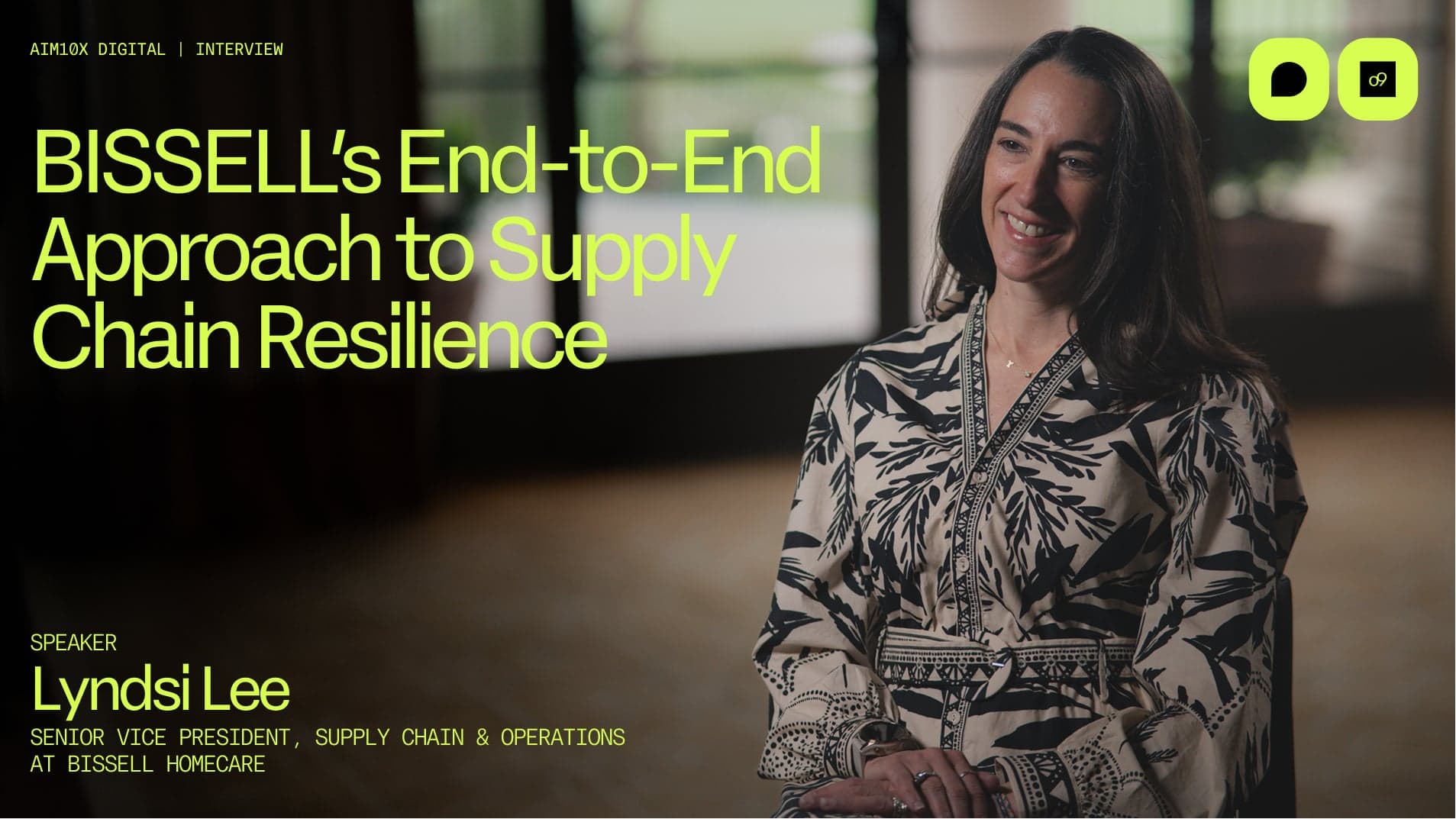
Lyndsi Lee joined BISSELL nearly five years ago, and when she did, she walked straight into one of the most turbulent periods supply chain leaders have ever faced. COVID was reshaping demand patterns, disrupting supply availability, and forcing companies to make decisions with imperfect data and very little time.
For Lee, who leads BISSELL’s end-to-end supply chain across plan, source, make, and deliver, that period became a defining lesson in what resilience really means.
“I would define resiliency as the ability to take change and volatility and really make it a competitive advantage,” she said.
That view fits naturally with BISSELL’s history. The company is celebrating 150 years, with roots going back to Melville BISSELL’s invention of the original carpet sweeper and the leadership of Anna BISSELL, one of the first female CEOs in the United States. Innovation has always been part of the company’s story, from pet-centric products to the continuous improvement mindset that Lee brings to supply chain.
For BISSELL, resilience is not simply about surviving disruption. It is about building the visibility, flexibility, and decision-making speed needed to turn volatility into better outcomes.
“There really was a burning platform for us to create this end-to-end visibility so that we could make decisions quickly and rapidly.”
From disruption to end-to-end visibility
Looking back to 2020, BISSELL was dealing with a familiar set of supply chain pressures: component shortages, container constraints, upside demand opportunities, and fragmented ways of working.
“We had a very fragmented organisation,” Lee said. “We had a relatively immature organisation. And so there were pockets of analytics. We didn't have a standard S&OP process.”
The challenge was not a lack of effort. It was the time and complexity required to understand the full picture. Components were shared across suppliers, products, and geographies. Decisions about which customers, regions, or products to prioritize required analysis that could take days or weeks.
“When I think back on COVID and the hours and hours and even weeks that it took for us to run different scenarios, we talked about container shortages. We talked about component shortages,” she said.
BISSELL needed a standard way to bring the data together and evaluate trade-offs across the business. With o9, the company could connect those decisions across its supply chain and run scenarios far faster.
“Instead of it taking weeks and weeks, it took hours,” Lee said. “With every executive whim, we were able to run different scenarios to know what the different trade-offs were.”
That shift gave the organization a clearer view of where components should go, which suppliers should receive them, and which products should be prioritized.
“[With o9] instead of it taking weeks and weeks, it took hours. With every executive whim, we were able to run different scenarios to know what the different trade-offs were.”
Lyndsi Lee
Senior Vice President, Supply Chain & Operations
Selecting a platform that could support the whole supply chain
When BISSELL began looking for a planning solution, the requirement was clear: the company needed an end-to-end platform.
“We wanted to be able to look inside our supplier's inventory, manage and constrain from a component perspective, do all of our planning processes, and most importantly, we wanted to be able to run scenarios efficiently,” Lee said.
Exception management was also critical. The goal was to move analysts away from firefighting and into proactive decision-making.
After a rigorous RFP process that lasted around six months, BISSELL selected o9. Lee said o9 was the only platform that offered the end-to-end solution the company was looking for.
As BISSELL migrated into o9, the business developed a more consistent weekly drumbeat through its S&OP process. Analysts gained access to better data and stronger scenario capabilities. Their work became less about rebuilding analysis and more about shaping decisions.
“They had the tools at their hands to run upside scenarios to actually drive conversation,” Lee said. “Their work has become much more impactful and rewarding.”
Letting the system do the work
One of the biggest changes came through multi-echelon inventory optimization, or MEIO.
Historically, BISSELL relied on rules of thumb to manage inventory. A planner might carry four to six weeks of supply for a SKU, but that logic quickly breaks down around major promotional events, demand volatility, or shifts in supply.
“MEIO changed the way that we approached inventory management very simplistically,” Lee said. “We let the system do the work.”
That meant moving away from emotion, guesswork, and blanket inventory buffers. Instead, o9 helped BISSELL optimize safety stock based on actual volatility in demand and supply.
The result was a powerful combination: lower safety stock and higher service levels.
“We were able to actually reduce safety stock pretty significantly, but we also increased our service level,” Lee said. “Take the emotion and the guesswork out of it.”
This also changed the role of inventory in the organization. Instead of using inventory as a catch-all buffer, BISSELL pushed more of the work into better demand planning and more precise supply chain decisions.
“We saw the magic combination of both of those elements of reduced inventory, but improved service levels.”
Building confidence through testing and results
The supply chain planning team adapted quickly to MEIO because many planners were already data oriented. They tested a focused set of SKUs, built confidence in the outputs, and created a safety net that allowed the team to learn into the change.
“They pretty quickly were on board with letting the system do the work,” Lee said.
The bigger change management challenge came from other stakeholders who were used to the legacy belief that strong service required carrying four, six, or eight weeks of inventory to cover volatility.
BISSELL’s customer-centric culture made that belief understandable. Service is a major differentiator for the company. But the data began to show that the business could improve service without relying on excess inventory.
The benefits became visible in several ways. Cross-regional shipments declined because inventory was better positioned. Chargebacks fell. Transportation and distribution costs improved. Inventory also decreased by around 10%, representing tens of millions of dollars.
“For us, really what manifested on the P&L were reduced chargebacks and reduced transportation costs,” Lee said.
Scenario planning as a weekly operating rhythm
Scenario planning has now become part of BISSELL’s weekly drumbeat.
Teams use it for upside and downside analysis, new product ramp planning, capacity constraints, tooling constraints, and major external events such as tariff changes.
Lee described a recent example where the team needed to evaluate the impact of new tariff announcements. The business had to understand whether to bring in additional inventory, stop production, assess serviceability, quantify chargeback risk, and evaluate revenue implications.
In the past, that kind of work took weeks. With o9, the team produced executive options in hours.
“They were able to put together options for the executive team to say, here are the cost implications of scenario A, here are the service implications… here are the revenue implications,” Lee said.
That enabled BISSELL to make informed decisions on tariff mitigation, supported by end-to-end data and a system the team trusted.
“Having end-to-end data, having a system that we were confident in the fidelity in, it gave the team the confidence to put forward the recommendations and to stand behind the recommendations.”
The advice: start moving
For Lee, the biggest lesson is that resilience cannot wait for perfect conditions.
“Nothing is going to be perfect,” she said. “Jumping in, making progress, having a continuous improvement mindset, I think is critical.”
BISSELL is still evolving its planning capabilities, but the foundation is now in place. The company has greater visibility, faster scenario planning, stronger inventory discipline, and a more resilient way to respond to volatility.
Her advice to other leaders is direct: don’t wait for perfection.
“You need the tools and the systems to support you… and to give you the confidence to know that you're dealing with the volatility as much as you can and even making it a competitive advantage,” Lee said.
For BISSELL, that is what resilience looks like in practice: fewer reactive decisions, faster trade-offs, better use of inventory, and a supply chain that can flex as the world changes.
Watch the full aim10x Digital 2026 video below.
About the authors

The Editorial Team, o9
A multidisciplinary collective of editors, strategists, technologists, and former executives with experience across Fortune 500 companies and top consulting firms. Grounded in o9’s mission to help enterprises make faster, better decisions through the power of AI-driven planning and execution software, the team shares clear, practical insights on digital transformation, supply chain, and enterprise planning to support business leaders in navigating complexity and driving change.