4 read min
Consider this scenario: a team is expediting a shipment to protect a customer commitment. The shipment arrives on time, but two days later, another facility runs short of the same inventory and misses an order with a greater financial consequence.
The team met its target, yet the enterprise lost value.
Now give an autonomous agent the same objective, incomplete context, and authority to act across thousands of orders. A weakness in decision-making becomes a much larger business problem.
I thought about this scenario while reading recent research from Stanford Medicine. Researchers identified separate developmental pathways for the forebrain and midbrain versus the hindbrain, supporting an interpretation of the brain as a composite of systems with distinct origins.
While the research concerns brain development, my business analogy also illustrates how specialized capabilities work together: planning and execution require distinct capabilities, connected by shared objectives and continuous feedback. Planning evaluates alternatives, allocates resources, and establishes priorities. Execution responds to changing conditions and turns decisions into action. Both involve judgment and both need visibility into the consequences of their choices.
As agents assume more decision authority, the quality of this connection deserves greater leadership attention.
Shared data is only the starting point
Two agents might access identical inventory records and still make conflicting decisions. One prioritizes customer service. Another minimizes transportation costs. A third protects production continuity.
Each agent needs the enterprise priorities governing these trade-offs, the dependencies between decisions, and the boundaries of its authority. Someone must remain accountable for resolving conflicts when existing policies provide no clear answer.
Decision history matters too. Why was inventory reserved? Which customer commitment justified the allocation? What assumptions supported the plan? This is the shared intelligence planning and execution require: business context sufficient to evaluate an action beyond the immediate task.
At o9, we describe our direction as APEX: Agile, Adaptive, Autonomous Planning and Execution. The three capabilities reinforce one another.
- Agile means responding quickly with an enterprise view. In the shipment example, the response would evaluate requirements across both facilities, compare transfer and transportation options, and assess the effect on customer commitments, margin, and cost.
- Adaptive means improving the rules and models behind future decisions. Following the shortage, the organization might revise inventory allocation policies, update supplier lead-time assumptions, or change when a conflict requires escalation.
- Autonomous means executing approved decisions within those boundaries. An agent proceeds when a transfer meets established service, inventory, and spending conditions. An unresolved conflict between customer commitments goes to an accountable decision owner.
The same operational event connects all three capabilities. The organization responds, learns, and establishes where future decisions should proceed autonomously.
Learning requires more than resolving an exception
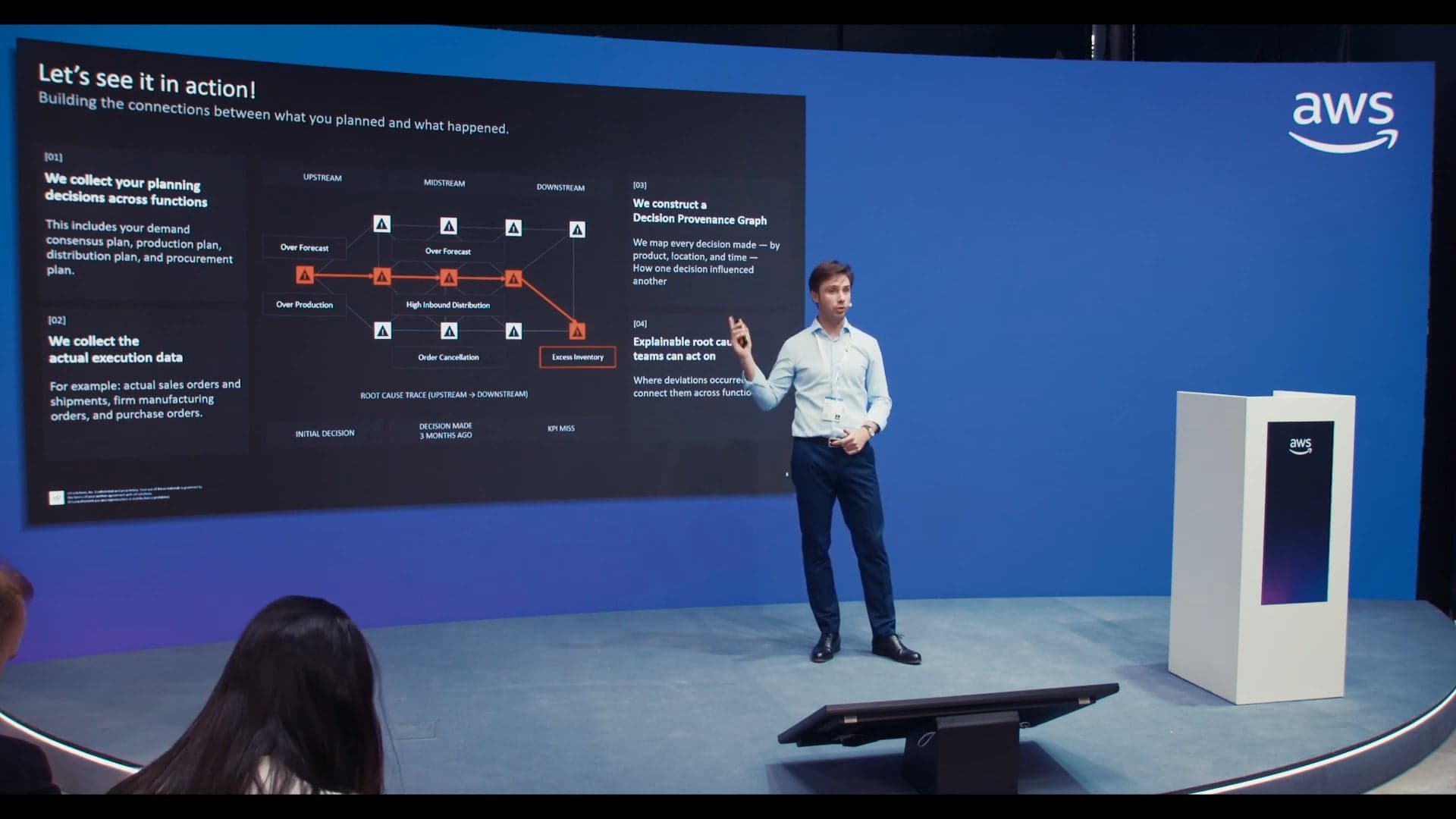
Closing an issue does not automatically improve the next decision. The organization needs a record of the alternatives considered, the assumptions used, the expected result, and the reason for the choice.
Post Game Analytics provides a disciplined way to compare expectations with outcomes and investigate differences. The findings should inform changes to models, policies, or operating practices. This process also needs to distinguish decision quality from outcome quality. A sound decision sometimes produces a poor outcome because of an event nobody reasonably anticipated. A weak decision sometimes benefits from favorable circumstances.
Learning requires examining what was knowable when the choice occurred. Otherwise, organizations risk rewarding fortunate outcomes and discouraging sound judgment. For leaders, scaling agents therefore involves decisions about objectives, authority, coordination, and accountability. These choices shape how the enterprise operates.
At your next staff meeting, take one recent operational exception and ask:
- When two teams or agents pursue conflicting objectives, who resolves the trade-off, and on what basis?
- When execution conditions change, how quickly do planning assumptions and priorities reflect the change?
- After reviewing the outcome, which model, policy, or practice improved?
Before expanding agent authority, trace one decision from the original objective through execution and learning. Identify where shared context disappears. Address those gaps before scaling.

About the authors

Igor Rikalo
President & COO at o9 Solutions
Igor Rikalo is the President and Chief Operations Officer of o9 Solutions. He oversees the global operations of the organization and plays an integral role in ensuring the business continues to scale at a global level. At o9, he has developed a successful track record of building high-performing teams, managing global strategic initiatives, and delivering strong business results.