13 read min
Supply chain risk management (SCRM) is the systematic process of identifying, assessing, monitoring, and mitigating risks that can disrupt the flow of goods, materials, or information across a supply network. It includes geopolitical instability, natural disasters, supplier financial failures, cyber attacks, logistics breakdowns, and commodity shortages. It covers risk identification across all supplier tiers, quantitative assessment of exposure, continuous monitoring, and structured response when disruption occurs. SCRM is broader in scope than supplier risk management, which focuses on vendor-level relationships and performance at tier-1.
The scale of what SCRM must address is clear in practice: when o9 mapped the full supply network of a leading US telecommunications infrastructure operator with more than $20 billion in annual revenue, a network of just 20 tier-1 suppliers across 106 sites extended back through 287 tier-2 suppliers, 26 at tier-3, 4 at tier-4, and a single tier-5 supplier across 9 sites. SCRM provides the architecture to see and manage that entire network, not only the top layer.
Why Does Supply Chain Risk Management Matter Now?
Supply chain disruptions are rising in frequency and severity, and most originate upstream where visibility is weakest. o9's data shows that fewer than 4% of more than 3,000 annual risk events require any action, which means intelligent filtering is as critical as comprehensive monitoring, and speed of response determines which options remain available.
When the Suez Canal was blocked in March 2021, supply chain teams faced a specific problem: which parts were affected, directly or indirectly through upstream suppliers, and what could they actually do? o9's approach reduces this to four decision paths. If on-hand inventory covers the disruption duration, no action is required. If inventory is short but an unaffected alternate supplier exists, source from them. If no alternate supplier is available but an alternate part exists, substitute it. If neither option is available, go outside regular supply chain channels or adjust the business plan. That structured logic is what separates risk-aware planning from reactive crisis management. Without it, every disruption triggers the same expensive scramble regardless of actual exposure.
The scale of disruption is confirmed externally. Statista data cited in o9's multi-tier risk analysis shows supply chain disruption events grew from approximately 3,500 in 2019 to over 11,000 in 2021. Resilinc data cited at the 2025 Gartner Supply Chain Symposium reports a 38% year-on-year rise in disruption events, with cyber attacks rising 965% in recent years. McKinsey's 2025 supply chain risk pulse found 95% of companies have tier-1 visibility, but only 42% can see into tier-2 or beyond. o9's platform processes more than 3,000 risk events per year for customers and filters them to fewer than 4% that require action. The challenge is distinguishing signal from noise fast enough to respond while options remain.
That visibility gap is where disruptions live. Most major supply chain failures originate upstream, with a sub-supplier or commodity that the buying organization has never mapped. Geopolitical volatility makes this more acute: o9's analysis of the Hormuz Strait crisis illustrates how a single maritime chokepoint can simultaneously affect energy costs, shipping capacity, and supplier reliability across multiple industries, often faster than any manual monitoring process can respond.
How Is Supply Chain Risk Management Different from Supplier Risk Management?
Supply chain risk management and supplier risk management address related but distinct problems: SRM manages the performance and reliability of direct vendors, while SCRM manages the entire supply network's resilience across all tiers. In o9's Digital Brain architecture, supplier risk management workflows handle forecast sharing, procurement collaboration, capacity, and sustainability at the tier-1 level. Supply chain risk management extends that model outward: mapping tier-2, tier-3, and deeper suppliers, monitoring risk events across the full network, and connecting risk signals directly to supply and demand planning decisions. A disruption identified at tier-3 triggers the right response in the right planning system automatically.
The structural difference matters for where organizations get blindsided. An organization with excellent tier-1 management can still face a critical shortage when two of its tier-1 vendors share the same tier-2 source for a key component. In o9's experience mapping complex supply networks, this kind of hidden single-source dependency at tier-2 or tier-3 is one of the most common structural vulnerabilities, invisible until the full network has been modeled. Once mapped, o9 assigns a Resiliency Score at the supplier, site, and individual part level, allowing procurement and planning teams to identify structural weaknesses before a disruption occurs rather than discovering them mid-crisis.
What Are the Main Types of Supply Chain Risk?
Supply chain risk categories span man-made and natural events, and effective SCRM requires monitoring across all of them simultaneously because real-world disruptions rarely stay within a single category. o9's risk management framework covers more than 30 distinct event types across both domains. Man-made categories include geopolitical events, cyber attacks, factory fires, labor disputes, port disruptions, regulatory changes, and bankruptcy. Natural categories include earthquakes, extreme weather, floods, and environmental hazards. Alongside event-based risks, o9's platform includes commodity risk simulations that stress-test supply chains against price and availability disruptions in specific materials, including copper, silver, gold, aluminum, and silicon, the commodities most likely to create cascading effects across multi-tier industrial supply chains.
The breadth of that taxonomy is essential, but breadth alone is not enough. In o9's work with a leading US telecommunications infrastructure operator, only 4% of approximately 3,000 monitored risk events per year required any action. The other 96% were either irrelevant to that company's specific supply chain or resolvable without intervention. Effective SCRM demands automated filtering and prioritization at scale, not just comprehensive monitoring.
What Are the Steps in a Supply Chain Risk Management Framework?
A supply chain risk management framework follows five stages: risk event visibility, local impact identification, downstream impact identification, mitigation, and learning. Each stage requires connected platform capabilities, because any gap between them delays response and limits options. o9 structures its risk management capability around this precise sequence.
Risk event visibility is the starting point. o9 collects and pre-classifies risk events from internal and external data sources, including partners such as Resilinc and Prewave, applying AI to filter signal from noise and surface only the events with probable supply chain impact.
Local impact identification connects the risk event to specific supply chain measures. o9 collaborates with tier-1 suppliers to determine which lead times, production capacities, or logistics routes are directly affected, using two-way supplier communication built into the platform.
Downstream impact identification maps the full chain consequence: which finished goods are at risk, which customers will be affected, and what the revenue exposure is. This step requires the bill-of-materials mapping and logistics lane visibility that only a supply chain digital twin can deliver at scale.
Mitigation involves running scenario simulations to compare resolution options. o9's platform presents structured alternatives, including alternate supplier, alternate SKU, alternate part, expedited shipping, build plan adjustment, alternate production location, and production capacity increase, evaluating each against service level and contribution margin impacts.
Learning closes the loop. o9 archives resolution scenarios and stakeholder commentary, applying machine learning to improve future risk detection and mitigation quality over time. Past events become training data for future resilience.
Why Is Multi-Tier Supply Chain Visibility So Difficult to Achieve?
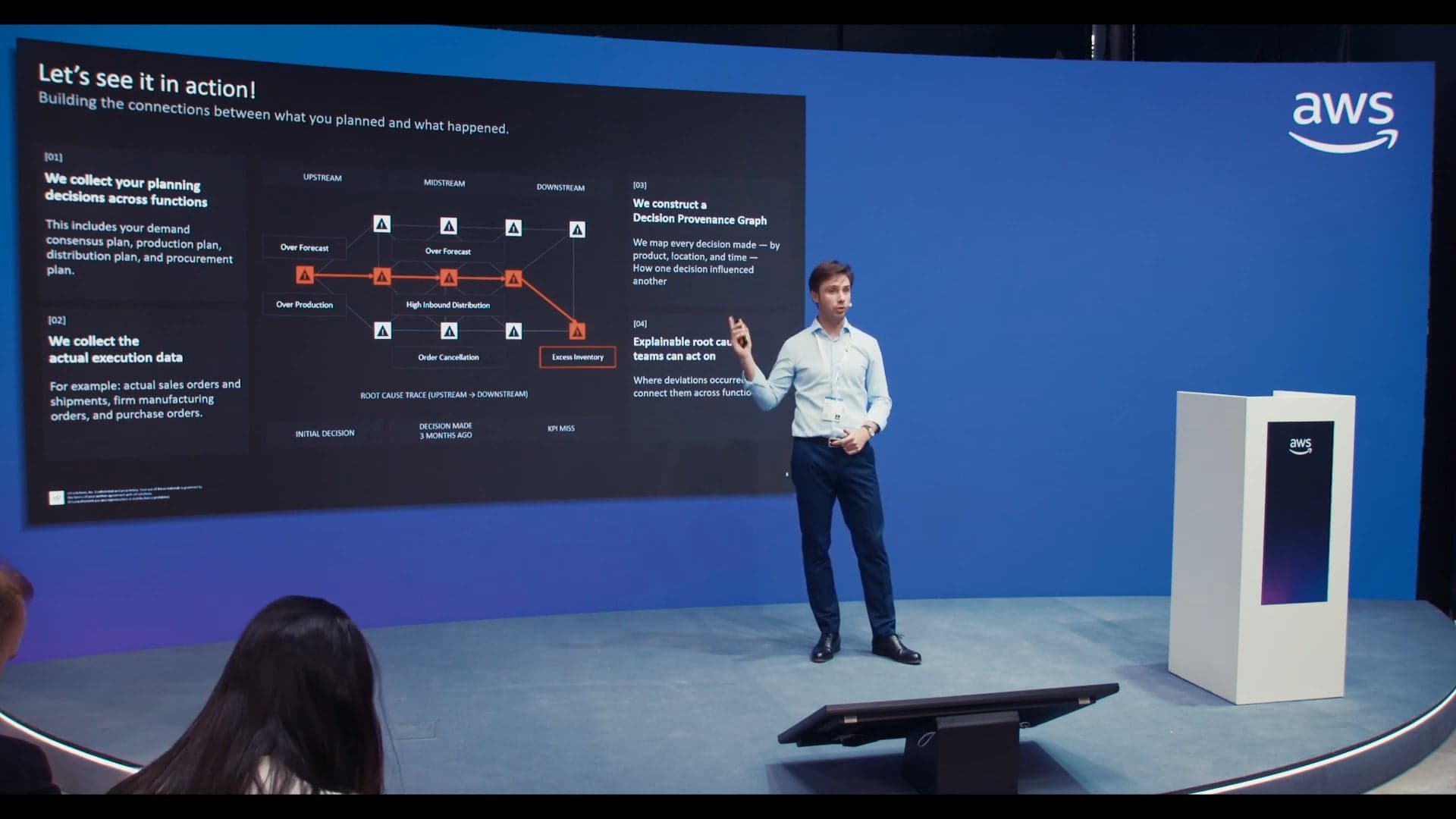
Multi-tier visibility breaks down because most supply chain systems are built around direct procurement relationships and were never designed to map the dependencies that exist two, three, or more tiers upstream. The scale of the problem is concrete. When o9 mapped the full supply network of a leading US telecommunications infrastructure operator with more than $20 billion in annual revenue, 20 tier-1 suppliers across 106 sites connected back to 287 tier-2 suppliers at 287 sites, 26 tier-3 suppliers at 29 sites, 4 at tier-4, and a single tier-5 supplier across 9 sites. Standard procurement systems captured the tier-1 layer. Everything below it was invisible until o9 built the network model. That hidden complexity is where disruptions propagate.
o9's analysis of current solution barriers identifies six recurring failure points: supply chain complexity that overwhelms manual mapping; data silos between procurement, logistics, and operations; insufficient real-time access to affected supplier status; supplier on- and offboarding dynamics that outpace monitoring tools; lack of real-time collaboration capabilities; and the absence of structured processes for learning from past events. Each is solvable with the right platform architecture. None is solvable with point solutions.
Regulatory pressure is adding urgency. The European Supply Chain Act requires companies to identify and manage human rights and environmental risks in their upstream supply chains, specifically, which means mapping sub-suppliers that many organizations have never formally tracked. o9's multi-tier visibility capability addresses both the operational risk and the compliance requirement in the same network model, surfacing supplier and site data that feeds risk management decisions and ESG reporting obligations simultaneously.
What Does a Supply Chain Risk Management Dashboard Show?
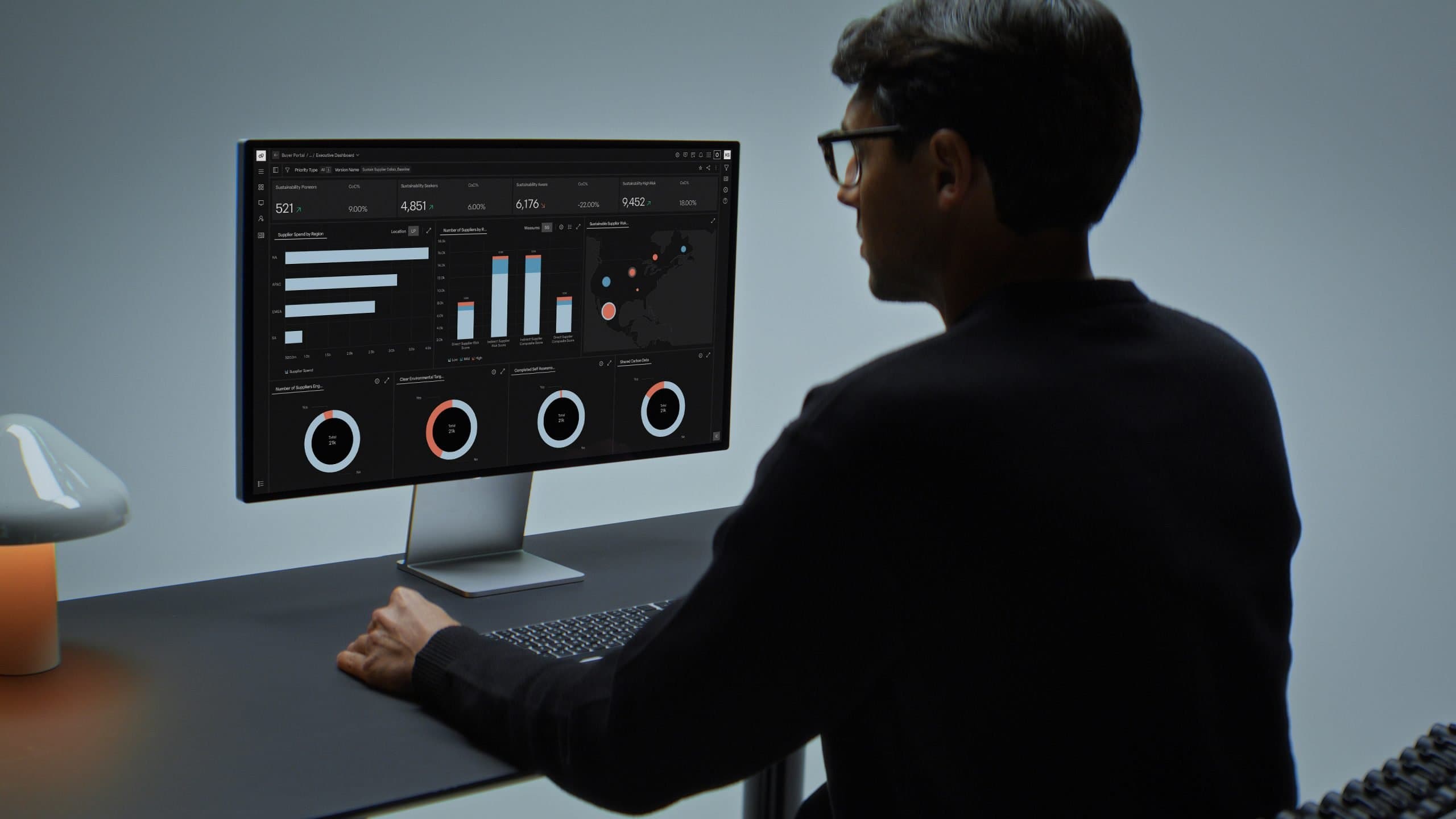
A supply chain risk management dashboard provides a real-time view of risk exposure across the supply network, combining a live event feed with supplier impact data, SKU-level exposure, and resiliency scoring at every level of the supply hierarchy. In o9's platform, the events dashboard displays total and open event counts filtered by severity, with each event showing the suppliers impacted, sites affected, parts at risk, supplier confirmation status, and event duration. Planners slice this data by severity, duration, or status in real time. Alongside the event feed, o9's Resiliency Score tracks how effectively each supplier, site, or individual part is managing its supply chain risk exposure, with historical score trends maintained over time so that structural deterioration in supplier resilience is visible before it results in a disruption.
The platform's S&OP integration ensures risk intelligence enters planning decisions at the right level of granularity, rather than arriving as a disconnected alert from a separate system. Planners can navigate directly from a risk event to the impacted SKUs, open purchase orders, and demand forecasts to assess coverage and select a resolution. Risk information surfaces in S&OP dashboards as aggregated scores and top-supplier lists, making it part of regular business planning rather than a separate risk team function.
How Is AI Changing Supply Chain Risk Management?
AI is transforming SCRM in three areas: detection speed, impact quantification, and mitigation quality. Together, these capabilities allow organizations to shift from reactive crisis management to proactive supply chain resilience. On detection, o9's Gen-AI-enabled risk monitoring ingests third-party risk data, geo-locates events, assigns severity ratings, and filters thousands of daily signals down to the handful that require action. On quantification, o9's supply chain digital twin models the network as a connected graph, including sub-suppliers, logistics lanes, and component-level bills of materials, enabling precise calculation of which SKUs, plants, and customers are affected by any given event. On mitigation, o9's scenario simulation allows teams to war-game responses before committing, comparing alternatives on cost, service level, and lead time impact.
In o9's analysis of Red Sea shipping disruption scenarios, integrating risk intelligence with supply chain planning reduced total risk response lead time by 21 days. The time between a risk event being publicly reported and internally recognized fell 75%. Local impact identification, downstream relevance assessment, and mitigation scenario development each fell 50%. That 21-day compression represents the difference between action measures, which preserve options, and reaction measures, which accept higher costs and fewer alternatives.
What Are the Business Benefits of Supply Chain Risk Management?
Connected SCRM produces measurable improvements across inventory, capacity, cost, and revenue, because risk-aware planning makes better decisions at every stage of the supply chain cycle. o9's analysis of customers operating fully integrated risk management solutions at scale shows consistent benefit ranges: inventory optimization of 5-8% through risk-adjusted safety stock calculations; expedite cost reduction of 12-17% through earlier stakeholder coordination; production capacity utilization improvement of 3-5% from earlier knowledge of material availability constraints; and labor cost reduction of more than 25% in replanning efforts. Revenue losses from unknown supply or compliance risks are reduced by more than 5%.
As one CFO at a construction equipment manufacturer described in o9's prospect research: "We're paying hundreds of thousands for external risk data and keep a team of 10 people busy with almost zero outcome because the amount of visibility is not manageable." The constraint is not data. It is filtered, contextual intelligence connected to decisions.
Supply Chain Risk Management with o9 Solutions
o9's Digital Brain platform brings together supply chain management and supplier risk management with advanced analytics in a single collaborative decision-making platform, recognized as a Leader in the Forrester Wave for Collaborative Supply Networks. It is the architecture for SCRM that connects risk signals to planning actions rather than keeping them in separate systems.
The platform's multi-tier risk management capability combines five integrated components. The supply chain digital twin models the network as a connected graph, including sub-suppliers, logistics lanes, and component-level bills of materials. Gen-AI-enabled risk event monitoring ingests third-party risk feeds from providers, including Resilinc and Prewave, filtering events for supply chain relevance and prioritizing by impact. Tier-n network mapping establishes end-to-end supplier visibility up to five tiers deep, capturing the dependencies that standard procurement systems miss. The collaboration platform connects planning teams directly with suppliers for rapid impact confirmation and mitigation coordination. Scenario simulation and learning runs risk scoring across geopolitical, natural disaster, financial, and cyber categories, allowing teams to stress test the supply chain against future disruptions and build institutional resilience from past events.
For companies facing tariff volatility, European supply chain legislation, or the structural reality that disruptions arrive faster than legacy planning tools can respond, o9 provides the architecture to move from reactive crisis management to proactive supply chain resilience.
Explore how o9 approaches supplier risk management at the vendor level, or speak to an o9 expert about multi-tier risk visibility for your supply network.
Frequently Asked Questions (FAQ)
What is supply chain risk management (SCRM)?
Supply chain risk management is the process of identifying, assessing, monitoring, and mitigating risks that can disrupt goods, materials, or information flows across a supply network. It covers the full threat spectrum across all supplier tiers: geopolitical events, natural disasters, financial failures, cyber attacks, and commodity disruptions. In o9's Digital Brain architecture, SCRM connects risk intelligence directly to supply, demand, and inventory planning, so that a disruption signal detected at tier-3 triggers the right planning response automatically.
How is supply chain risk management different from supplier risk management?
Supplier risk management focuses on managing direct (tier-1) vendor performance: financial health, quality, delivery, and contract compliance. Supply chain risk management addresses the entire multi-tier network, including sub-suppliers, logistics routes, and commodity dependencies several tiers upstream. Read our dedicated guide to supplier risk management for a full breakdown. In o9's platform, both disciplines are integrated: SRM workflows manage tier-1 collaboration, while multi-tier risk management extends visibility and response capability across the full supply network.
What are the steps in a supply chain risk management framework?
The core stages are: risk event visibility (collecting and filtering risk signals), local impact identification (translating events into supply chain measures such as on-hand inventory, open purchase orders, and demand forecasts), downstream impact identification (quantifying the effect on products, customers, and revenue), mitigation (selecting from structured resolution options including alternate supplier, alternate SKU, alternate part, expedited shipping, or production capacity adjustment), and learning (archiving outcomes to improve future response quality). o9 structures its platform around this complete cycle.
What does a supply chain risk management dashboard show?
o9's SCRM dashboard shows a live count of total and open events filtered by severity, with each event displaying the suppliers, sites, and parts affected along with supplier confirmation status and event duration. Planners slice the data in real time by severity, duration, or status. o9's Resiliency Score provides a continuously updated measure of each supplier's, site's, and part's ability to manage supply chain risk, with historical score trends that surface structural deterioration before it becomes an operational crisis.
How does AI improve supply chain risk management?
AI improves SCRM in three areas: detection (o9's AI filters more than 3,000 annual risk events down to fewer than 4% that require action), quantification (o9's Digital Brain models the full multi-tier network so any event is immediately translated into specific SKU, supplier, and revenue exposure), and mitigation (o9's scenario simulation lets planners model disruption scenarios across business, factory, natural, human, and transportation disruption types and compare response options before committing).
About the authors

The Editorial Team, o9
A multidisciplinary collective of editors, strategists, technologists, and former executives with experience across Fortune 500 companies and top consulting firms. Grounded in o9’s mission to help enterprises make faster, better decisions through the power of AI-driven planning and execution software, the team shares clear, practical insights on digital transformation, supply chain, and enterprise planning to support business leaders in navigating complexity and driving change.