8 read min
One hundred AI agents. Months of development. Impressive technology.
And not one of them could make a decision.
That was the discovery Abhishek Mohanty made while reviewing an enterprise AI project. The engineering was sophisticated, but when he asked what decisions the agents actually owned, nobody had an answer.
"100 agents, not a single one of them has authority to make the decision," he recalled. "That's not a technology or AI problem, that's a trust problem."
It's a revealing example of the challenge facing companies investing in agentic AI. Organizations are building increasingly capable systems, yet many still struggle to translate those capabilities into faster, better decisions.
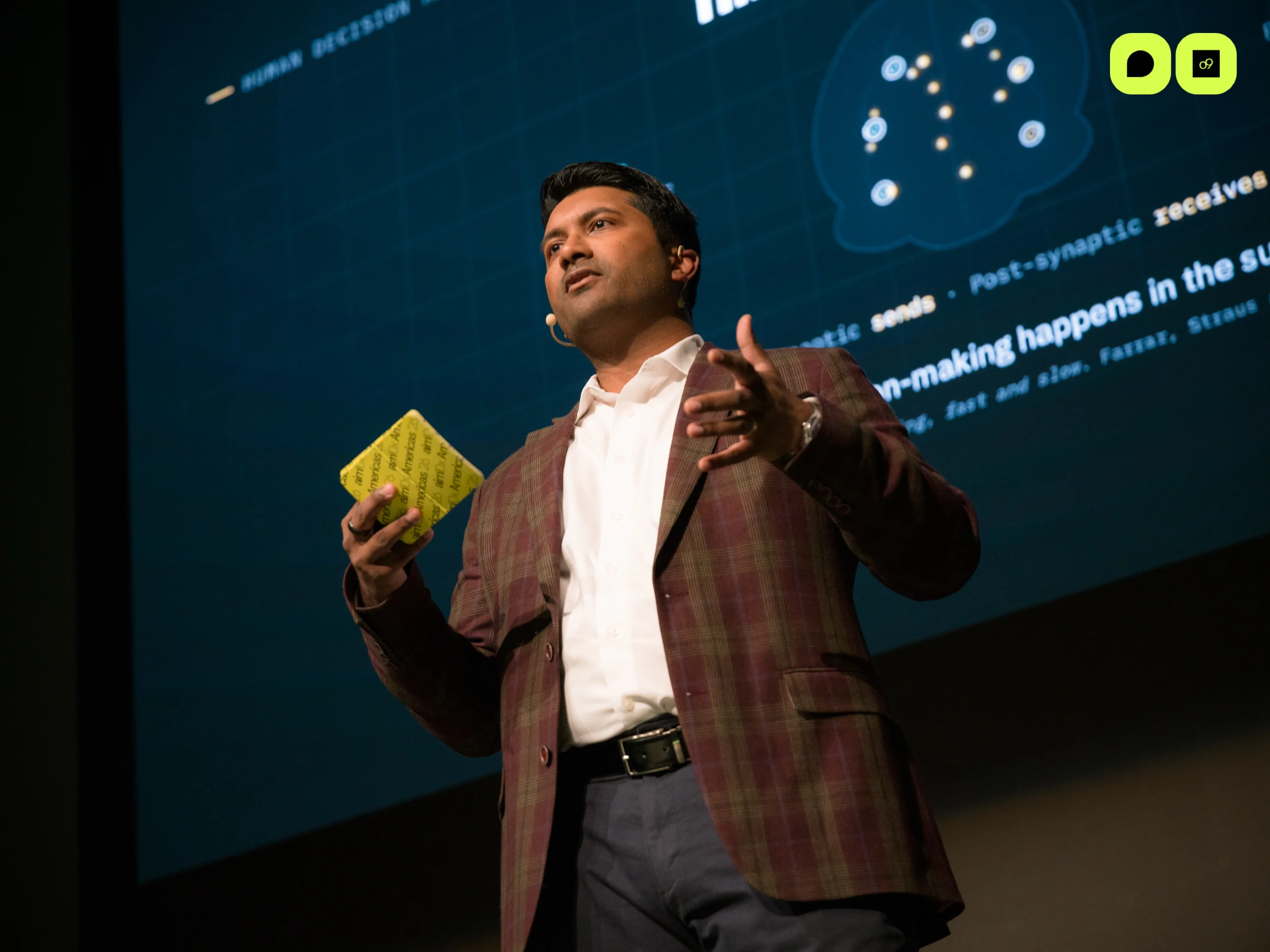
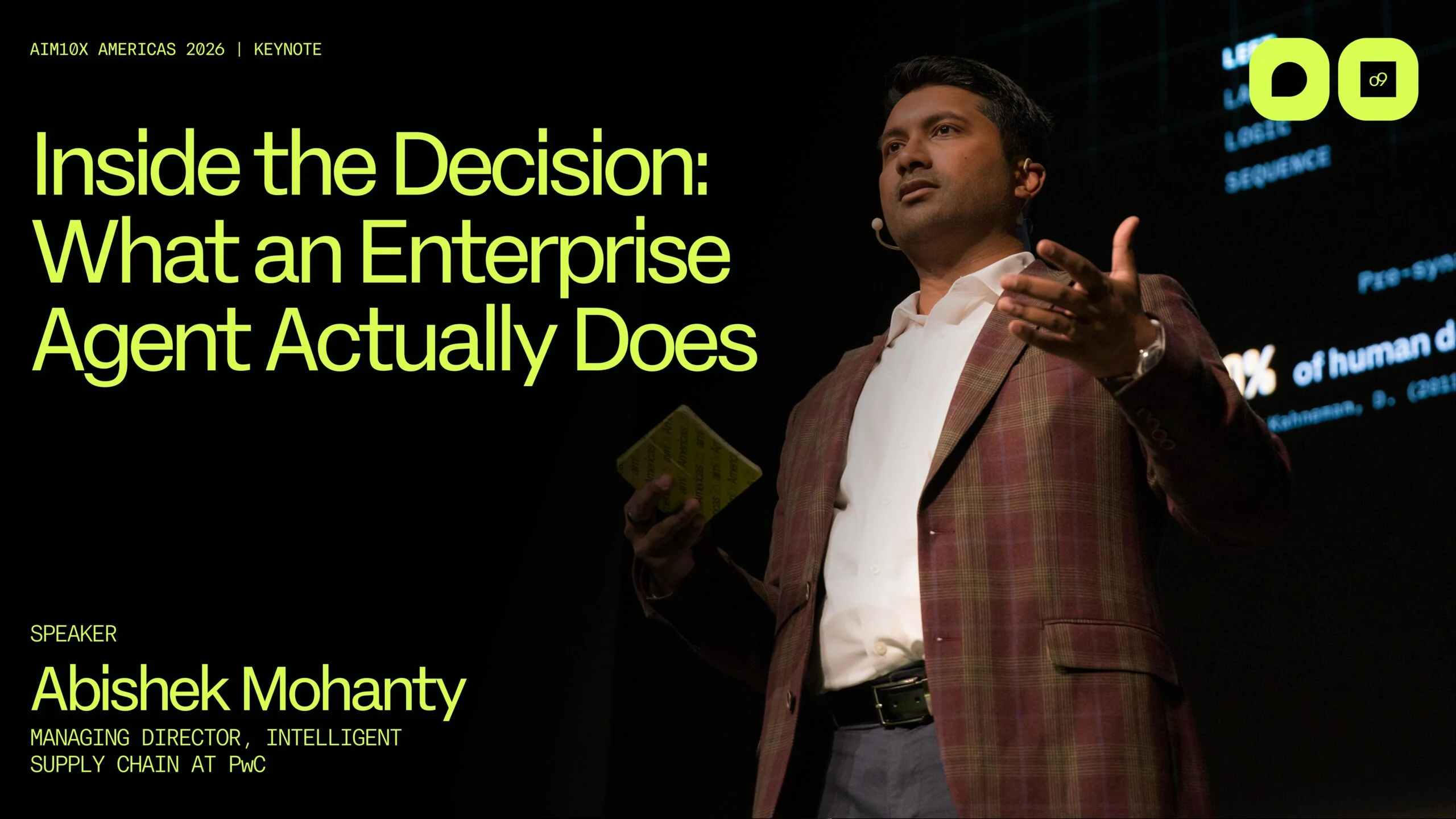
Speaking at aim10x Americas 2026, Mohanty, Managing Director, Intelligent Supply Chain at PwC, explored what separates an AI assistant from an agent capable of making decisions, what happens behind the scenes when agents work together, and how enterprises can introduce autonomy without losing control.
Faster answers aren't necessarily faster decisions
Supply chain technology has advanced considerably over the past decade.
Companies began by connecting data and improving visibility. They subsequently introduced AI-assisted planning, helping teams analyze information and generate recommendations more quickly. Now, agentic AI offers the possibility of systems that can take increasingly complex actions within defined boundaries.
Each stage has brought progress, along with its own problems.
Early transformations sometimes automated processes that were already inefficient. Generative AI introduced faster analysis, but often relied on poorly governed data. And today, organizations risk confusing the speed of an AI-generated answer with the speed of an actual business decision.
"We're starting to mistake faster answers for faster decisions," Mohanty said.
Consider a planning team that identifies a supply constraint and generates several recommendations in minutes.
If those recommendations still need to pass through multiple functional reviews, competing priorities, and another meeting the following week, the underlying decision process remains largely unchanged.
The technology has accelerated the analysis. The organization still needs to decide what to do.
Where supply chain decisions get stuck
Part of the difficulty comes from how enterprises are organized.
Sourcing teams might plan in weeks. Manufacturing schedules can change by shift. Transportation decisions may need to happen within hours, while customer service responds to problems almost immediately.
Each function has different priorities and measures of success.
Mohanty described a project where planning was measured on demand forecast accuracy, manufacturing on throughput, and transportation on cost per case.
Each team was performing against its own objectives.
But who owned the trade-offs between them?
"It's that tradeoff and the handoff is something that no one really owned," he explained.
The consequences become more significant when decisions are delayed or made independently.
A choice to transfer inventory might protect customer service but increase transportation costs. A manufacturing adjustment might improve capacity utilization while creating problems for another product line. A decision that looks financially attractive within one function may have unintended consequences elsewhere.
Mohanty captured the problem in a memorable phrase:
"Five different clocks, five different definitions of success."
His argument is that the next generation of enterprise AI needs to operate across those functional boundaries, connecting decisions that affect the same business outcome.
The difference between a copilot and an agent
The distinction between AI copilots and agents is central to Mohanty's vision.
A copilot responds to a prompt. It can retrieve information, summarize a situation, or suggest what a user should do next.
The user then evaluates the recommendation, makes the decision, and often has to implement it across several systems.
An agent works differently.
Given an objective, access to appropriate tools, and a set of operating limits, it can work through a sequence of steps until the objective has been achieved or a boundary requires it to stop.
"Agents on the other side, given a goal and a set of tools, runs in a loop until that goal is met or the limits that you've set has been hit," Mohanty explained.
The difference becomes clearer in an operational setting.
A copilot might identify an inventory shortage and recommend alternative sources.
An agent with the necessary business knowledge and authority could investigate those alternatives, evaluate the trade-offs, coordinate with other systems, and carry out an approved response within its defined scope.
That doesn't mean every decision should be delegated to AI.
Mohanty divides enterprise decisions into three broad categories: rules-based decisions, trade-off decisions, and judgment decisions.
Rules-based decisions have clearly defined parameters and relatively little ambiguity. Trade-off decisions involve competing options, such as substituting a product or transferring inventory. Judgment decisions involve greater uncertainty, business risk, and strategic consequences.
The level of autonomy should reflect the nature of the decision.
Why enterprise context matters
Modern large language models are remarkably capable at working with general information.
But knowing how to interpret language is different from knowing how a particular business operates.
As Mohanty pointed out, a general-purpose model doesn't automatically understand an organization's transportation management system, warehouse processes, manufacturing relationships, or recurring operational problems.
It needs that knowledge to make reliable decisions.
He compared the process to training a new employee.
Even a highly capable recruit wouldn't be given unrestricted authority over a company's operations on their first day.
They would learn the business, understand its constraints, receive defined responsibilities, and gradually earn greater trust.
Enterprise agents need a similar approach.
"You wouldn't hand off your keys to your operations on the first day for a capable new hire," Mohanty said.
The goal is to develop agents that understand the specific operating environment and can act reliably within it.
This also requires organizations to think carefully about how much decision-making authority they are comfortable delegating.
An AI system may be technically capable of proposing an action. Whether it should be allowed to execute that action is a separate question.
What happens inside an enterprise agent
Mohanty described three elements that help turn agentic AI into a governed enterprise capability: the harness, the instructions, and the live reasoning between agents.
The harness establishes the operating boundaries.
It defines what an agent owns, which decisions it can make, what it must escalate, what it needs to report, and which actions it can reverse.
It also distinguishes between hard and soft constraints.
Hard constraints cannot be crossed without the appropriate authorization. These might include contractual obligations or customer commitments requiring human approval.
Soft constraints allow the agent to evaluate alternatives and make trade-offs within permitted boundaries.
"This is autonomy written in scope, folks," Mohanty said.
The second element is the instructions that define an agent's responsibilities.
In his illustrative example, one agent identifies signals and filters out noise. Another evaluates potential responses. A third records decisions, updates systems, and verifies that the necessary information is available for subsequent actions.
The third element is how those agents coordinate.
Instead of relying on sequential handoffs between separate functions, specialized agents can share information, evaluate options, and work toward a common objective.
Mohanty emphasized that agents also need to understand reversibility.
If an action can be undone, the system should know how. If it cannot be reversed, the authorization requirements should reflect that risk.
"An action you can't reverse, you shouldn't be passing that out for someone to make a decision," he said.
That combination of explicit responsibilities, operating limits, and coordinated reasoning is what makes greater autonomy possible.
The importance of traceability and trust
One potential advantage of enterprise agents is their ability to evaluate decisions without the same departmental incentives that influence human organizations.
A transportation manager may naturally prioritize freight costs. A production manager may focus on throughput. A commercial leader may be primarily concerned with protecting revenue.
Mohanty argued that an appropriately designed agent can help evaluate these competing priorities without defending a particular function's position.
However, that potential depends on the information, objectives, and constraints used to govern the system.
AI-generated decisions can still reflect bias in their data or design. Clear reasoning, validation, and oversight therefore remain essential.
For Mohanty, enterprises need to understand how a decision was reached, which information informed it, and whether it stayed within the agreed boundaries.
That traceability becomes especially important as organizations move from AI-generated recommendations toward automated actions.
Trust has to be built through the system's design and demonstrated performance.
What happens to the planner?
As agents take on more analytical and coordination work, the role of the people using them will also change.
Activities such as reconciling information, comparing options, and preparing recommendations may increasingly be handled by AI.
That creates an opportunity for planners to focus more on decisions requiring business judgment, particularly those involving uncertainty, strategic priorities, and relationships.
Mohanty described this as a change across three connected areas: the work, the worker, and the workforce.
Organizations need to redefine which activities are performed, develop the skills employees will need, and reconsider how teams are structured as automation advances.
"The work's moving towards judgement," he said.
The transition also extends beyond supply chain.
If manufacturing introduces sophisticated agents while finance, commercial, and other functions continue operating through disconnected processes, many of the same coordination problems will remain.
"A transport decision is a customer decision, which is a cash decision," Mohanty explained.
For enterprise autonomy to deliver its full potential, connected functions need to develop together.
Start with a decision, not another AI pilot
Mohanty's closing advice was practical.
Rather than launching a large collection of agents and working out their responsibilities afterward, organizations should begin with a specific decision they want to improve.
Define the decision's scope. Establish what the agent may do, what it must escalate, what it needs to report, and which actions it can reverse.
If those boundaries cannot be clearly documented, the decision may not yet be ready for automation.
Organizations should also involve the other functions affected by that decision, building the confidence and coordination required to introduce greater autonomy.
And for business leaders allocating investment, Mohanty offered a particularly pointed recommendation:
"Fund decisions, not use cases, not pilots, not programmes."
It's a useful distinction at a time when the number of AI agents an organization has deployed can easily become a measure of progress.
The more meaningful question is what those agents are actually authorized to accomplish, whether their decisions can be trusted, and how those decisions improve business performance.
After all, an enterprise can have 100 AI agents and still find itself waiting for next week's meeting.
About the authors

The Editorial Team, o9
A multidisciplinary collective of editors, strategists, technologists, and former executives with experience across Fortune 500 companies and top consulting firms. Grounded in o9’s mission to help enterprises make faster, better decisions through the power of AI-driven planning and execution software, the team shares clear, practical insights on digital transformation, supply chain, and enterprise planning to support business leaders in navigating complexity and driving change.