6 read min
Every tyre that reaches the road represents thousands of interconnected decisions. From raw material sourcing and production scheduling to quality control, delivery, and customer service, Apollo Tyres operates in a world where every link in the chain matters. They must keep operations running smoothly while ensuring that each planning cycle leaves the organization better prepared for the next.
Most organizations measure planning success through operational outcomes such as service levels, inventory performance, forecast accuracy, or cost. While these metrics remain critical, they only tell part of the story. Sustainable improvement comes from understanding not just what happened, but why it happened, and whether the decisions made along the way were the right ones given the information available at the time.
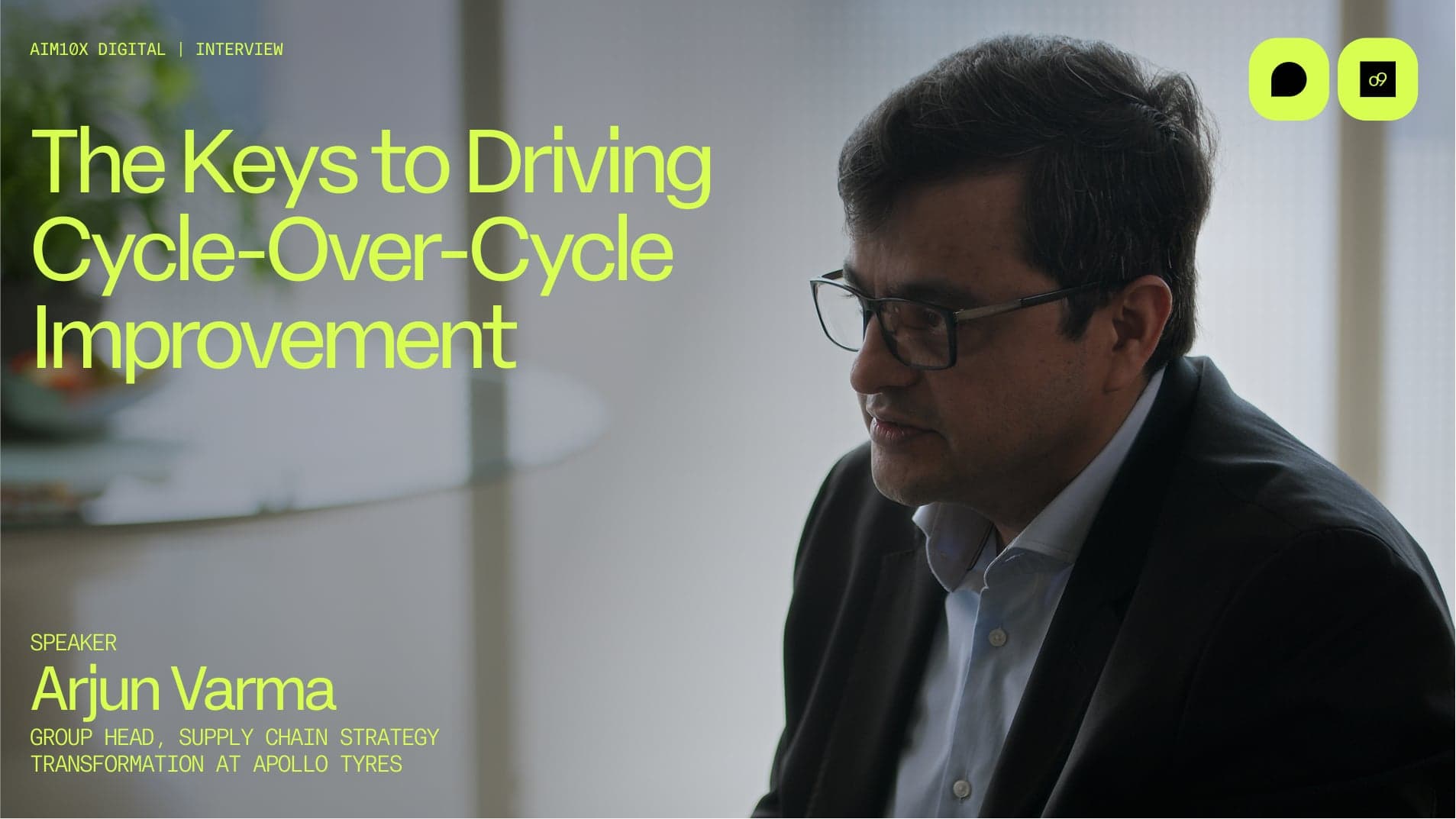
During his session at aim10x, Arjun Varma, Head of Strategy & Transformation for Global Supply Chain at Apollo Tyres, shared his perspective on what it takes to create cycle-over-cycle improvement in today's increasingly complex supply chain environment. His message was clear: organizations must move beyond viewing planning as a process and begin treating it as an intelligence capability that enables better decisions across the enterprise.
Building the Foundation for Supply Chain Orchestration
Apollo Tyres operates across diverse geographies, including India, Europe, Africa, Southeast Asia, and the Americas. Managing a global business of this scale requires balancing a wide range of variables, from customer demand and channel complexity to commodity volatility and operational constraints. At the same time, the business must continuously optimize the trade-offs between service, cost, and cash.
Addressing this complexity requires more than functional excellence. According to Varma, organizations need an orchestration approach that connects decisions across the entire value chain. Rather than managing individual functions in isolation, supply chain leaders must create a framework that enables coordinated decision-making and allows teams to manage the business by exception.
The first step in this journey is establishing a strong data foundation. Apollo Tyres is currently investing in its S/4HANA transformation to create a consistent operating backbone across the organization. Beyond providing cleaner and more reliable data, this foundation establishes the rules, processes, and governance that will shape how the business operates in the future.
Data alone is not enough. Organizations must also create end-to-end visibility across their networks, connecting manufacturing, warehousing, logistics, and distribution operations. With visibility linked to planning processes, businesses can gain the ability to anticipate challenges earlier, understand the implications of decisions faster, and respond more effectively when conditions change.
Planning as the Intelligence Layer
One of the most compelling ideas from the session was the evolving role of planning. Traditionally, planning has been viewed as a process that coordinates demand, supply, inventory, and operations. Increasingly, however, planning must become the intelligence layer that sits on top of the enterprise.
With the right data foundation and visibility in place, planning creates readiness. Strategic and tactical planning activities allow businesses to evaluate scenarios, assess risks, and prepare for uncertainty before it reaches the operational horizon. This preparation enables organizations to respond faster and with greater confidence when disruption occurs.
Technology plays an important role in enabling this shift. Apollo Tyres selected o9 because of its ability to support concurrent planning and provide a scalable platform capable of evolving alongside the business.
For Varma, the objective is, of course, to digitize existing planning processes. However, they also want to create an environment where technology actively supports decision-making, helps teams navigate increasing complexity, and enables the organization to continuously improve from one planning cycle to the next.
Focusing on Decision Quality
Perhaps the most important takeaway from the discussion was the distinction between decision quality and decision outcomes. Too often, organizations evaluate decisions solely based on the results they produce. However, outcomes are influenced by many factors that may not have been known or predictable when a decision was made. Market conditions change. Customer behavior shifts. Unexpected events occur.
Judging decisions exclusively through hindsight can discourage learning and create a culture that focuses on blame rather than improvement. Instead, Varma advocates evaluating the quality of the decision itself.
Did the team consider the available information? Were the assumptions clearly understood? Was the reasoning sound given the context at the time?
These questions create a more productive framework for learning. They encourage teams to focus on improving their decision-making capabilities rather than simply reacting to outcomes after the fact.
A good decision can still produce a disappointing outcome. Equally, a poor decision can occasionally produce a favorable result. Sustainable improvement comes from understanding the difference.
Making Learning Systematic
A key component of improving decision quality is making assumptions explicit.
Many organizations struggle to understand why a decision succeeded or failed because the assumptions behind it were never documented. Months later, teams attempt to reconstruct the context from memory, often with limited success.
By clearly documenting assumptions at the time a decision is made, organizations create a valuable reference point for future analysis. Teams can revisit decisions, evaluate whether assumptions proved accurate, and identify where additional information or different thinking may have led to better outcomes.
This transforms post-game analysis into a structured learning process.
Rather than focusing on individual mistakes, the goal becomes understanding whether issues resulted from flawed assumptions, execution challenges, changing market conditions, or policy constraints within the organization.
Over time, these insights strengthen both the planning process and the organization's ability to make better decisions.
The Challenge of Cross-Functional Decisions
Varma also highlighted that the most difficult decisions are rarely contained within a single function.
Decisions involving production, customer commitments, inventory, procurement, and logistics often require trade-offs that span multiple teams.
These are also the decisions where organizations most frequently encounter friction, particularly when different stakeholders are measured against different objectives.
Solving this challenge requires more than visibility. It requires collaboration.
Establishing governance frameworks, decision forums, and technology-enabled collaboration capabilities helps create alignment around shared business goals and enables faster, more effective decision-making.
Because the most valuable decisions in an enterprise are rarely local optimizations. They are decisions that balance competing priorities across the entire value chain.
Continuous Improvement as a Competitive Advantage
For supply chain leaders, the goal is getting better with every planning cycle.
Organizations that consistently improve are those that create strong data foundations, establish end-to-end visibility, document their assumptions, and systematically learn from their decisions.
As supply chains become more complex and volatility becomes a permanent feature of the business landscape, the ability to improve decision quality cycle after cycle may become one of the most important competitive advantages an organization can develop.
A tyre moves forward because every rotation builds on the last. The same is true for enterprise planning. The companies that succeed will be those that view planning not simply as a forecasting exercise, but as a capability that continuously strengthens how the enterprise thinks, learns, and makes decisions—turning every cycle into an opportunity to improve the next one.

How Automotive Leaders Are Reimagining Supplier Collaboration
The Complete Guide to Strategic Demand Planning 2026
About the authors

The Editorial Team, o9
A multidisciplinary collective of editors, strategists, technologists, and former executives with experience across Fortune 500 companies and top consulting firms. Grounded in o9’s mission to help enterprises make faster, better decisions through the power of AI-driven planning and execution software, the team shares clear, practical insights on digital transformation, supply chain, and enterprise planning to support business leaders in navigating complexity and driving change.