4 read min
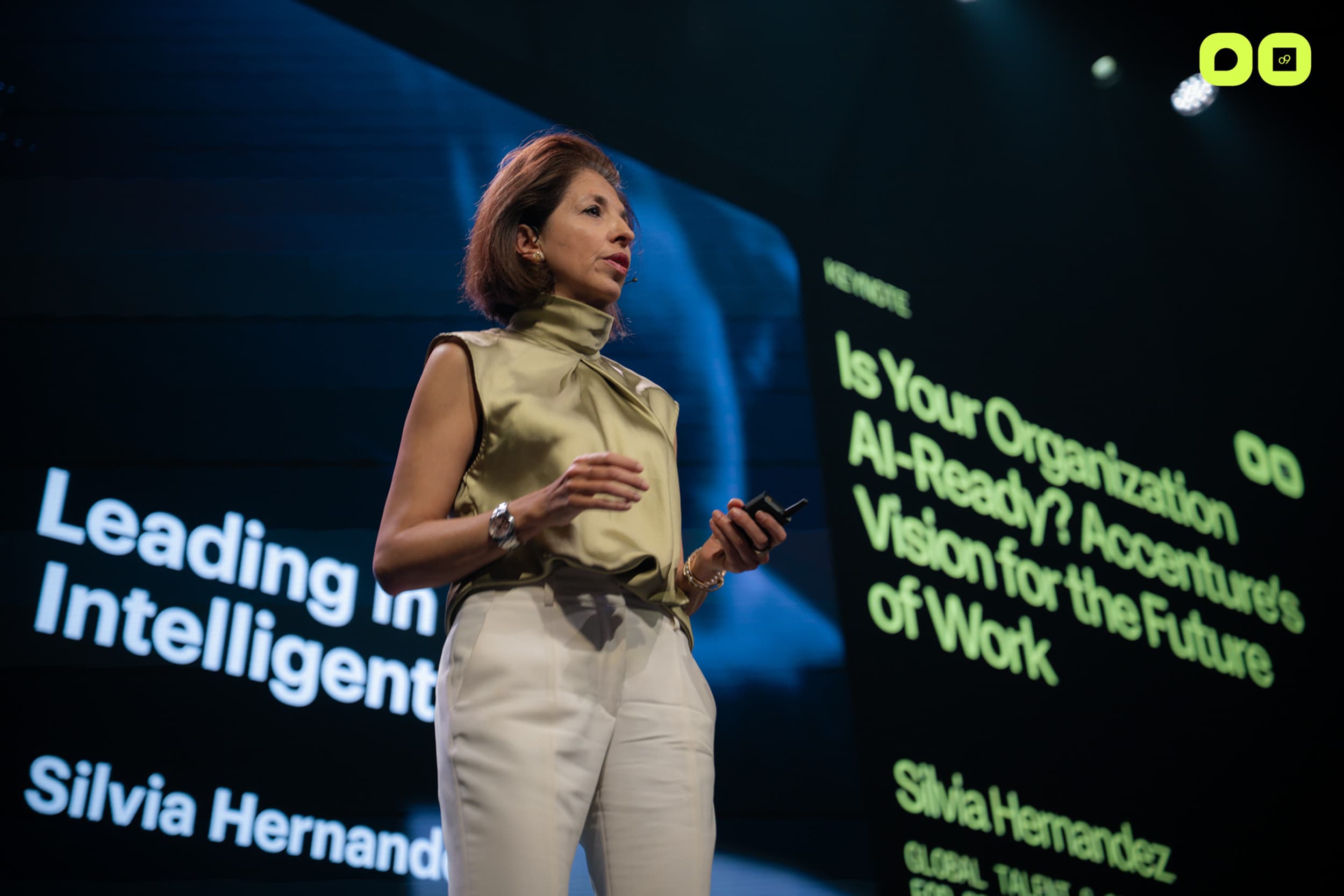
When Silvia Hernandez asked her daughter for advice on how to keep an audience engaged during a post-lunch keynote at aim10x Europe, the response was clear: “Show them a video and tell them a story.” And that’s exactly what she did, blending insight, storytelling, and data from over 2,000 client engagements to deliver a compelling message on the real challenges of AI transformation.
Hernandez, Global Talent & Organization Lead for Product Industries at Accenture, took the audience beyond the hype to ask a deeper question: Are organizations truly ready to unlock the value of AI and agentic technologies?
Her answer: not yet. But we can be, if we put people at the center of the transformation.
Human potential is the multiplier
We are entering what Hernandez calls the “intelligent age”: a time in which technologies like generative AI and agentic systems are reshaping how we work, how we make decisions, and how we lead. But the real unlock, she argued, doesn’t lie in the algorithms or platforms themselves. It lies in how we apply them, and who we involve in shaping them.
“Technology alone will not be sufficient,” Hernandez said. “Throughout history, the greatest value has been created when humans embraced new tools—not when the tools replaced the humans.”
Accenture’s experience backs that up. Across its client base, organizations are investing heavily in digital transformation, yet relatively few are seeing the full return. One reason? Underinvestment in the human side. According to Hernandez, companies should be investing three times more in human capability than in technology. Few are meeting that bar.
The leadership disconnect
Each year, Accenture surveys thousands of C-suite executives and employees around the world. The message from leadership is clear: 97% believe AI and agentic technologies are critical to their organization’s future.
But just 30% believe their organization is ready.
And that’s not the most troubling disconnect. When Accenture speaks to employees, they find a significant gap in trust. While many individuals say they are willing to engage with AI, they don’t trust their organizations to deploy it in ways that will benefit everyone.
Too often, the narrative around AI is rooted in fear: that machines will replace humans. But Hernandez pushed back on that framing. “In our projects, we see the most value unlocked when the machine amplifies the human,” she said. The problem is that too few transformation programs are designed with that goal in mind.
Designing systems that amplify (not replace) humans
If we want to change the outcome, we need to change the approach. That means moving beyond a narrow focus on data science or engineering talent and expanding the conversation to include empathy, creativity, ethics, and trust.
To illustrate the point, she shared findings from a recent study by Wharton professor Ethan Mollick and a leading consumer products company, Procter & Gamble. The study compared how individuals, teams, and agents performed across different work tasks. The result? Individuals working with agents consistently outperformed teams working without them.
Agents helped individuals “think without silos,” Hernandez explained. They broke down functional boundaries and enabled faster, more dynamic decisions. Even more surprising: people reported greater satisfaction working with agents than with human teammates. The potential for hybrid teams, of humans and digital collaborators, is immense.
But again, that potential will only be realized if organizations are intentional about how they deploy agentic technologies. That includes:
- Designing with people, not just for peopleToo many AI initiatives are rolled out without involving the people who will use them. This leads to resistance, low adoption, and limited impact.
- Investing in capability, not just capacity Traditional hiring and training models won’t suffice. Organizations need to build new capabilities around adaptability, digital fluency, ethical reasoning, and continuous learning.
- Redefining leadershipIn the intelligent age, leaders need to engage directly with technology. They must understand how it works and how it affects the people they lead. “Artificial intelligence is the first technology that requires leaders to truly understand how to use it before they can deploy it,” Hernandez noted.
Culture is strategy
Ultimately, transformation is not just about platforms or workflows. It’s about mindsets. Hernandez introduced the idea of “perma-shock,” a world in which volatility is constant and resilience is a strategic imperative. In this context, culture is not a soft layer; it’s the infrastructure that enables trust, adaptability, and value creation.
“Our organizations are used to consuming talent,” she said. “We hire people, they work with us, and then they leave. But in the intelligent age, we have to think about accessing, creating, and sustaining capability as part of our value delivery strategy.”
Hernandez ended with a nod to Peter Drucker, who famously said, “Culture eats strategy for breakfast.” But she added another line: “The best way to predict the future is to shape it.”
For organizations that want to lead in the intelligent age, that shaping must start with people. Because as Hernandez put it: “The future is not artificial. The future is human.”

About the authors

o9
The Digital Brain Platform
o9 Solutions is a leading Enterprise Knowledge and AI-powered platform helping companies build Agile, Adaptive & Autonomous Planning & Execution Models for transforming enterprise decision-making in environments of rising volatility and uncertainty. Whether it is improving forecast accuracy, matching demand and supply and driving collaboration across the multi-tier supply chain to improve resilience at optimal costs and inventory, or optimizing new product and commercial initiatives to drive revenue growth and margins, decision-making processes from long-range to tactical to execution horizon can be made faster and smarter and connected on o9’s Digital Brain Platform.
o9 brings together game-changing technology innovations — such as innovative enterprise knowledge graph modeling, big data analytics, advanced algorithms for forecasting, demand/supply balancing, scenario planning, real time learning, collaboration, generative and agentic AI, easy-to-use interfaces and cloud-based delivery, and innovative management methods — as well as organization, process and change management best practices to transform decision-making speed and intelligence.