13 read min
TL;DR: Supply chain management (SCM) is the end-to-end discipline of coordinating how a product moves from raw material to end customer, covering sourcing, production, warehousing, logistics, and all the information flows that connect them. Only 29% of supply chain organizations have built the capabilities they need to meet future demands, according to Gartner. In 2025, the pressure to balance cost efficiency, operational resilience, and sustainability is making the quality of supply chain management one of the most consequential strategic decisions a business can make.
Every product a customer buys passed through a supply chain to get there. Raw materials were extracted, components were manufactured, finished goods were assembled, packed, stored, and shipped. Every one of those steps was managed by someone, using some combination of systems, processes, and judgment.
Supply chain management is the discipline that coordinates all of it. When it works well, customers receive what they ordered, on time, at a price the business can sustain. When it breaks down, the consequences move fast: empty shelves, delayed shipments, excess inventory, and cost overruns that take months to unwind.
This guide explains what supply chain management is, how it works across its core functions, and what separates organizations that manage their supply chains well from those that are always reacting to the last crisis.
What Is Supply Chain Management?
Supply chain management is the end-to-end coordination of all the processes, people, and systems involved in moving a product from raw material to end customer. It covers sourcing, production, warehousing, logistics, and the information flows that connect them all.
The term "supply chain" refers to the network of suppliers, manufacturers, distributors, and retailers through which a product travels before it reaches the person who buys it. Supply chain management is the active discipline of overseeing and optimizing that network, not just observing it.That scope is broader than it might appear. A global consumer goods company might have thousands of suppliers across dozens of countries, multiple manufacturing sites, regional distribution centers, and retail customers with different service requirements. Managing the supply chain means making decisions, every day, about how to keep that network moving efficiently and reliably. The SCM software market generated approximately $33.4 billion in annual revenue in 2024, a figure that reflects how central the discipline has become to business operations.
Supply Chain Management vs. Supply Chain Planning: What's the Difference?
Supply chain planning is one discipline within the broader field of supply chain management. Planning decides what to make, buy, and ship. SCM then executes and oversees the entire physical and financial flow across the network.
A useful way to think about the distinction: planning is the brain, determining what should happen across the supply chain and when. Supply chain management is the nervous system, connecting and coordinating every function required to make it happen. Planning without execution is just a spreadsheet. Execution without planning is reactive firefighting.
In practice, the two are deeply intertwined. Supply chain planning produces the forecasts, inventory targets, and production schedules that guide SCM decisions. SCM execution then feeds real-world data back into planning, updating forecasts and exposing gaps between what was planned and what actually happened. Organizations that treat planning and execution as separate functions typically perform worse than those that run them as a continuous loop.
The Core Functions of Supply Chain Management
Supply chain management encompasses six interconnected functions: sourcing and procurement, production and manufacturing, inventory management, warehousing and distribution, logistics and transportation, and demand and supply planning. Each function depends on the others, and a delay or failure in one ripples quickly through the rest.
Sourcing and procurement are where the supply chain begins. Procurement teams identify suppliers, negotiate contracts, manage relationships, and ensure that the raw materials and components needed for production arrive on time and at the right quality. In global supply chains, this function also involves monitoring supplier financial health, geopolitical exposure, and compliance with environmental and labor standards.
Production and manufacturing convert inputs into finished goods. SCM's role here is to ensure that production schedules align with demand forecasts, that capacity is used efficiently, and that quality standards are maintained. When demand shifts or a component is delayed, production planning must adapt quickly.
Inventory management decides how much stock to hold, where to hold it, and how to replenish it. Holding too much inventory ties up working capital and increases storage costs. Holding too little creates stockouts and lost sales. Getting this balance right, across multiple locations and product categories, is one of the most technically complex challenges in SCM.
Warehousing and distribution cover how goods are stored, organized, and dispatched from facilities. Modern distribution networks often include multiple tiers of warehousing, from regional hubs to local fulfillment centers, optimized for delivery speed and cost.
Logistics and transportation move goods between suppliers, production sites, warehouses, and customers. This function manages carrier relationships, freight costs, delivery timelines, and increasingly, the carbon footprint of physical movement.
Demand and supply planning provides the forward-looking foundation for all other SCM decisions. Without an accurate view of what customers will need and what the supply base can provide, every other function is working from guesswork. This is where integrated business planning connects commercial goals to operational capacity.
Why Supply Chain Management Has Become a Boardroom Priority
For most of the past two decades, supply chain management was treated primarily as a cost center. The goal was to do it cheaper. That framing changed significantly after 2020, and has continued to evolve.
Cost pressure has not gone away. BCG research from 2025 found that cost management is the top priority for one in three corporate leaders globally, and 65% of executives identify supply chain and manufacturing costs as the biggest levers available for savings. But cost is now one of three competing priorities, not the only one.
Resilience has moved to equal footing. Gartner data from 2024 shows that 73% of companies have restructured their supply chain networks in the past two years, with risk management and resilience displacing cost efficiency as the primary driver of those changes. The Red Sea shipping disruptions of 2024 and the more recent Strait of Hormuz constraints, a waterway through which roughly 20% of the world's traded oil passes, demonstrated how quickly a single chokepoint can be felt across global logistics networks.
Sustainability has joined the agenda as a compliance requirement, not just a values statement. Sixty-seven percent of supply chain leaders are now directly accountable for environmental and social sustainability KPIs. Regulatory frameworks such as the EU's Corporate Sustainability Reporting Directive (CSRD) require detailed disclosure of Scope 3 emissions, which are the indirect emissions generated throughout the supply chain, not just within company-owned facilities.
Still, despite the urgency, only 29% of supply chain organizations have built at least three of the five key capabilities Gartner identifies as necessary for future readiness: agility, resilience, regionalization, integrated ecosystems, and integrated enterprise strategy.
The Three Pillars of Modern Supply Chain Management
Leading supply chains are no longer optimized for cost alone. They are built to balance three competing priorities: cost efficiency, operational resilience, and sustainability. The tension between these three is the central strategic challenge in SCM today.
Cost efficiency remains foundational. McKinsey research indicates that integrating AI into supply chain operations can reduce logistics costs by 5 to 20%. Companies that hit their cost targets in 2024 outperformed peers on total shareholder return by an average of nine percentage points, according to BCG. Cost improvement is still a primary driver of shareholder value, but the methods have shifted from manual negotiation and process consolidation toward data-driven optimization and automation.
Operational resilience is the ability to absorb shocks and recover quickly. It requires multi-tier supplier visibility (understanding not just your direct suppliers but their suppliers and their suppliers' suppliers), diversified sourcing, and the scenario planning capability to model responses before a crisis forces one. The supply chains that navigated 2024 and 2025 most effectively were those that had already mapped their vulnerabilities and pre-prepared contingency responses.
Sustainability is rapidly moving from voluntary reporting to mandatory compliance. Scope 3 emissions, which can account for more than 70% of a company's total carbon footprint in manufacturing-heavy industries, now need to be tracked and reduced, not just acknowledged. Supply chain decisions, specifically where products are sourced, how they are made, and how they are moved, are the primary levers available for hitting those targets.
How Technology Is Reshaping Supply Chain Management
Real-time visibility, AI-driven decision-making, and digital twins are transforming how supply chains are managed. The supply chain visibility software market is projected to grow from $3.3 billion in 2025 to nearly $10.9 billion by 2034, reflecting the scale of that investment across industries.
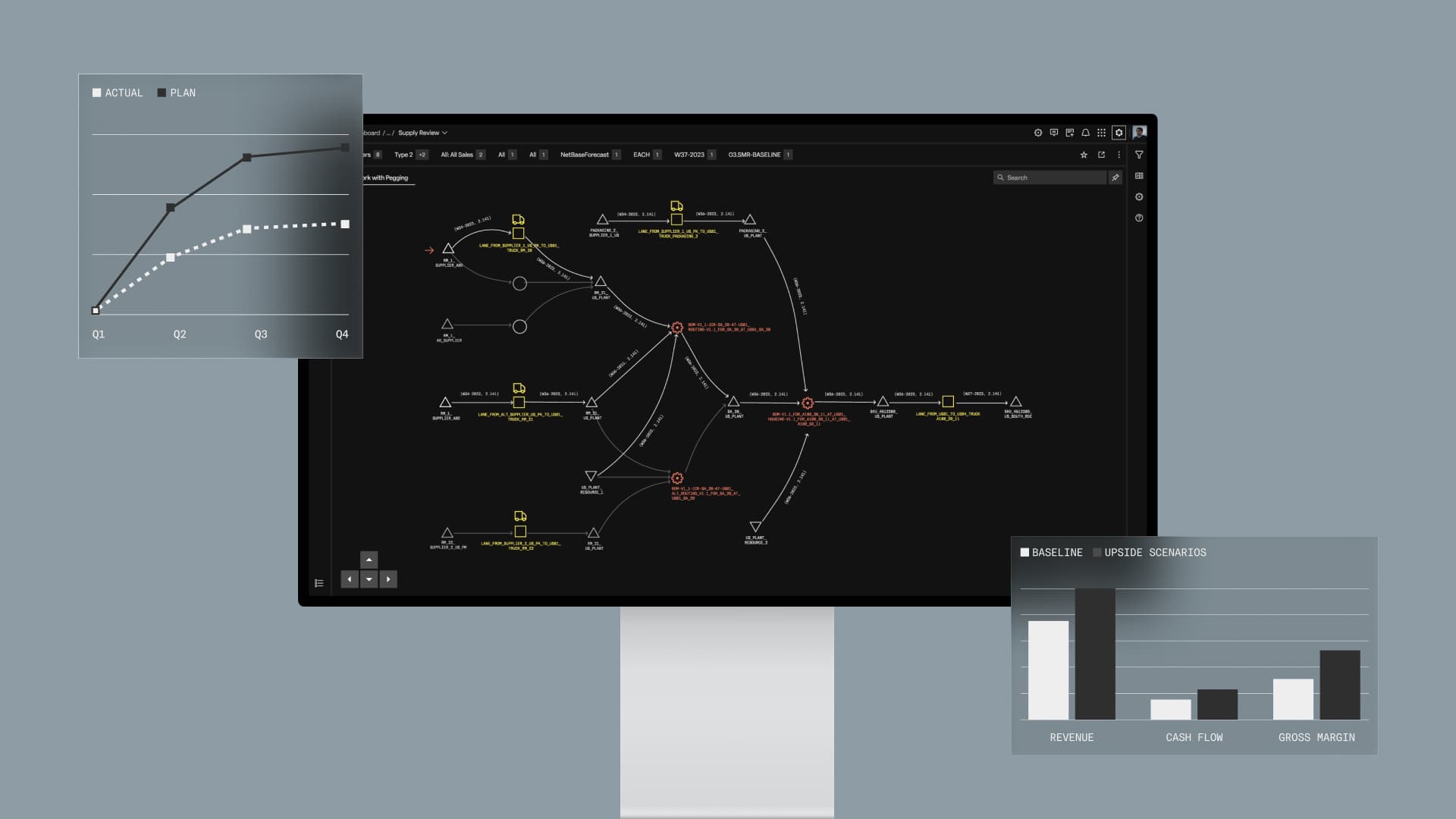
Real-time visibility gives supply chain teams a live picture of inventory positions, shipment status, and supplier performance across the entire network. Without it, managers are making decisions based on data that is hours or days old. Control towers, which are centralized dashboards that aggregate and interpret supply chain data in real time, have become the operational nerve center for leading SCM organizations.
AI for decision support is moving from pilot to production across the industry. Ninety-four percent of companies now plan to use AI or generative AI to assist with supply chain decision-making. AI-powered control towers have been shown to yield a 307% return on investment within 18 months. Forty-seven percent of small and mid-sized businesses now use AI in their supply chains, up from 18% in 2023, driven by more accessible SaaS tools.
Digital twins create virtual replicas of the physical supply chain, allowing teams to simulate disruptions, test network design changes, and model the impact of sourcing decisions before committing resources. A digital twin can answer, in minutes, questions that would previously have required weeks of analysis: what happens to cost and service levels if we shift 30% of volume from one supplier region to another?
Agentic AI, meaning systems capable of taking actions autonomously rather than only generating recommendations, is beginning to handle routine exception management: rerouting shipments, triggering replenishment orders, and adjusting production schedules in response to real-time signals. Gartner predicts that 60% of supply chain disruptions will be resolved without human intervention by 2031.
The Business Case for Better Supply Chain Management
Companies that excel at supply chain management outperform peers on cost, service, and shareholder return. McKinsey research shows AI integration in supply chain operations alone can cut logistics costs by 5 to 20%. Companies that met their supply chain cost targets in 2024 outperformed those that did not by an average of nine percentage points on total shareholder return, according to BCG.
The downside of poor supply chain performance is equally measurable. A supply chain disruption lasting more than 30 days can cost 3 to 5% of annual EBITDA (earnings before interest, taxes, depreciation, and amortization, a standard measure of business profitability). A sustained multi-month disruption can reach 30 to 50% of a year's EBITDA, according to McKinsey. For a business with $1 billion in revenue, that is a potential nine-figure impact from a single event.
The organizations that outperform on supply chain management share a common trait: they have invested in the capabilities, systems, and talent to act before a problem becomes a crisis, rather than after.
Common Challenges in Supply Chain Management
Even organizations that understand the strategic importance of supply chain management consistently run into the same obstacles.
Limited end-to-end visibility. Seventy percent of supply chain professionals cite visibility and inconsistent data as their biggest operational challenge, according to recent survey data. Fewer than 30% of organizations have achieved integrated supply chain optimization across their operations. Without a reliable, real-time view of the full network, decisions are based on incomplete information.
Siloed systems and fragmented data. Most businesses run procurement, production, logistics, and finance on separate platforms that do not share data automatically. The result is that critical supply chain decisions get made on stale information, or not made at all because no one has a complete picture.
Geopolitical and trade volatility. McKinsey's 2025 risk survey found that 82% of companies' supply chains are currently affected by new tariffs. Supply chain networks that were built for a stable trade environment are having to be redesigned under time pressure, often at significant cost.
Sustainability compliance. The EU's CSRD and similar frameworks require companies to report on Scope 3 emissions with increasing granularity. Most supply chain management systems were not built to capture and report on emissions data across multiple supplier tiers. Retrofitting that capability is a major challenge for procurement and SCM teams.
Talent gaps. Ninety percent of supply chain leaders in a McKinsey survey said their organizations lack the talent and skills needed to meet their digitization goals. Supply chain management requires a combination of operational, analytical, and technological expertise that is difficult to find and harder to retain.
What to Look for in a Supply Chain Management Platform
The strongest supply chain management platforms provide a unified data environment spanning planning, procurement, production, and logistics, with AI-powered recommendations and real-time visibility across the full supplier network.
Beyond that foundational requirement, five capabilities distinguish leading platforms from those that simply add complexity.
End-to-end data integration means the platform connects to every system in the supply chain, from supplier portals and ERP (enterprise resource planning, the core business management system) to warehouse management and transportation management systems, and surfaces a single consistent view of the network.
AI and machine learning for optimization goes beyond improving demand forecasts. It enables continuous optimization of inventory positions, production schedules, and logistics routing, surfacing recommendations that would take human teams weeks to produce.
Scenario planning and digital twin capability allow supply chain teams to model the impact of disruptions and strategic decisions before they are executed. The ability to test a nearshoring decision, a supplier switch, or a distribution network redesign in a virtual environment significantly reduces the risk of large, irreversible commitments.
Sustainability tracking built in means emissions data, supplier ESG scores (environmental, social, and governance ratings), and Scope 3 reporting are embedded in the platform, not bolted on through a separate tool that requires manual data exports.
Exception-based design for high adoption ensures that planners and managers engage with the system daily because it surfaces what matters, rather than requiring them to navigate complex dashboards to find it. Platforms that prioritize the user experience consistently achieve higher adoption, which is the primary driver of realized value from any SCM investment.
Supply chain management is one of the most operationally complex disciplines in business, and one of the highest-leverage. The organizations investing now in the right processes, technology, and talent will be structurally better positioned when the next disruption arrives, and better able to capitalize on the windows of stability between disruptions.
Frequently Asked Questions
What is supply chain management?
Supply chain management is the end-to-end coordination of all the processes, people, and systems involved in moving a product from raw material to end customer. It covers sourcing and procurement, production, inventory management, warehousing, and logistics.
What are the main functions of supply chain management?
The six core functions are sourcing and procurement, production and manufacturing, inventory management, warehousing and distribution, logistics and transportation, and demand and supply planning. Each function depends on the others, and disruptions in one cascade through the rest.
What is the difference between supply chain management and supply chain planning?
Supply chain planning is a discipline within the broader field of supply chain management. Planning determines what to make, buy, and ship. Supply chain management then executes and oversees the entire physical and financial flow across the network. They are closely interconnected: planning drives execution, and execution feeds updated data back into planning.
How does AI improve supply chain management?
AI improves supply chain management by enabling real-time decision support, reducing logistics costs by 5 to 20% through optimization, and allowing routine exception management to be handled automatically. It also improves demand forecasting accuracy and enables digital twin simulations for strategic network decisions.
What are the biggest challenges in supply chain management today?
The most pressing challenges are limited end-to-end visibility, siloed data across disconnected systems, geopolitical and tariff volatility, increasing sustainability reporting requirements, and a shortage of skilled talent. Addressing them requires investment in unified data platforms, real-time visibility tools, and AI-powered decision support.

About the authors

The Editorial Team, o9
A multidisciplinary collective of editors, strategists, technologists, and former executives with experience across Fortune 500 companies and top consulting firms. Grounded in o9’s mission to help enterprises make faster, better decisions through the power of AI-driven planning and execution software, the team shares clear, practical insights on digital transformation, supply chain, and enterprise planning to support business leaders in navigating complexity and driving change.