9 read min
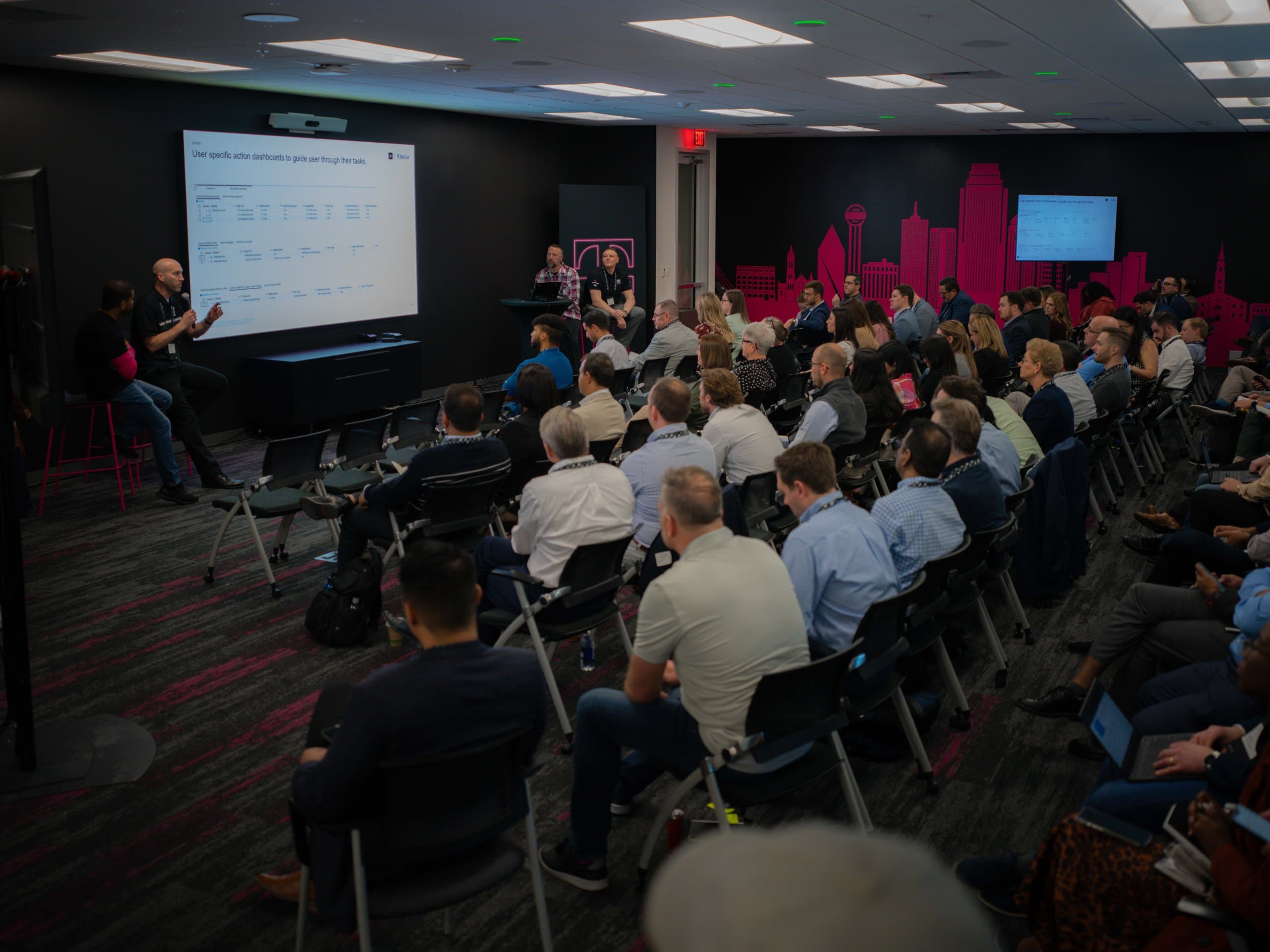
DALLAS, March 18 — More than 100 senior leaders from across industries attended T-Mobile’s Dallas offices for what became the largest Go & See event in o9 Solutions’ history. The day-long session, co-hosted by T-Mobile and o9, offered an in-depth look at T-Mobile’s ambitious digital planning transformation—an initiative that has driven over one billion dollars in value by unifying demand and supply planning, supplier collaboration, and risk management on a single next-generation software platform.
Attendees were guided through T-Mobile’s end-to-end transformation journey, complete with live demonstrations that highlighted how demand and supply planning, supplier collaboration, and proactive risk management capabilities can be seamlessly integrated to better support day-to-day operations and decision-making. This up-close view of T-Mobile’s integrated planning platform served as a testament to the power of aligning people, processes, and next-generation technology under a singular, forward-thinking vision.
______________________
The Planning Challenges Leading to Transformation
The morning began with T-Mobile taking the stage to detail the scope of the company’s network supply chain, which spans over 80,000 sites, 50,000 nodes, and more than 600 active parts. On any given week, the telecom giant might juggle 1,000 distinct projects—each one demanding a specific set of parts and resources.
This sprawling telecommunication network was being managed through a patchwork of disconnected tools and systems. According to Brian Eldredge, Senior Business Operations Manager at T-Mobile, “inventory was tracked in one system while fulfillment was handled in another,” and over time, “the proliferation of systems necessitated a need to combine everything on the same page.”
Brian and his team first tried to centralize fulfillment in 2018, consolidating warehouses and processes to gain better visibility. Although this move was a step in the right direction, the COVID-19 pandemic exposed deeper issues. Faced with the need to maintain 99.5% stock availability to ensure 95% fulfillment success, T-Mobile wrestled with having the right materials at precisely the right time, all while avoiding ballooning inventories. This also put a strain on its relationships with its suppliers, leading to the realization that they were “speaking two different languages.”
Zach Anderson, who leads System Design, Development, and Implementation at T-Mobile, remembered the days when planners relied on 16 different “job aids” and endless Excel spreadsheets just to get an approximate view of demand. He said they “didn’t need more people to fix it” but realized they needed “a single platform” to align data and processes before vital insights were lost.
Their search led them to o9, a partner with the flexibility and processing power to bring together disparate data streams, address the company’s unique business requirements, and integrate demand and supply planning, supplier collaboration, and risk management capabilities on one platform.
Mastering Demand and Supply
The day's second session featured a live demo showcasing how T-Mobile leverages the o9 platform to streamline its entire demand and supply planning cycle. Having already centralized key data, the company demonstrated exactly how it now collaborates internally before finalizing forecasts for suppliers, ensuring that the plan truly reflects real-world constraints.
Brian remarked that publishing a forecast is now “as simple as hitting a little refresh,” noting that once the numbers are updated internally, they automatically become available across the o9 environment. Before o9, Zach noted that there was “no way to measure” T-Mobile’s forecast accuracy, but now the team consistently evaluates KPIs such as inventory levels and turns, as well as month-over-month trends, to ensure they stay on target.
According to Brian, the team has been “spot on for where we want to be over the past six months,” a milestone he attributes to the ongoing monitoring of forecast accuracy. This has also significantly reduced friction with suppliers; Brian explained that they see “an awful lot less of suppliers running to management to argue about forecast accuracy” when everyone is operating from the same dataset. Sean added that T-Mobile can now hold suppliers accountable for their committed numbers, enabling the company to track trends more effectively.
Advancing Digital Supplier Collaboration
The next session dove into how T-Mobile works hand-in-hand with its suppliers—represented at the event by Nokia and Pacific Technical Solutions—through o9’s digital supplier collaboration capability. Sean pointed out that switching to o9 “reduced the redundancy of texting, emails, calls” and that everything is now “saved and digitized” for easy reference. He noted that o9 brought ideas on how to improve supplier collaboration that T-Mobile hadn’t considered, partly thanks to a collaborative design approach. By involving key suppliers early, some began using the tool six to eight months before formal go-live, and T-Mobile ensured high adoption rates once the system officially launched.
To illustrate how the collaboration actually works, Sean walked attendees through the monthly forecasting cycle: T-Mobile publishes the forecast to suppliers on the first of the month, then locks it in by the tenth. He highlighted how the “starting buying dashboard” in o9 serves as a “great calculator” to track the percentage of commits from suppliers across more than 500 SKUs. He called it a “one-stop shop” for monitoring any forecast cycle and validating supplier responses.
Shannon McDearis, Nokia’s Head of T-Mobile Market Operations at Nokia, added that once a forecast is published, the system automatically brings critical SKUs to a user’s attention. She emphasized that “it is very intuitive,” allowing suppliers to copy, paste, or even auto-commit on dozens or hundreds of SKUs in minutes. Shannon said this efficiency “makes it easy” to highlight issues and discuss their potential impact right away.
The collaboration extends to real-time tracking of supplier commits. Sean explained that if a supplier decommits on certain items, all parties can see exactly when and why it happened, making future decisions faster and more informed. Shannon agreed, calling it a useful “sanity check” to spot oversights, overcommits, or undercommits. If the numbers are out of alignment, the system flags those exceptions to address them before they become bigger problems.
When asked if the o9 tool drives all interactions between T-Mobile and its suppliers, Sean affirmed that it does—conversations now originate from specific data points in the tool. Mark Zamalloa, President of Pacific Technical Solutions, praised this new approach for reducing stress and last-minute scrambles. He added that his team initially "felt this was going to be just another program” but admitted his team now “lives, breathes, and sleeps this data” and that “there's so much information we leverage that's real-time."
Proactively Managing and Resolving Risks
The conversation shifted to T-Mobile’s newest innovation around proactively managing risk. Shannon explained that the tool ranks disruptive events, such as severe weather or geopolitical developments, by category. She noted that centralizing this data in one dashboard helps both parties quickly understand the scope and severity of each potential threat.
Sean walked participants through the process of assessing risk. Based on the specific SKUs impacted by a given event, the system delivers different datasets and calculates a resilience score. According to Sean, the system “recommends what I need to do and highlights exactly how I’m impacted,” effectively putting T-Mobile “in the front seat” to tackle issues before they escalate. He emphasized that this proactive stance “gives us a competitive edge” and praised the platform’s visual representation of the flow of products, which traces items from suppliers to distribution centers and onward to end locations.
In a quick demo, Sean typed in a specific SKU to show how a simulation can model disruptions over the next four weeks. As he described it, the platform “provides a very collaborative approach” that “cuts the noise out for planners,” enabling T-Mobile and suppliers to see precisely where their risk lies and start mitigating it immediately. Zach pointed out that “within 30 seconds, we know every single SKU and every single vendor impacted,” allowing T-Mobile to respond decisively while competitors might still be scrambling for basic information.
Transformation Lessons Learned and Value Realized
The final session served as a retrospective on T-Mobile’s multi-year transformation, highlighting both the successes and the key lessons learned.
- Simplicity Rules: Zach emphasized the critical role of simplicity in any transformation effort. He underscored that “it needs to be simple” to encourage user adoption, warning against over-engineering solutions that might appear impressive but fail to be practical or user-friendly.
- Starting Small: Sean supported the philosophy of beginning with “easy wins.” By addressing immediate needs first and gradually introducing more advanced features, T-Mobile was able to maintain momentum and continually showcase the benefits of the new system to stakeholders.
- Driving Service Levels: Imran Mohammed, a Senior Engineer on T-Mobile’s System Design team, credited o9’s “continuous improvement” for helping T-Mobile meet its ambitious 99.9% service-level target. This ongoing focus on refinement ensured the platform remained aligned with evolving business needs.
- Business-Led Implementation: Steffen Kuehl, T-Mobile’s Senior Director of Supply Chain, highlighted the advantages of keeping the project “mostly within the business users.” This approach minimized IT complexities, accelerated decision-making, and contributed to what he described as the “most flawless” implementation he’s witnessed at T-Mobile—delivered on time, under budget, and driving inventory down from $1.5 billion to $238 million.
- A Continuous Journey: o9’s Chief Digital Officer, Krishna Kulankara, reminded attendees that large-scale transformations are ongoing initiatives, not one-off projects. He pointed out that T-Mobile took several years to craft a roadmap, build a Center of Excellence (COE), and keep iterating—all while the business environment rapidly evolved around them.
- Embracing Best Practices: Steffen encouraged others to stay “open to best practices” that o9 brings to the table and to leverage out-of-the-box capabilities rather than reinventing processes. By doing so, organizations can accelerate deployments and achieve results more efficiently.
- Unified Platform, Multiple Views: According to Zach, o9’s ability to integrate with existing data sources and provide role-specific views was a game-changer for T-Mobile. Sean recalled feeling “in shock” at how a single platform could unite so many disconnected aspects of the business, streamlining operations and decision-making.
______________________
The day’s sessions made it clear that T-Mobile’s digital planning transformation, powered by o9, has delivered remarkable operational gains, deeper supplier partnerships, and a more proactive approach to risk management. From integrating demand and supply planning to closing supplier collaboration gaps and mitigating disruptions, the program fundamentally transforms how T-Mobile’s supply chain operates.
With lessons that emphasize simplicity, continuous improvement, and leveraging out-of-the-box functionality, T-Mobile’s journey shows how a thoughtful combination of technology, process, and culture can yield both substantial financial returns and a more resilient organization.

About the authors

Luis Felipe Andrietta
Senior Director, Industry Solutions
Luis Felipe is a Supply Chain professional with 10+ years of experience, having developed multiple Supply Chain Advanced Analytics solutions and led transformations across several clients in different industries during his tenure across different consulting firms. Luis is passionate about using digital and analytics in Supply Chain to deliver bigger and sustained impact to clients. At o9, Luis is responsible for partnering with Industrial Manufacturing clients on their journey to fully leverage the benefits of Advance Planning Solutions to elevate decision making and more sustainable operations.