5 read min
In recent years, we have closely collaborated with our partners, clients, prospects, and industry leaders to analyze the evolving dynamics of global supply chains. Our findings, supported by insights shared during many of our aim10x sessions with executives across various industries, highlight crucial lessons learned from recent disruptions.
A significant observation is that many large-scale enterprises rely on legacy software like SAP APO and BY primarily as systems of record, with actual planning continuing to be carried out offline in siloed spreadsheets. It has become clear that managing multi-billion dollar global operations via Excel is unsustainable, inefficient, and environmentally unsound - particularly during periods of intense disruption.
This brings us to a vital question: Why is it more important than ever to replace your legacy planning software? Here, we’ve identified a few key capabilities that businesses should adopt to provide their supply chains with a competitive edge moving forward.
Driver-based demand management to identify risks and opportunities sooner. Recent challenges have shown that many organizations react too slowly to significant changes, such as:
- Product mix shifts: A sharp rise in demand for essential products and a decline in others.
- Channel shifts: Substantial moves between go-to market channels requiring localized data due to region-specific trends.
- Regional demand variability: Differences in lockdown and reopening schedules across countries, cities, and sometimes, zip codes.
- Temporary surges: Spikes in demand due to customer and consumer stockpiling, with subsequent dips in demand being unpredictable.
Investing in capabilities like Demand Sensing, Key Account Collaboration and AI-enabled forecasting can help organizations detect and respond to demand risks and opportunities much sooner. For instance, if your business primarily sells to retail channels, leveraging both sell-in and detailed sell-out data, including consumer pricing, promotions, and other drivers, can transform your planning from reactive to proactive. Although it might seem like you lack this data, your organization likely possesses a wealth of underutilized information. Engaging with your sales, marketing, and consumer teams can uncover this hidden data, which can be crucial for refining your planning processes.
Driver-based supply management to improve visibility and adaptability. Many organizations lack sufficient visibility into their supply chains, particularly in the following areas:
- Production changes: Varying rates of production slowdowns and ramp-ups among suppliers.
- Inventory and capacity visibility: Challenges in viewing inventory and capacity across different ERP systems and record-keeping platforms.
- Upstream constraints: Limited visibility into upstream constraints at suppliers, including Tier-2 and Tier-3 suppliers.
Now is the time to invest in technology that can build a digital twin of your entire value chain, modeling all the capacities, costs, inventory, material availability, and partners. Concerned about data constraints? No need. There are many more innovative ways to solve fundamental data challenges, which we outline here. Start with the construction of a digital twin to enhance visibility, deliver significant value, and set the foundation for increasing agility across your operations.
Supplier Relationship Management (SRM) to enhance partnerships and resilience. Effective SRM is essential for improving transparency and collaboration with suppliers; by optimizing supplier interactions, companies can better anticipate and mitigate risks, manage costs efficiently, and enhance service quality - all crucial in the disruptive marketplace of today.
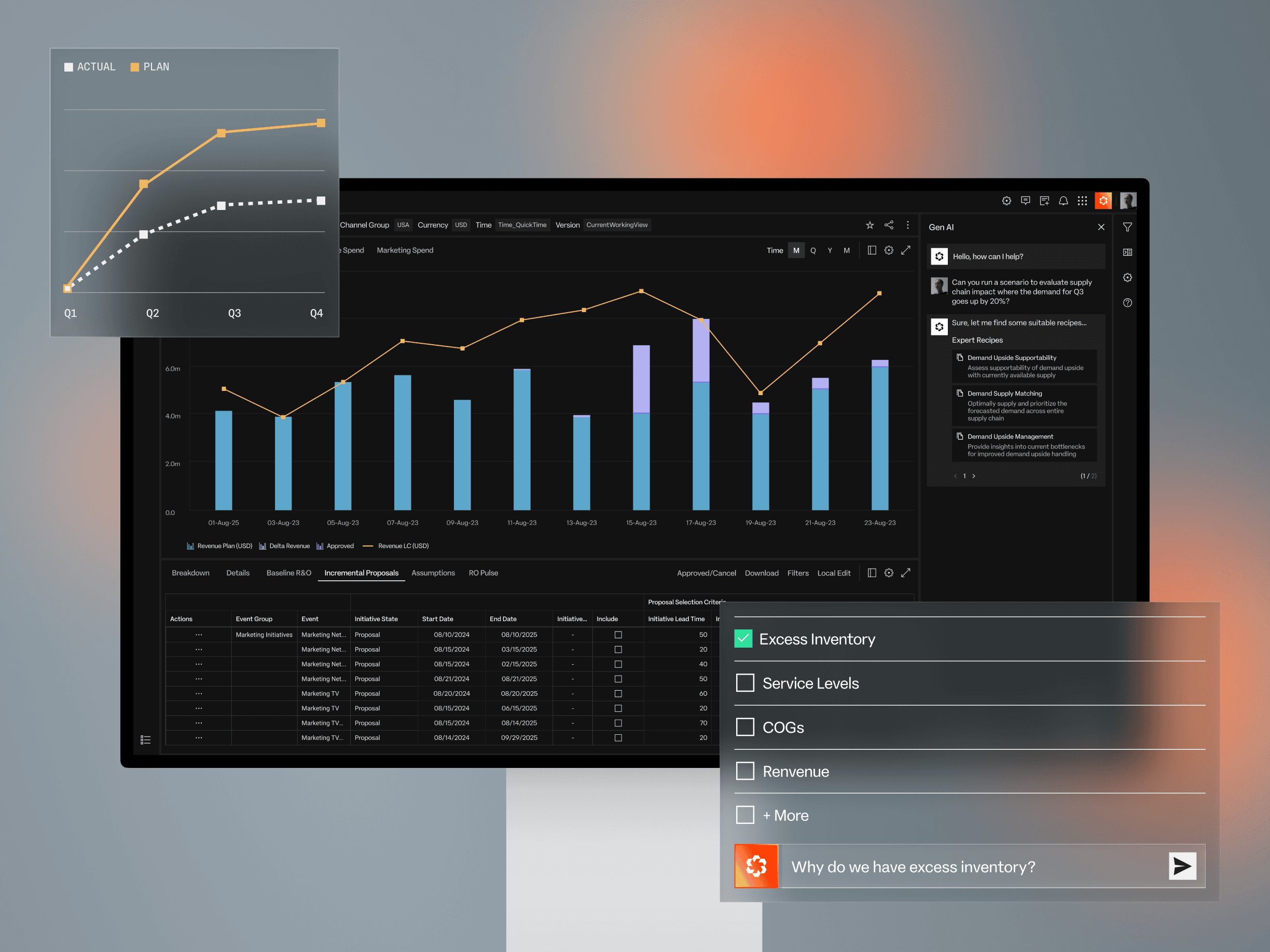
Integrated planning and rapid response for near real-time decision-making. Many organizations struggle with running scenarios in disconnected systems or spreadsheets, which is time-consuming and often ineffective. Integrating planning and response processes enables real-time scenario analysis, helping to evaluate trade-offs and make faster, more informed decisions.
Typical scenarios to explore include:
- Short-term horizon: Balancing immediate shifts in regional/product mix demand with existing inventory and network capacity.
- Mid-term horizon: Developing risk-based profit and loss scenarios to prepare for various future states, ranging from worst-case to best-case outcomes.
But, to gain true value from this, the next step is to:
- Bridge silos: Bridging commercial and supply chain silos in planning and decision-making has become more critical than ever. For instance, demand can be 95 (worst case), 105 (most likely), or 120 (best case). The commercial teams are interested in building those scenarios in a platform, recording their assumptions, and understanding the P&L impact before asking their supply chain colleagues for feedback.
After P&L evaluation, the supply chain team would respond almost instantly, offering a supply commitment to these scenarios. More importantly, they provide a detailed breakdown of the true cost-to-serve, including non-standard costs such as expedited shipping, flexible capacity, and alternative sourcing options. This step is crucial because while each commercial scenario has its risks and opportunities, the actual costs incurred by the supply chain are tangible and immediate. Before committing additional resources, it's vital to understand these financial trade-offs and discuss them with key stakeholders from Commercial, Supply Chain, and Finance departments.
- Accelerating planning cycles: Traditional monthly S&OP processes are no longer enough due to the need for faster decision-making, meaning e.g. S&OE is needed for weekly decision making and control owers for daily to near real-time updates. Legacy systems generally lack the architecture needed for rapid reconfigurations and are built to follow a sequential process that slows the identification of risks and opportunities, which is why modern systems that support quicker, more effective decision-making are crucial.
Convinced or curious?
Get in touch with us today! We have a fast and agile approach to replacing your legacy software. We can provide use cases from leading companies across industries and a path with our Digital Process Prototype process to embark on your organization’s transformation journey.
About the authors

o9
The Digital Brain Platform
o9 Solutions is a leading Enterprise Knowledge and AI-powered platform helping companies build Agile, Adaptive & Autonomous Planning & Execution Models for transforming enterprise decision-making in environments of rising volatility and uncertainty. Whether it is improving forecast accuracy, matching demand and supply and driving collaboration across the multi-tier supply chain to improve resilience at optimal costs and inventory, or optimizing new product and commercial initiatives to drive revenue growth and margins, decision-making processes from long-range to tactical to execution horizon can be made faster and smarter and connected on o9’s Digital Brain Platform.
o9 brings together game-changing technology innovations — such as innovative enterprise knowledge graph modeling, big data analytics, advanced algorithms for forecasting, demand/supply balancing, scenario planning, real time learning, collaboration, generative and agentic AI, easy-to-use interfaces and cloud-based delivery, and innovative management methods — as well as organization, process and change management best practices to transform decision-making speed and intelligence.