10 read min
On November 28th, over 150 senior supply chain and IT leaders gathered in Bangalore to hear executives at global enterprises share insights, lessons learned, and the outcomes of their planning and decision-making transformation initiatives.
The event, sponsored by McKinsey, PwC, Microsoft, Thoucentric, NTT Data, HCL, Kearney, Valiance, Algoleap, and Cognizant, featured current and former business leaders from Mankind Pharma, Thoucentric, Apollo Tyres, Carl Zeiss India, Diageo, Indofil, Asian Paints, LT Foods, DS Group, Godrej Consumer Products, Wipro Enterprises, o9, and more.
Each speaker shared how their organizations are leveraging new technology and ways of working to address the challenges facing their global supply chains.
Imperatives of Digital Transformation
“Companies must go big in digital transformation, and supply chain is the backbone of that.”
India’s transformation into one of the largest economies in the world has changed the landscape of global business—and added increasing complexity to its supply chains. This highlights the urgency for faster, more accurate decision-making and a pressing need for innovation.
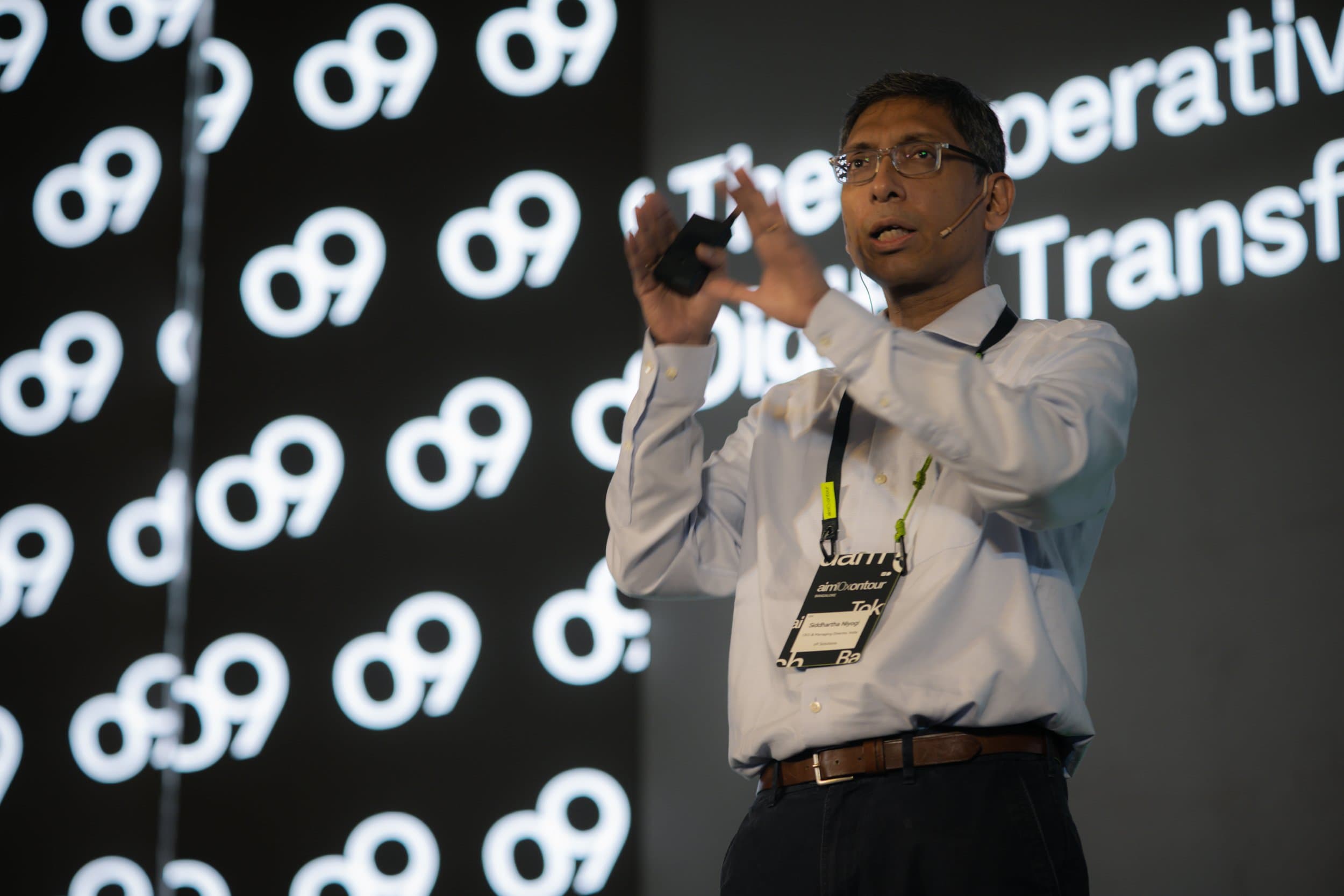
With this premise, aim10x Bangalore’s first session, led by o9 Solutions’ India CEO Siddartha Niyogi, set the tone for the day ahead. How are organizations across the subcontinent equipping for their digitalization initiatives?
The session explored a few common challenges organizations face: reliance on human intervention, manual processes, and data quality. Sid highlighted o9’s approach to touchless planning, where human intervention is minimized, and automation takes the lead. “Touchless planning means as little human intervention as needed. Global CXOs are relentlessly driving for this automation.”
Companies can achieve significant operational improvements by reducing complexity and automating planning. Sid shared examples from his career to illustrate the potential. At Lenovo Beijing, a shift in strategy improved inventory fill rates. Similarly, Samsung’s “no forecast, no supply” policy streamlined processes and drove success.
Sid urged leaders embarking on digital transformation to “Keep the models simple,” explaining that overly complex models at the highest planning granularity can hinder progress: digital transformation is not only about technology. It requires aligning strategies, policies, and processes while managing the significant change this entails.
“Spreadsheets and excessive constraints make planning a high-touch process. But touchless planning means as little human intervention as needed. Global CXOs are relentlessly driving for this automation.”
Siddartha Niyogi
CEO & Managing Director, India, o9 Solutions
Mankind’s Journey to Building a Resilient Supply Chain through Integrated Planning
With 93% of its sales in India, Mankind products are integral to the healthcare ecosystem. "Every seventh prescription written in India has a Mankind product in it, Dr. Namrata Sharma, Special Projects, CEO Office at Mankind Pharma highlighted, adding that 83% of doctors in India prescribe their products. Mankind serves urban and rural areas alike, with a significant presence in Tier 4, 5, and 6 cities. This reach is bolstered by a diverse portfolio spanning over-the-counter (OTC) products, animal health, and direct-to-consumer (D2C) segments.
Bharath Bhushan Rathi, Head of Logistics at Mankind Pharma, reflected on the Indian pharmaceutical landscape and emphasized the supply chain’s inherent complexity. "The Indian economy is driven by the monsoon," he explained, "and we see an upsurge in diseases like dengue and malaria post-monsoon. Demand varies drastically by region." Compounding the challenge, inventory planning is critical in this seasonal economy. He explained that competitors hedge inventory during monsoon season, but optimizing inventory days to ensure availability is the real differentiator. Stable operations, he noted, are a prerequisite for effective planning. "With o9, we are not just building a supply chain but an agile supply network," he added.
Arun A., Head of Demand Planning, described the company’s digital transformation journey, branded as Project ADAPT. Starting with Excel-based processes, Mankind Pharma evolved to using o9’s integrated platform for demand planning and forecasting. Arun detailed the transformation:
- Over three years, the company strengthened its workforce, benchmarked processes, and spent 4–6 months designing a blueprint for success.
- The o9 platform introduced advanced statistical forecasting, integrating market insights from sales and marketing with data-driven predictions.
- The platform allowed for more regional-level granular forecasting, moving from univariate to multivariate approaches.
“We’ve successfully onboarded 400 team members to o9’s collaborative platform, achieving a 90% adoption rate with 6 modules live.”
Arun A.
Head of Demand Planning at Mankind Pharma
"With 400 users onboarded and a 90% adoption rate, we achieved collaboration across teams like never before," Arun stated. Segmentation and the alignment of demand planning with sales and marketing were pivotal to their success.
Dipanjan Ghosh, the company's AVP of IT Supply Chain, added, "Our goal is smart decision-making. We want to remove the cognitive load from our teams, allowing the system to generate optimized outputs cycle by cycle." The transformation has already yielded substantial benefits:
- The adoption of daily replenishment has improved responsiveness to demand fluctuations.
- De-bottlenecking supply chain operations enhanced efficiency.
- Improved inventory optimization has reduced holding costs while ensuring availability.
Dipanjan concluded with a forward-looking perspective: "From 2025, we aim to scale within the function, focusing on sustainability, affordability, and availability. These are the core tenets of our supply chain strategy."
Selecting the Right Partner
“Digital planning is a bold vision. It’s a significant investment, and management can roll their eyes. Then, it is important to understand the value at the root and the time to achieve ROI.”
Digital planning transformations demand bold thinking and clear direction. Rahul Goyal, Engagement Manager at McKinsey, shared global enterprises’ best practices for choosing the right implementation partner and how it can help transformation teams in the process.
A successful transformation relies on a combination of roles, each bringing unique responsibilities. Rahul broke this down into four archetypes:
- The Client. Responsible for setting the north star of the supply chain and driving the overall vision.
- The Value Assurer. A strategic partner who establishes the foundation for success, focusing on strategy, governance, process design, and change management. Rahul described this role as someone “co-leading the client’s vision.”
- The Platform Provider. Offers scalable solutions tailored to the organization’s needs, such as the o9 platform, which integrates data and decision-making capabilities across supply chain functions.
- The System Integrator. Ensures technical design, development, and data integration while meeting the project’s minimum acceptance criteria.
Selecting the right partner requires adherence to core principles. Rahul emphasized how “The top-performing implementors do these five things differently: a solid business case, a strong business-IT partnership, end-to-end transformation, robust project management, and the right talent and organizational structure.”
Rahul concluded with a call to action for companies embarking on digital planning transformations. “Transformation success is not just about technology,” he said. “It’s about ensuring every partner and team member understands their role in the journey and executes it with precision.”
Securing CEO and Executive Alignment
During a panel discussion featuring senior cross-industry executives, Manish Garg (Thoucentric), Vishwanath Tiwari (Apollo Tyres), Manoj Sharm (Carl Zeiss India), and Nikhlesh Pathik (o9 Solutions) provided actionable insights on aligning executive leadership behind digital planning initiatives. The discussion highlighted the importance of clear communication, building trust, and maintaining alignment across functions and geographies.
Challenges in securing executive buy-in often stem from misaligned priorities across functions, but aligning on vision can help the whole organization focus on one common goal, Manoj explained. “Whether you want to remove human dependency, improve forecast accuracy by X%, or reduce costs, it’s essential to state the problem, understand the need, and then pitch it to the management.”
Panelists agreed that the o9 platform was critical in addressing misalignment challenges by supporting touchless planning and integrating key performance indicators across functions. And if the right tool is vital in enabling cross-functional alignment, so is trust. Vishwanath observed, “Buy-in is just trust. Capability and integrity. Who is leading this transformation? Is he capable and honest?” Establishing cross-functional alignment early and ongoing engagement ensures a smoother implementation process and better adoption rates.
One key lesson from the panel was sustaining executive alignment even after the project’s go-live phase. Nikhlesh recommended forming continuous improvement teams and conducting regular updates with leadership. “Keep sharing the setbacks and failures as they are experienced in business,” he advised, “and have insights ready to solve them.”
Building Success: Critical Capabilities of a Tech-Enabled Digital Transformation
With executive buy-in secured, the next step is execution—turning vision into reality. Ajay Nair from PwC led a session focusing on the critical components for a successful implementation. He opened by stressing the urgency of adapting to shifting business models: “Close to 60-70% of CEOs believe that their business models will change,” he noted, referencing a transition toward intelligent and self-driving supply chains.
Ajay highlighted the core pillars of effective implementation: advanced analytics, cross-functional integration, and robust data foundations. He stressed that adoption should be at the heart of any transformation effort: “How do you see the planner truly being able to use the solution? This should be a key criterion in the business case.”
He also emphasized aligning technology with long-term objectives while adapting to market changes. “A holistic approach, combining strong data structures with user-focused tools, is critical for maximizing value.”
Driving Effective Implementation: Implementation Issues that Lead to Adoption Risks
As the journey toward digital transformation continues, the importance of effective change Change management emerged as a critical topic as the day’s agenda turned toward implementation. A panel discussion featuring Parul Goel (o9 Solutions), Prashant Katiyar (Mankind Pharma), Garima Saxena (Diageo), and Sandeep Baxala (Indofil) emphasized that successful transformations depend on how well people adapt to new processes.
Despite operating in different industries, Mankind Pharma, Diageo, and Indofil’s dependence on complex supply chains brought similar challenges to overcome in their transformation process, such as reliance on spreadsheets, fragmented data, and resistance to change.
“The value unlocked from Touchless Demand Planning was quick, with 70% adoption in the first phase.”
Prashant Katiyar
General Manager, Business Transformation & Operational Excellence, Mankind Pharma
Panelists agreed that managing change is as critical as choosing the right technology. The o9 platform helped address these issues, but adoption required deliberate change management. “Touchless Demand Planning in the first phase saw early adoption, about 70%,” Prashant noted. Empowering users and aligning teams are key to achieving lasting transformation, and Sandeep stressed the crucial role of internal champions: “Ensure that your key users become your ambassadors to drive adoption internally.”
The panel highlighted lessons like starting data preparation early and involving change management during blueprinting. Garima advised, “Don’t underestimate the power of data—look at it, cleanse it. Give time to UAT.” Sandeep added, “Have stringent reviews and ensure continuity with consultants.”
Beyond the AI Hype in Supply Chain Planning
As AI continues to generate excitement in the world of supply chain planning, the last session of the day explored its real-world applications and impact on global supply chains.
Panelists Vishal Gupta (Godrej Consumer Products), Madhusudanaan NM (Asian Paints), Rejin Surendran (Wipro Enterprises), and Arvind Vedavit (Microsoft) joined a discussion to critically assess the benefits of AI, such as more accurate forecasting, better and faster scenario planning, and automated decision-making.
Despite operating in different industries, Godrej, Asian Paints, and Wipro Enterprises have demonstrated a commitment to innovation and digital transformation to maintain competitiveness in their respective markets. Each has adopted AI-driven solutions to improve operational efficiency.
Challenges like data quality, change management, and talent alignment prompted them to transform their processes. To address these issues, the companies leveraged dedicated AI teams, focused on data governance, and adopted structured training programs. Vishal explained, “AI must be part of a larger strategic story with a well-defined use case, high-quality data, and the right partner ecosystem.” Rejin added, “It’s not AI replacing humans, but humans who use AI replacing others.”
“It's not that AI will replace humans but that humans who use AI will excel. That's why educating the user community on AI concepts and their benefits is crucial.”
Rejin Surendran
Global CIO, Wipro Enterprises
Results included improved demand forecasting accuracy, better onboarding through decision recommendation models, and more precise cost predictions for client proposals. Madhusudanaan shared that integrating tribal knowledge into AI has streamlined processes and helped teams adapt faster: “AI helps us by moving tribal knowledge into standardized models, which improves onboarding.”
Lessons from the discussion centered on preparation and collaboration. Vishal emphasized building a culture that embraces innovation: “Organizations need structured strategies, aligned technology and talent, and a culture ready for change.”

About the authors

o9
The Digital Brain Platform
o9 Solutions is a leading Enterprise Knowledge and AI-powered platform helping companies build Agile, Adaptive & Autonomous Planning & Execution Models for transforming enterprise decision-making in environments of rising volatility and uncertainty. Whether it is improving forecast accuracy, matching demand and supply and driving collaboration across the multi-tier supply chain to improve resilience at optimal costs and inventory, or optimizing new product and commercial initiatives to drive revenue growth and margins, decision-making processes from long-range to tactical to execution horizon can be made faster and smarter and connected on o9’s Digital Brain Platform.
o9 brings together game-changing technology innovations — such as innovative enterprise knowledge graph modeling, big data analytics, advanced algorithms for forecasting, demand/supply balancing, scenario planning, real time learning, collaboration, generative and agentic AI, easy-to-use interfaces and cloud-based delivery, and innovative management methods — as well as organization, process and change management best practices to transform decision-making speed and intelligence.