6 read min
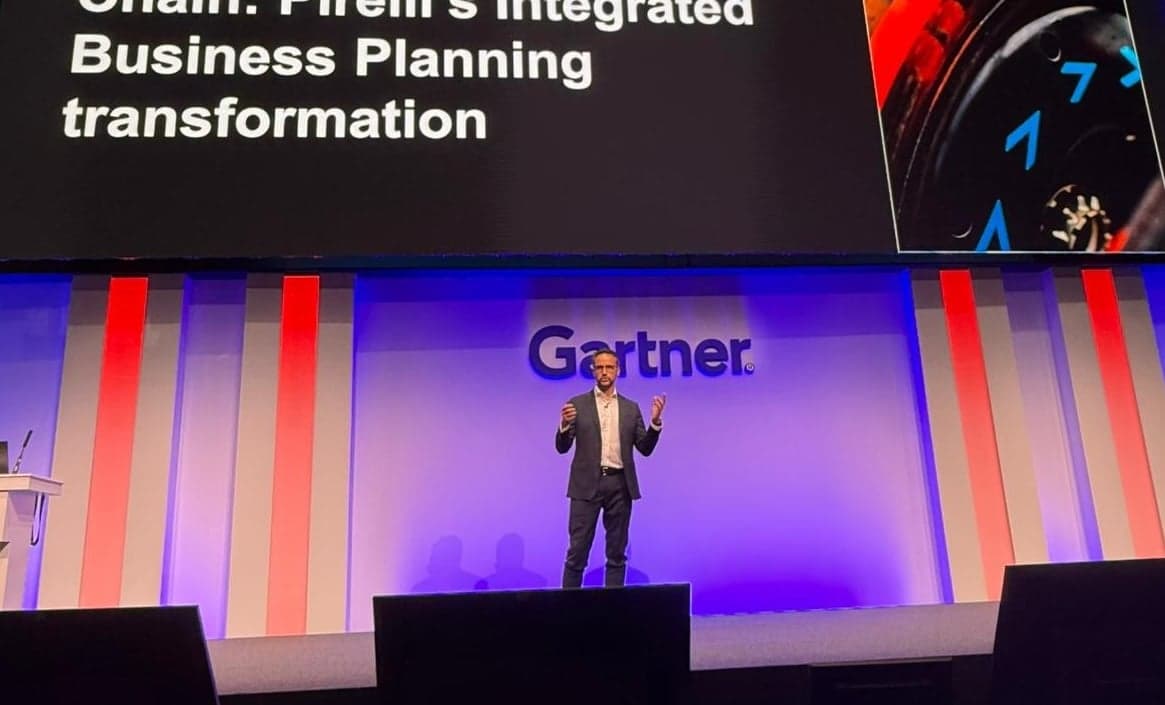
At the Gartner Supply Chain Symposium in Barcelona, Luca Galantina, Global Head of Value Chain at Pirelli, shared how the iconic tire maker is leveraging o9’s next-generation Integrated Business Planning (IBP) platform for automotive suppliers to align its R&D, sales, marketing, manufacturing, supply chain, procurement, quality, and planning and control teams on one plan for the future and keep the company in the driver’s seat of innovation and execution.
The Unique World of Pirelli’s Supply Chain
Pirelli operates in the premium and prestige segment of the tire market, serving elite car manufacturers. “We are selling all over the world and producing all over the world,” Luca said. “And we sell through two channels: original equipment (OE) and replacement.”
What makes Pirelli’s model unique is the “pull-through effect”—a dynamic where OE sales directly influence future replacement sales. Each tire fitment must go through a rigorous, model-specific homologation process that can take up to two years. These OE products then drive demand for the same homologated replacement tires years later, requiring precision planning and deep integration across functions. “We work with two dependent demands,” Luca explained. “The OE demand is based on car manufacturers' production volumes, Pirelli’s homologations, and market share allocations. The replacement demand is derived from the OE sales three to four years prior.”
This dual-channel interdependence, combined with Pirelli’s global footprint, high product offer variety, and demand-supply alignment challenges, created an urgent need to enable faster and more effective collaboration across departments, which ultimately led to an Integrated Business Planning digital transformation program.
Complexity as Catalyst: Why Transformation Became Inevitable
For Luca and his team, the tipping point wasn’t a technology imperative but a business necessity. “We needed something that put all the information together and translated it into effective business insights in order to allow us to take faster and data-driven business decisions,” he said. The legacy model, which was reliant on spreadsheets, sequential decision-making, and siloed departments, was no longer viable. For example, plans were driven by volume rather than profitability metrics because the financial data was only added downstream of the planning process.
That’s when Pirelli turned to Integrated Business Planning (IBP). But for Luca, IBP is “first and foremost a new way of working” and much “more than just a new digital platform.” He described it as a “virtual roundtable,” where R&D, sales, marketing, manufacturing supply chain, procurement, quality, and planning and control functions sit together—figuratively and literally—sharing data in real time and making faster, better decisions.
Orchestrating four planning levels on a single platform
To bring this new way of working to life, Pirelli implemented Integrated Business Planning across four interconnected levels. Each layer builds on the previous one, creating a consistent and responsive planning process, all orchestrated on a single platform:
- Step 1: New OE Business Evaluation (Weekly): The process begins with the continuous evaluation of new automotive OEM requests for quotation and their respective long-term value for Pirelli. As Luca explained, “We decide what to take and what to leave, considering the integrated profitability not only on the original equipment channel, but also on the replacement channel.” These weekly decisions are critical. They influence everything that follows and ensure Pirelli invests in the most strategically valuable businesses.
- Step 2: Strategic long-range planning (Annually, 5-Year Horizon): The outcomes of new OE business evaluations directly feed into the long-term strategic plan, which is updated annually but remains dynamic throughout the year. “Strategic planning is fed regularly by our decisions during the new business evaluation. So it’s live,” Luca emphasized. And unlike before, Pirelli now operates at much greater granularity: “We are now able to perform our strategic planning at the item level and single car model level. That is crucial for us because of our business model.”
- Step 3: Rolling Plan & Budgeting (Monthly, 12–18-Month Horizon): The first year of the strategic plan becomes the foundation for a rolling plan, which is reviewed monthly and adjusted based on the latest market insights. This ensures that mid-term plans remain grounded in strategic intent. “When we do the budget planning, we always start from the first year of the strategic planning, and we deploy it at the monthly level, embedding the latest market trends,” said Luca. “Then we review it every month with a rolling horizon of about twelve to eighteen months.”
- Step 4: Operational Planning (Daily/Weekly): Finally, the short-term—typically the first three months of the rolling plan—is translated into daily-level execution plans for production and distribution. These are fully synchronized with all upstream layers. “We take the first three months of the rolling plan to deploy those months at a more detailed, daily level,” Luca explained.
Luca emphasized the importance of coherence across these planning layers: “When we’re deciding something daily, it’s coherent with the monthly rolling plan, which in turn is aligned with the long-term strategic plan,” he said. “That orchestration is the heart of IBP.”
The Approach: Governance, Change Management, and Agility
Managing transformation at Pirelli required more than software. It demanded governance, leadership, and cultural buy-in. First, a dedicated team was established to lead the implementation full-time. Then, two key committees were formed:
- An operational committee, meeting monthly to follow up on the implementation plan and resolve issues;
- A steering committee, led by the CEO and Chief Digital Officer, meets quarterly to set strategic direction.
But for Luca, the most critical pillar was change management. “We selected 35 key stakeholders—function leaders and key users—and onboarded them from day one,” he said. Over 130 collaborative design sessions were held to co-create the future-state processes. The team also conducted organization-wide engagement through plenary sessions, brochures, training modules, and Q&As.
“Everyone must understand what we are doing, why we are doing it, and what the benefits are,” Luca emphasized. “Only then can you earn their commitment.”
The Results: Strategic Clarity, Smarter Decisions, Stronger Collaboration
The results of the transformation are clear and significant:
- Granular Strategic Planning: Previously managed via a scattered IT landscape that included a lot of spreadsheets, strategic plans are now performed at the item level, tailored to individual car models, which is crucial for Pirelli’s unique business model.
- Integrated Profitability Analysis: Pirelli now evaluates OE and replacement sales jointly before responding to every OEM RFQ, enabling better profitability and selectivity.
- Enhanced Cross-Functional Collaboration: “Thanks to the platform, all the functions are forced to work together,” Luca said. “Data quality has improved, and decisions are made faster with more transparency.”
Lessons from the Road: Luca’s Advice to Transformation Leaders
Reflecting on the journey, Luca distilled several hard-earned lessons:
- Top Management Sponsorship is Non-Negotiable: “Our CEO is in the steering committee. That top-down support has been critical.”
- Change Management Must Be Intentional: “You need time and effort to bring the organization on board, not just tools.”
- Flexibility Is Essential: “This isn’t a walk in the park. Agility and adaptability of the scoping along the way are a must.”
- Don’t Digitize the Past: “The biggest trap is trying to replicate your old way of working on a new platform. IBP is a new business process, not just a system upgrade.”
What’s Next: GenAI, Raw Materials, and Sustainability
Looking forward, Luca outlined three priorities for the second wave of transformation:
- Extending IBP upstream to raw material suppliers, bringing end-to-end visibility into the value chain.
- Using Generative AI innovation to help users interpret recommendations from machine learning/optimizers/heuristic algorithms, increasing trust in automation.
- Embedding sustainability into IBP algorithms, with goals like minimizing carbon emissions and maximizing bio-based and recycled materials usage.
As he wrapped up, Luca left the audience with a simple but powerful reminder: “IBP is not just about digital tools. It’s about creating a smarter, more collaborative way of running the business.”
About the authors

The Editorial Team, o9
A multidisciplinary collective of editors, strategists, technologists, and former executives with experience across Fortune 500 companies and top consulting firms. Grounded in o9’s mission to help enterprises make faster, better decisions through the power of AI-driven planning and execution software, the team shares clear, practical insights on digital transformation, supply chain, and enterprise planning to support business leaders in navigating complexity and driving change.