5 read min
Barilla's product may be pasta, but planning is the secret ingredient. A global footprint, a diverse product mix ranging from shelf-stable staples to perishable baked goods, and a proud 145-year legacy all mean that the company’s supply chain operates with both complexity and precision.
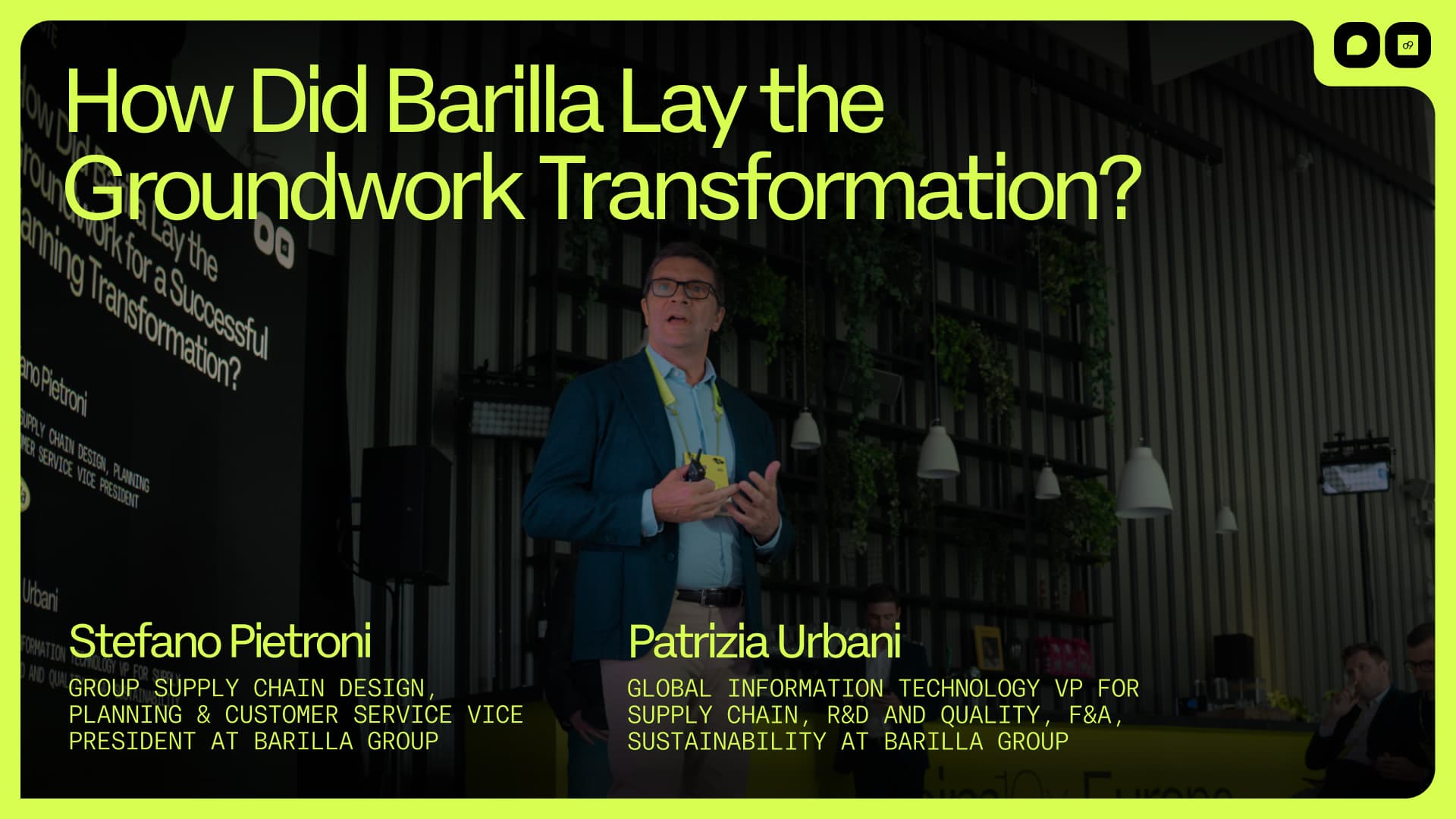
As customer expectations rise and demand patterns shift, Barilla is rethinking how it orchestrates supply, demand, and distribution. At the heart of this transformation is a multi-phase planning program, led by Stefano Pietroni (Vice President, Supply Chain) and Patrizia Urbani (Global IT Program Manager), and powered by o9’s Digital Brain.
The grounds for transformation
“We’re a company built on product, but process is how we stay competitive,” explained Pietroni. Barilla manufactures 98% of its own goods, with plant utilization rates averaging 96%. That leaves very little margin for error and a lot of urgency to get planning right.
Over the past decades, complexity has grown substantially, both from an operations perspective and in the commercial landscape. “We now manage dozens of brands and serve customers across highly fragmented channels,” Pietroni said. “Planning has become a strategic lever.”
The team began by targeting near-term use cases with clear business impact: order promising and distribution optimization. These would form the basis for a larger transformation that included replacing the company’s aging SAP APO system.
According to Pietroni, the end goal was never just to modernize tools. “The real challenge was balancing customer service with efficiency in a high-saturation environment. We needed agility and selectivity to serve our customers better.”
Designing for real-world complexity
For Barilla, success started not with software, but with structure. “We began by clearly mapping our process needs,” Urbani said. The company designed a use-case framework spanning short-term tactical planning, mid-term distribution planning, and weekly load building. That clarity made it easier to evaluate potential platforms based on real-world needs.
During the software selection process, standard criteria like functional coverage and architecture were table stakes. What really stood out for Barilla was innovation and adaptability.
“We wanted something more than a mature solution—we wanted a partner that could evolve with us,” Urbani explained. o9’s flexible architecture and co-development approach proved a strong match. “There were features like low-touch enrichment and load-building that weren’t just promising. They were collaborative. We built them together.”
Embedding a partnership mindset
Implementing a planning transformation of this scale required more than technical readiness. It required alignment between business and IT, and a new way of working.
“We formed an ‘end-to-end acceleration team,’” said Urbani, “a dedicated group of business and IT experts fully focused on the transformation.” This team served as a bridge between Barilla and o9, shaping the solution, prioritizing functionality, and ensuring use cases remained grounded in day-to-day operations.
Change management was also a central pillar. Barilla assessed each role impacted by the transformation, worked closely with HR to anticipate needs, and created a structured communication plan to support adoption. “We didn’t wait for resistance to appear,” Urbani noted. “We started planning for it from day one.”
Scaling transformation with discipline
Barilla’s implementation has been deliberately phased. Phase one prioritized near-term levers like order promising and distribution. Phase two will expand into integrated tactical and mid-term planning, with global rollout underway beyond the EMEA region.
That sequencing was intentional. “Agility matters most in the near term,” said Pietroni. “But the broader goal is end-to-end visibility and control—from execution to strategy.”
As the team expanded functionality, they also contributed to the development of new features within the o9 platform. “In some cases, we co-developed entirely new capabilities,” Urbani said. “The flexibility was a strength, but it also required discipline. We had to be very deliberate in how we scoped and governed each design decision.”
Reflections on what worked, and what didn’t
Barilla’s teams credit the close partnership between business and IT as a major success factor. “We never played the blame game,” said Urbani. “We were focused on outcomes, and that made a huge difference.”
The collaboration with o9 was another highlight. Frequent in-person workshops, open lines of communication with product and support teams, and a shared mindset of continuous improvement kept momentum strong. “They didn’t just sell us software,” Urbani said. “They helped us build capability.”
Still, there were lessons learned. One was around resourcing. “We underestimated the effort needed from internal teams,” said Urbani, particularly as the project moved into more complex use cases like load building and allocation logic.
Another takeaway was around methodology. While agile helped accelerate early wins, it eventually made it harder to see the full picture. “For future initiatives, we’d recommend starting with a traditional blueprint,” Urbani advised, “then executing in agile sprints. A hybrid approach offers the best of both worlds.”
The road ahead
With key use cases now live and global rollout in progress, Barilla is steadily building the foundation for a more connected, responsive planning capability. Future phases will focus on integrating long-range planning, enhancing automation, and refining global coordination.
But just as important as what’s coming next is what’s already changed. “We’ve created a new way of working,” said Pietroni, “one that’s aligned to our business goals, enabled by technology, and grounded in clarity and process.”
For a company built on tradition, Barilla’s transformation is a masterclass in how to modernize with discipline, evolve with purpose, and plan for the future—one carefully measured step at a time.
About the authors

The Editorial Team, o9
A multidisciplinary collective of editors, strategists, technologists, and former executives with experience across Fortune 500 companies and top consulting firms. Grounded in o9’s mission to help enterprises make faster, better decisions through the power of AI-driven planning and execution software, the team shares clear, practical insights on digital transformation, supply chain, and enterprise planning to support business leaders in navigating complexity and driving change.




![Aim10x digital shurtape [bts] copy](/_next/image?url=https%3A%2F%2Fcms.o9solutions.com%2Fwp-content%2Fuploads%2F2025%2F12%2Faim10x-Digital-Shurtape-BTS-copy.jpg&w=3840&q=75)