
Forecasting, the lifeblood of an organization, has the critical role of being able to predict the future, mitigate risks, and capitalize on emerging opportunities. However, this process is being heavily impacted by the acceleration of these and other demand drivers.
This White Paper will examine how next-generation technologies such as Machine Learning (ML) and Artificial Intelligence (AI) can significantly improve a business’ forecasting accuracy, ensuring it survives and thrives rather than being left behind.












UNLOCKING BILLIONS IN VALUE FOR CLIENTS IN 30+ INDUSTRIES
In this White Paper, you’ll learn:
Moving Beyond Historical Forecasts
Historical sales data cannot keep pace with modern market volatility, trapping businesses in rigid legacy systems that leak enterprise value. Download the White Paper to discover how next-generation planning eliminates these blind spots and proactively safeguards your supply chain.
Capitalizing on Leading Indicators
Past sales records leave organizations blind to real-time demand shifts driven by external forces like local weather or social commerce. Upgrading to driver-based machine learning eliminates this human bias to deliver up to a 20% accuracy improvement. Learn how to sense demand changes at a granular item and location level.
The 7 Steps of Algorithmic Forecasting
Converting chaotic market data into reliable knowledge requires a rigorous engineering process, not an ad-hoc operational fix. Without structured pipelines, forecasting models quickly suffer from quality degradation and data drift. Learn how to master our proven 7-step deployment blueprint.
Balancing Statistical and Machine Learning Models
No single model fits every demand scenario; enterprises must match the right mathematics to each specific business segment. Discover exactly when to deploy classical time-series versus advanced decision-tree or pre-trained foundation models. Learn how ensembling strategies generate a single, high-integrity forecast recommendation.
Synchronizing Horizons with the MLMH Framework
Enterprise planning fractures when short-term tactical demand sensing is disconnected from long-range strategic corporate outlooks. This gap breeds data inconsistencies and isolates teams into disjointed departmental spreadsheets. See how our Multi-Level, Multi-Horizon (MLMH) framework seamlessly reconciles high-level strategy with granular operational data.
Scaling Efficiency with Agentic AI
Rigid automation fails during unexpected market disruptions, leaving planning teams trapped in thousands of hours of manual overrides. Shifting focus to true Forecast Value Add allows Agentic AI to introduce autonomous reasoning within your defined business parameters. Learn how to transform standard data segments into hyper-automated, touchless workflows.
"Upgrading forecasting capabilities from legacy approaches to ML forecasting with drivers can deliver up to 20% improvements, and migrating to o9's full digital demand management can achieve up to 25%."

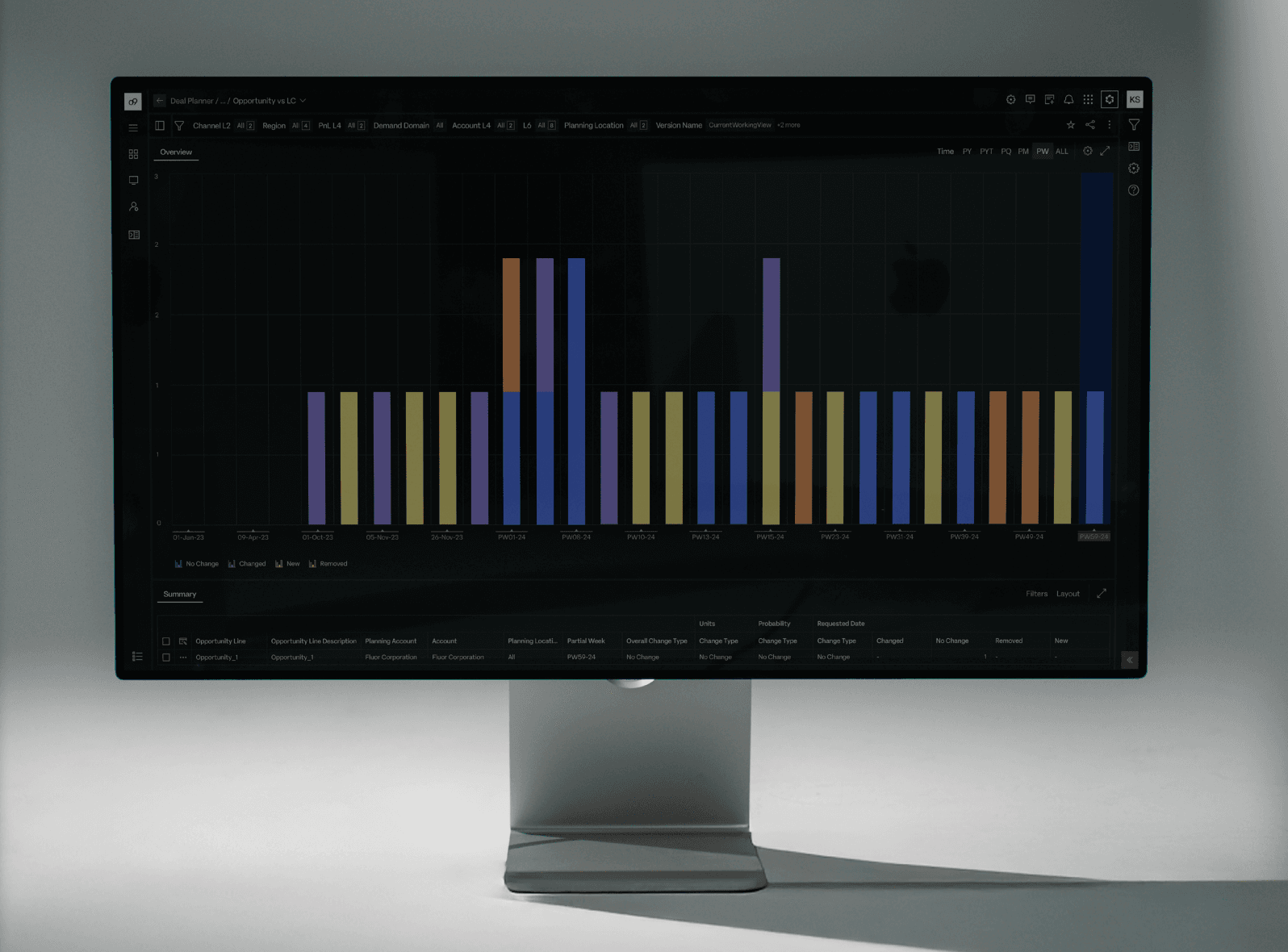
Breaking the Reliance on Historical Data to Predict Future Demand
Forecasting using purely historical data or lagging indicators cannot keep pace with modern market volatility and rapid shifts in consumer behavior. Relying on past performance traps planning teams in slow, siloed legacy systems that result in costly manual overrides, excess inventory, and a pervasive loss of enterprise value.
Transitioning to a driver-based planning framework connects commercial intent with real-time market leading indicators (such as local weather, social commerce, and macroeconomic trends) to proactively mitigate risk and safeguard supply chain margins.

Explore these key questions
Traditional time-series models cannot exploit modern market data because they rely strictly on historical sales to predict future demand. This backward-looking approach traps planners in slow, siloed cycles that fail to adjust to rapid shifts in consumer behavior. Moving past pure data collection is required to gain the real-time insights needed to proactively mitigate risk.
"Large Language Models (LLMs) are becoming essential forecasting assistants that can analyse unstructured data (such as market trends, customer sentiment, and news) and rapidly contextualise demand."