13 read min
Fifty floors above London, more than 100 senior leaders across RGM, commercial, marketing, insights, growth, and transformation gathered at The Lookout on October 1 for Growth Leaders Summit London 2026, a forum focused on profitable growth across consumer products and retail.
Across sessions on AI, RGM transformation, consumer insight, brand growth, commercial decision-making, and the future of value creation, four shifts became apparent.
1. Making RGM smarter is not enough. It has to become how the business works
Companies have spent years making RGM more sophisticated. The harder challenge is making it part of how commercial decisions actually happen.
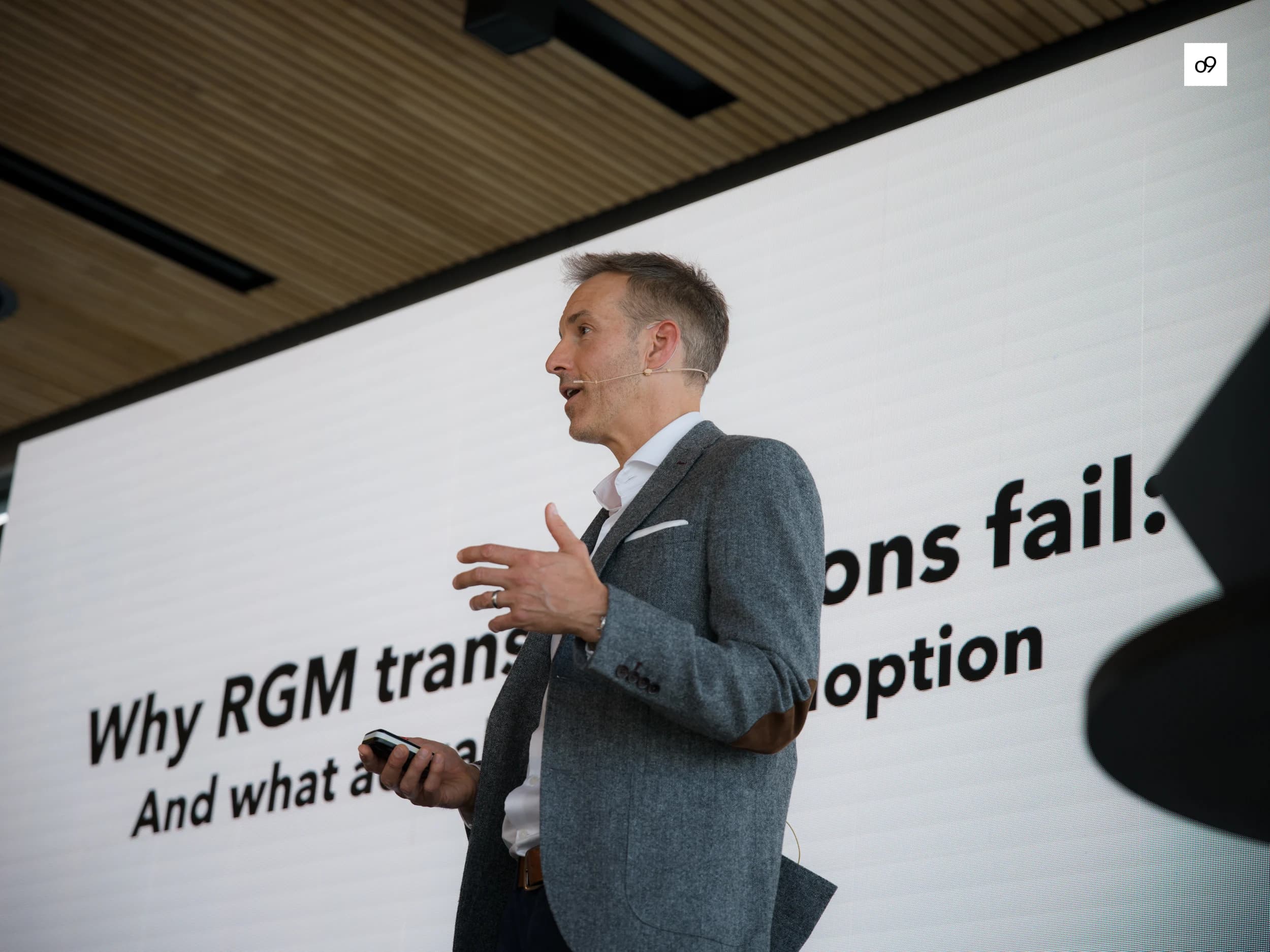
Nick Wishman, Global Head of Revenue Growth Management at Nomad Foods, described the gap vividly.
“We’ve built a Formula One engine and we’ve stuck it into a city bus,” he said of businesses that have invested heavily in RGM tools, models, and training without always creating the processes and behaviors needed to use them.
For Nick, the problem is increasingly one of adoption. Value often breaks in the handoffs between strategy and insight, insight and planning, and planning and execution.
That makes the challenge much broader than building another RGM capability. RGM needs to become part of the commercial planning process itself: the workflows people follow, the decisions they own, the information they use, the governance around investment, and the incentives that shape behavior.
Nick illustrated the governance problem with an example from a previous role. He needed three signatures to approve a team lunch, yet as a salesperson could invest £50,000 in a promotion with little visibility. Better analytics layered onto weak decision processes can simply help companies scale poor decisions faster.
His conclusion captured the shift: “The industry has spent 20 years making RGM smarter. The next decade will belong to the companies that make RGM stick.”
If Nick focused on embedding RGM into the commercial operating model, James Stok, RGM Consulting & Capability and Leadership Coach at Unlocking Your Potential, looked at the same problem from the perspective of the people expected to use it.

RGM, he argued, can easily feel like “sales prevention” when it begins with internal targets, processes, and rules rather than the problem a customer is trying to solve.
His alternative was “category at the start, brand at the heart”: begin with how the retailer can grow the category, then establish the role the brand can play within that growth. That changes the conversation from asking customers to support the manufacturer's priorities to identifying something both sides have a reason to act on.
Timing matters just as much. James noted that businesses can spend monthly reviews debating the recent past and immediate future even though many customer decisions inside roughly a 12-week window have already been made. The more valuable planning horizon is the one in which the decision is still open.
And more data does not necessarily solve the problem. Instead of asking analysts to “find insights,” James argued for beginning with a commercial hypothesis or business question and using the data to prove or disprove it.
Nick and James were ultimately describing two sides of the same challenge: RGM needs to be embedded in how the business plans, while helping commercial teams make better decisions in the moments when those decisions can still be changed.
A demonstration from Liz Nguyen, Solutions Consultant Manager at o9 Solutions, and Rhiannon Toole, Senior Solutions Consultant at o9 Solutions, offered a glimpse of how agentic AI could take that idea further.
In a simulated negotiation between a consumer goods key account manager and a retailer, an AI agent pulled together demand, transactional, sell-out, market, pricing, promotion, and assortment information to build a negotiation brief.
It identified where performance was falling short, surfaced underperforming promotions and an assortment issue, explained the drivers behind them, and proposed potential actions. Different pricing and promotional options could then be simulated before entering the negotiation.
The agentic piece became more important once the retailer responded. Rather than treating the counteroffer as the start of another round of manual analysis, the new terms could be assessed against the same commercial context, their implications simulated, and the recommendation updated.
That is where the potential value goes beyond faster analytics. An agent can increasingly help maintain the context of the decision, connect information that normally sits across different analyses, test alternatives, and respond as conditions change, while leaving the commercial team in control of the judgment and negotiation itself.
The result is a potentially much tighter loop between understanding what happened, deciding what to do, testing the economics, negotiating, and replanning.
Instead of AI replacing the human interaction at the heart of a commercial negotiation, it can give the people conducting it far greater analytical support while the decision is still live.
2. Growth is shifting to needs and markets incumbents have overlooked
If the first challenge is improving how commercial decisions get made, the next is knowing where to point them.
Growth may be harder to find in mature consumer categories, but it has not disappeared. Increasingly, it is being captured by brands that identify needs established players have missed.
That was the argument from Cynthia Hernandez, Global Director, Insights & Analytics at Tate & Lyle, who pointed to Bain research showing that insurgent brands account for less than 2% of the U.S. consumer goods market but captured 36% of its growth. Some had delivered 55% to 70% volume growth while charging substantial premiums.
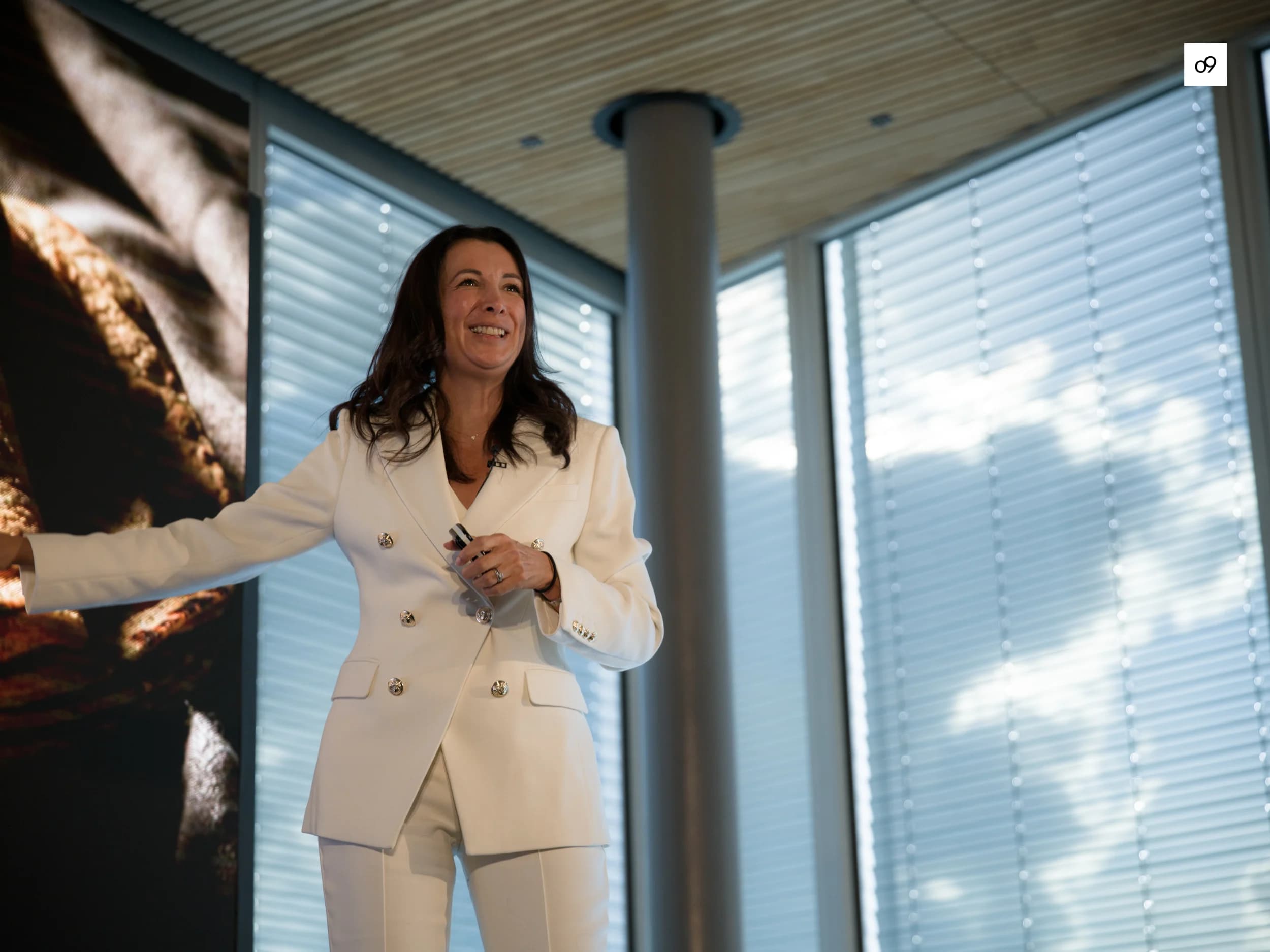
“Growth has moved. It hasn’t disappeared,” Cynthia said. These companies were not simply pricing better. “They actually found a need that no one noticed before, and then they invested in that.”
A grain-free tortilla was not really solving a gluten problem; it resolved the collision between dietary restrictions and a family's cultural relationship with food. A convenient nutrition brand was not primarily solving a knowledge gap around healthy eating; consumers already knew what they should eat. It was solving a time problem.
Cynthia then connected those examples to broader nutritional shifts. Tate & Lyle research found consumers increasingly seeking less sugar, more protein, and more fiber. Importantly, those behaviors were not confined to GLP-1 users. She argued they were already becoming mainstream.
One finding was particularly consequential for established brands. Consumers who had left a category said they could be persuaded back if products delivered the nutritional attributes they now wanted, but only 14% said they would necessarily return to the same brand.
Consumers increasingly search for what they need, such as protein, fiber, lower sugar, or particular ingredients, rather than beginning with a brand name.
That makes reformulation a growth issue, not merely a technical one. Spotting the need is only the first step; the harder challenge is delivering against it without sacrificing taste, texture, or functionality.
Tero Airaksinen, Senior Business Development Manager at Fazer, explored the same dynamic at the level of an entire market: how can a company recognize an opening before incumbency hardens around it?

His Romania case study challenged the instinct to wait for exhaustive market intelligence before entering a new market.
Modern retail and many Western brands arrived relatively recently in Romania compared with mature Western European markets. Consumers therefore have fewer multigenerational relationships with incumbent brands, making them more willing to try unfamiliar products. Buyers can also be more willing to give new entrants a chance.
That creates a window, but not a permanent one.
As the market matures, the advantages available to challengers begin to narrow. Waiting until every uncertainty has been removed can therefore become a decision in itself: a decision to enter late.
Tero also argued that selecting the right local partner may matter more than another dataset. A partner that is too small may lack the power to open doors; one that is too large may have little reason to prioritize a smaller brand.
“You need to find a sweet spot where you both work together on the same goal,” he said.
Cynthia and Tero made the same point from different directions: growth opportunities often become visible before certainty does.
3. Brands need to compete on a broader definition of value
Finding an opportunity is only part of the equation. Brands also need to understand what makes consumers choose them.
Andrew Geoghegan, author of Effective Brand Building, argued that today's volatility is better understood as part of a wider “information crisis.” Previous shifts, from writing to the printing press, also transformed who controlled information and how societies made sense of the world.

For brand leaders, the practical danger is reacting to every disruption with another short-term intervention. The underlying laws of consumer behavior, Andrew argued, have proved far more durable.
“The foundations haven't changed. But how we need to go to market fundamentally has,” he said.
His Glenfiddich case study illustrated the distinction. The brand had run seven campaigns in seven years, its range was difficult to navigate, and its premium credentials were unclear. The response was not another campaign, but a simple ambition the organization could align behind: become the number-one single malt whisky by value while retaining scale.
That ambition then informed the range, innovation, design, partnerships, experiences, and communications.
In other words, the response to a more complex market was not more complexity. It was greater coherence around the consumer.
One place that changing go-to-market environment is especially visible is influencer marketing, where credibility can matter as much as reach.
Dr. Valeria Penttinen, Assistant Professor of Marketing at Northern Illinois University, explored “deinfluencing”: creators actively telling followers not to buy certain products.

Her experiments found that negative recommendations could make subsequent positive recommendations more persuasive. Consumers interpreted criticism as evidence that the influencer was selective rather than simply trying to sell them everything.
But there was an important boundary.
When an influencer criticized one product and then moved into a paid promotion for another product from the same brand, the effect reversed. Consumers could interpret the sponsorship as though the brand had paid the creator to change their tune.
The implication is more nuanced than “negative reviews build trust.” Visible independence builds trust; activity that makes that independence appear compromised can quickly undermine it.
Valeria therefore encouraged brands to “treat deinfluencing as expert feedback” rather than automatically avoiding creators willing to criticize products.
If Andrew and Valeria focused on relevance and credibility, Tom Savigar and Alex Bradley, Co-founders of Avansere, asked a broader question: what do consumers now expect value itself to include?
Their research measures value across three dimensions: economic, emotional, and environmental. According to their Value Edge Index, consumers were seven times more likely to purchase brands performing strongly across the index, while substantial gaps remained between what people expected and what they felt brands delivered.
The largest gap was not price.
It was emotional security: whether a brand helps people feel supported, confident, and secure.
Their research also challenged assumptions about generations. Consumers over 55 wanted richer experiences almost as much as Gen Z and were placing greater weight on environmental responsibility.
The opportunity, Tom and Alex argued, is not to chase every expectation. It is to identify the value gaps that matter to consumers and that the brand has a credible right to close.
Across the three sessions, the definition of a strong brand became progressively broader: coherent in what it stands for, credible in how it communicates, and relevant to a wider set of consumer expectations.
4. AI creates the most value when companies are selective about where they use it
The potential of AI was evident throughout the day. But two sessions made the case for something equally important: understanding its boundaries.
Magnus Hultman, Professor of Marketing and International Business at Brock University, asked a deceptively simple question: where does AI actually improve performance?

His research examined an AI-supported promotional planning tool within a large consumer goods manufacturer.
At the aggregate level, introducing AI did not produce a statistically significant average sales increase.
The more useful result emerged when the researchers looked beneath the average.
Products starting with lower market shares recorded a statistically significant 11% sales increase, while impact varied by category. More complex, occasional-purchase categories appeared to benefit more. In simpler commodity categories, adding AI could provide considerably less value.
“AI works, but it doesn't always work,” Magnus said.
His broader argument was that AI should be targeted at the products, categories, and decisions where evidence suggests it can improve performance. That also preserves an important role for managerial judgment: the advantage may go not to the company that automates everything, but to the people who become better at deciding where AI is useful.
Louise Verde, Director, Customer Success at EPIC Insights, extended the same argument into consumer research.
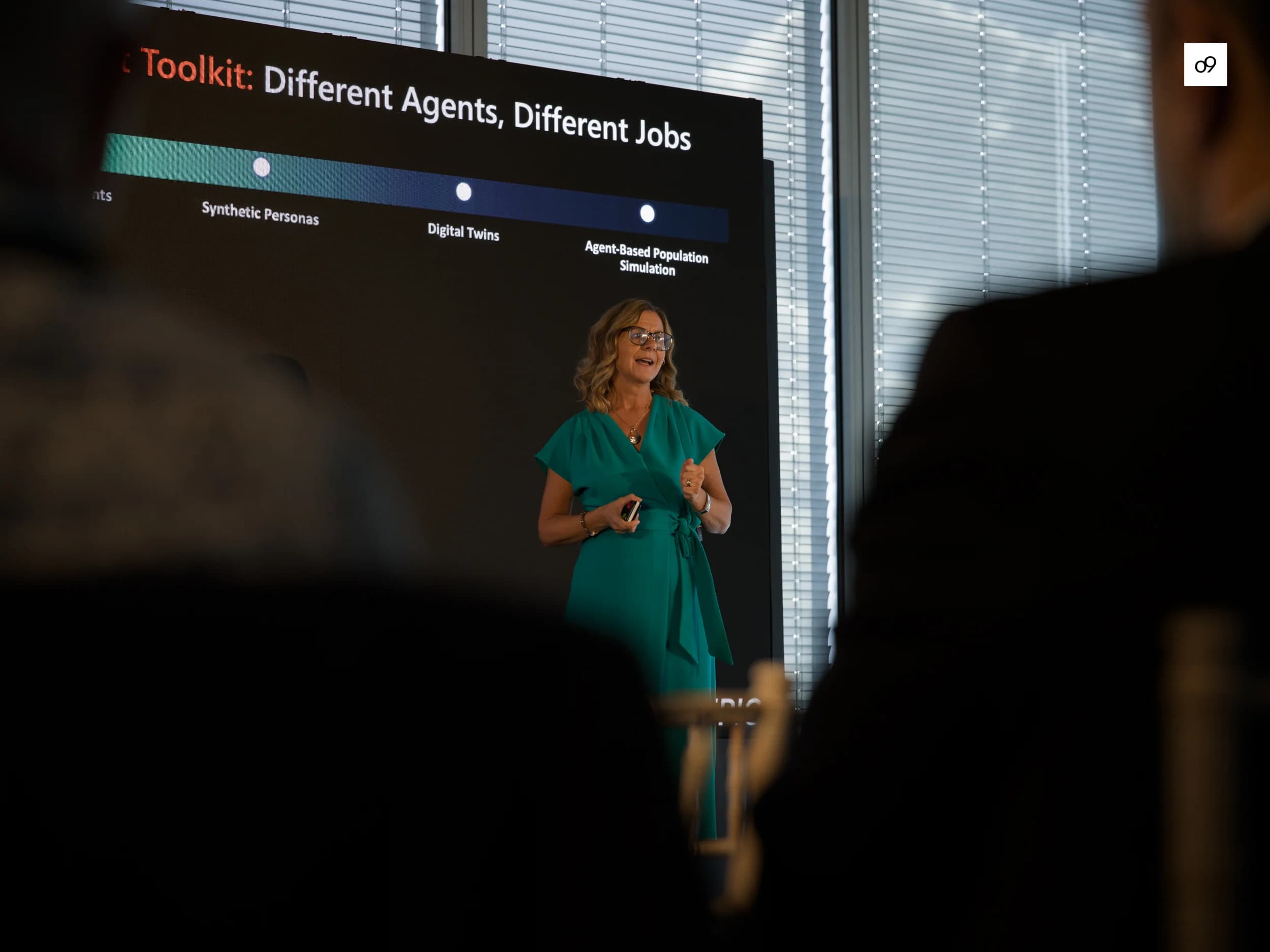
If Magnus showed that AI effectiveness depends on where it is deployed, Louise showed that it also depends on what question it is being asked to answer.
AI can dramatically accelerate research, allowing companies to test far more ideas than traditional research budgets or timelines would permit.
But synthetic respondents behave differently from people in ways that matter.
Louise cited research comparing digital twins with the people on whom they were based: across 19 tests, the best correlation reached only 0.2, while in 94% of cases the digital twins agreed with one another more than the humans did.
That tendency to converge toward the average becomes a problem when the purpose of research is to uncover different segments, unexpected behaviors, or genuine willingness to pay.
The practical model Louise highlighted was therefore additive rather than substitutive. Synthetic personas can answer lower-risk questions quickly, while human research remains important when the decision is novel or the consequences of being wrong are high.
“Match the cost of the method to the price of being wrong,” she said.
About the authors

The Editorial Team, o9
A multidisciplinary collective of editors, strategists, technologists, and former executives with experience across Fortune 500 companies and top consulting firms. Grounded in o9’s mission to help enterprises make faster, better decisions through the power of AI-driven planning and execution software, the team shares clear, practical insights on digital transformation, supply chain, and enterprise planning to support business leaders in navigating complexity and driving change.