authors

Chakri Gottemukkala
Co-Founder and CEO
February 11, 2026
7 read min
Every year, Davos brings together leaders who are shaping the global economy. And every year, there is a dominant theme. This year, it wasn’t hard to spot.
Volatility, uncertainty, complexity, and ambiguity were no longer treated as temporary conditions. They were accepted as permanent features of the global business environment. At the same time, artificial intelligence dominated almost every conversation. The promise of AI is enormous. Still, across discussions, many leaders came back to the same concern: despite significant investment, translating AI advances into consistent enterprise value remains difficult.
That tension defined Davos this year. There was broad recognition that the world is becoming more volatile, not less. At the same time, there was an equally clear realization that existing approaches to decision-making and execution are struggling to keep up, even with increasingly powerful technologies.
The consistent struggle
Across conversations with executives, there was a common pattern. Pilot programs showed promise. Proofs of concept looked impressive. Generative AI demonstrated remarkable capabilities. But when it came to driving sustained improvements in growth, margins, cash flow, and resilience, results were uneven.
What stood out was that this gap was rarely framed as a technology limitation. Instead, leaders pointed to how decisions are made and executed inside large enterprises. As organizations grow more complex, intelligence alone does not create value. Value is created when change is detected early, understood in context, translated into coherent decisions across functions, and executed quickly at scale.
Truthfully, most operating models today were not designed for that reality.
Why VUCA exposes operating model limits first
Supply chains, more than any other function, make this visible.
Volatility shows up there first, be it a geopolitical event that disrupts sourcing, a demand shift that creates inventory risk, or a cost change that is felt through pricing, margins, and service levels. Each situation generates dozens, sometimes hundreds, of follow-up questions. What is the impact? Where does it show up? What are the trade-offs? What should we do now, not next quarter?
In many organizations, answering those questions still takes weeks. Data lives in different systems. Planning happens in functional silos. Decisions are escalated through layers of management. By the time action is taken, the situation has often changed.
To be very clear, this is not a failure of people. On the contrary, in most of the companies I spoke with at Davos, the talent is exceptional. The failure lies in an operating model that relies too heavily on tribal knowledge, manual coordination, and retrospective analysis in a world that now demands real-time, forward-looking decision-making.
The AI paradox: more intelligence, same outcomes
This is where the AI paradox becomes very apparent.
Adding AI to a fragmented operating model often amplifies existing problems rather than solving them. Models generate insights faster, but decisions still move slowly. Predictions improve, but execution remains disconnected. Automation is applied in isolated pockets, without a shared understanding of enterprise priorities or constraints.
In essence, companies have more insight than ever, but are not acting any faster.
What makes this gap so consequential is its scale. For a $10 billion manufacturing enterprise operating a traditional model, analysis typically shows $200–250 million in annual EBITDA leakage and $300–400 million in free cash flow tied up in excess inventory.
This, to me, points to a deeper issue: enterprises do not only need smarter tools. In fact, they need a different way of organizing how decisions are made, connected, and executed across the business.
The missing conversation
What I believe is largely missing from current dialogue is a serious discussion about operating models.
The focus remains on technology adoption: which AI, which platforms, which vendors. Far less attention is paid to the underlying system that turns decisions into outcomes, but history suggests that this is where lasting advantage is created.
When we look at companies that have consistently outperformed through periods of disruption, a pattern appears. They are not simply early adopters of technology. They operate differently. Their decision-making is more integrated. Their execution is faster. Their learning cycles are shorter.
These are operating model characteristics, not software features.
From open-loop to closed-loop enterprises
Most traditional operating models are open-loop. Plans are created, execution follows, and performance is reviewed later. Learning is slow, often informal, and rarely institutionalized.
In contrast, digital-first operating models behave as closed-loop systems. They continuously compare plans with outcomes, attribute results to decisions, learn from deviations, and adjust behavior in near real time. This is how volatility becomes manageable rather than overwhelming.
At Davos, the companies commanding higher valuations were not necessarily those with the boldest strategies. They were the ones demonstrating this kind of operating discipline and adaptability. Investors recognize that in a VUCA world, the ability to convert strategy into performance consistently is a competitive advantage in its own right.
Why autonomy without structure is risky
Another important theme emerged in conversations around agentic AI. But first, I want to briefly clarify that by ‘autonomy’, I don’t mean replacing human judgment, but rather reducing unnecessary latency by automating routine decisions while keeping people free and accountable for higher-risk, higher-impact choices.
There is understandable excitement about automation and autonomous decision-making. But many executives also expressed concern about trust, accountability, and governance. Who is responsible when an automated decision goes wrong? How do you explain outcomes to regulators, boards, or customers?
These are valid questions. Autonomy without structure introduces risk, but autonomy built into a well-defined operating model creates leverage.
This distinction matters. Enterprises need systems that know not only how to act, but why they are acting, within which constraints, and with what trade-offs. That needs a structured decision context, as well as powerful models.
APEX as an operating model response
These reflections from Davos reinforce a belief I have held for years: the next phase of enterprise transformation will be driven less by individual technologies and more by operating model innovation.
That is the thinking behind APEX.
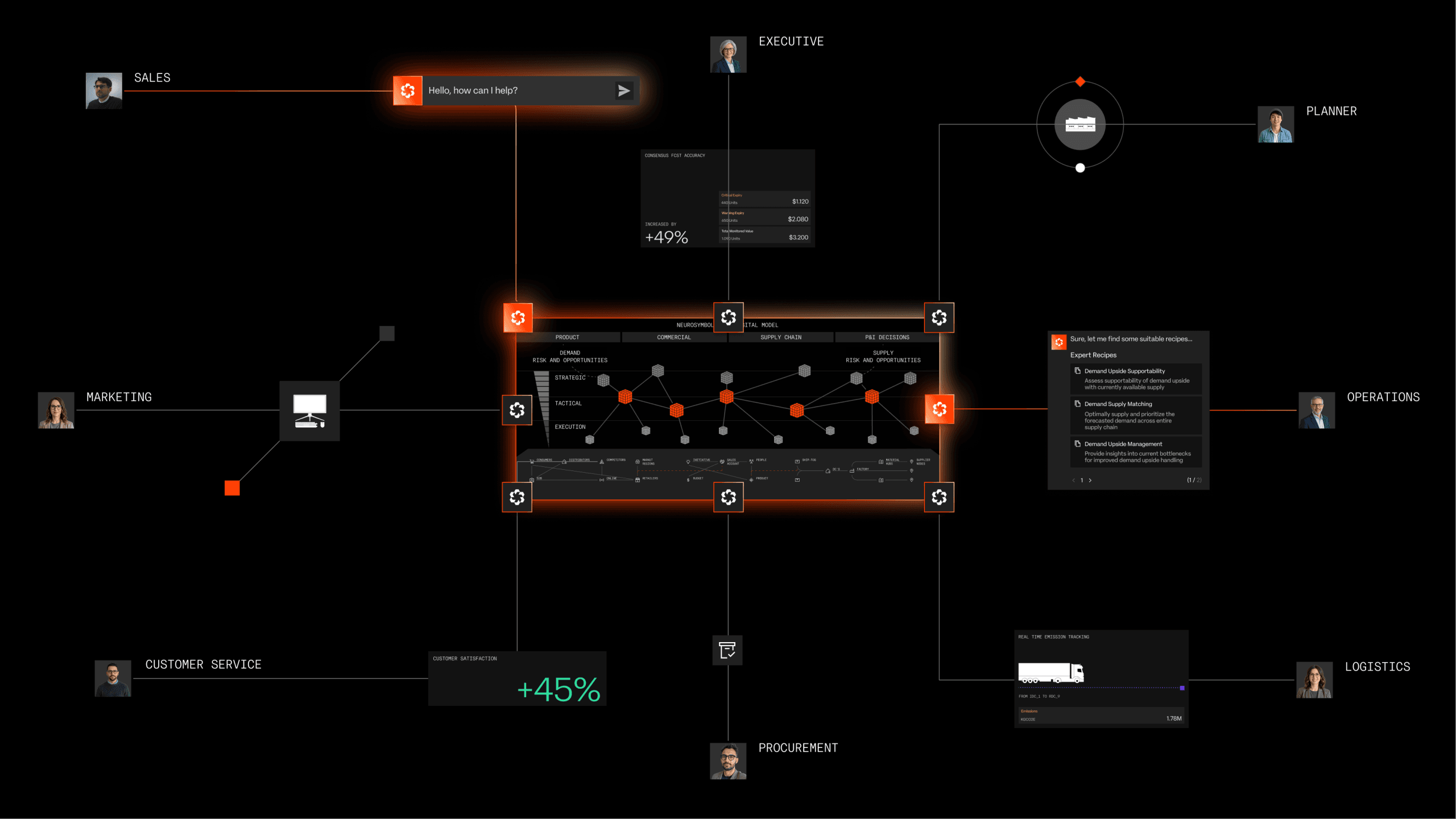
What matters in practice is how that operating model is implemented. o9’s implementation of APEX is grounded in a breakthrough neuro-symbolic, agentic AI approach, built on more than 15 years of investment in enterprise knowledge graphs and domain-intelligent forecasting and optimization capabilities. This foundation allows AI to be applied directly to the hardest value creation problems in enterprises: connected decision-making across planning and execution, with trust, governance, and actionability at scale.
APEX is not a product. It is an operating model designed for a world where volatility is constant and decision-making is the primary source of value creation. It brings together agile detection, adaptive learning, and autonomous execution into a single system that spans planning and execution horizons. Hence, APEX.
Technology plays a critical role, of course. Platforms like the o9 Digital Brain, enterprise knowledge graphs, and neuro-symbolic agentic AI make this operating model possible at scale. But the technology is the enabler, not the destination.
The destination is an enterprise that can sense change early, understand it deeply, decide coherently, and act quickly, while continuously learning from the results.
What should leaders take away from Davos?
If there is one takeaway from Davos this year, it is this: the challenge ahead is not choosing the right AI. It is building the right operating model.
Leaders who focus only on AI adoption risk repeating the same patterns with more sophisticated tools. Leaders who rethink how decisions are made, connected, and executed will be better positioned to turn VUCA into value. That is not an easy journey. It requires investment, discipline, and a willingness to rethink long-standing assumptions. But it is increasingly clear that this is where sustainable advantage will come from.
Davos made one thing unmistakable. The world is not getting simpler, and enterprises that want to thrive will need operating models built for complexity, speed, and learning. AI is central to that future, but only when it is grounded in enterprise reality. Turning intelligence into action at scale requires more than LLMs alone; it necessitates domain-intelligent data, algorithms, and decision logic embedded into the operating model itself.